













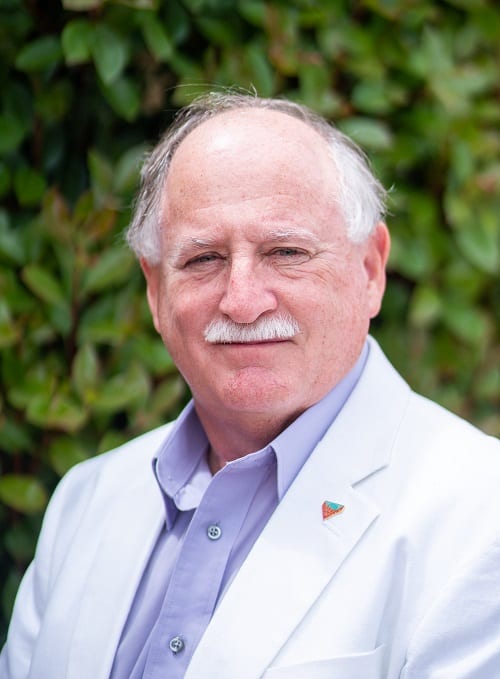
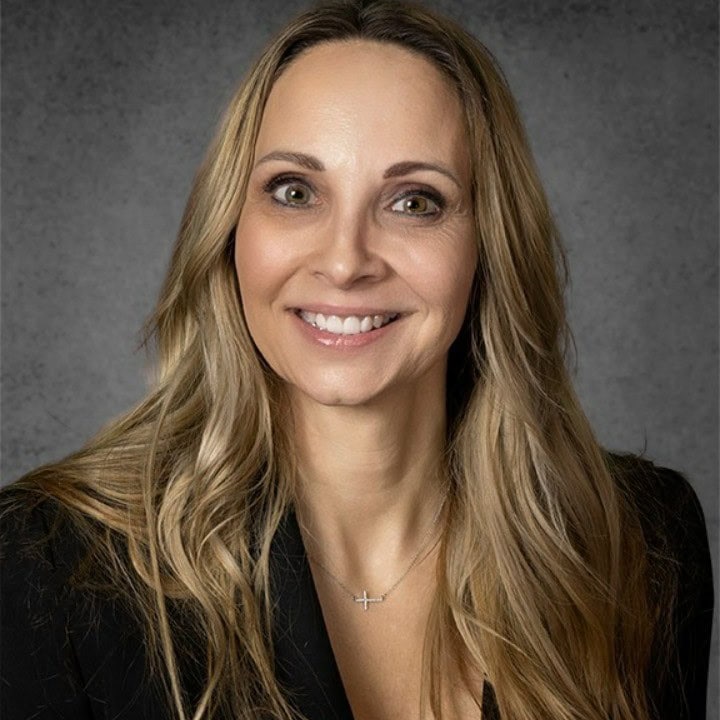
Sedona Mayor Scott Jablow has been accused by City Manager Anette Spickard of being manipulative in the city’s process of installing Flock Safety automatic license plate readers, leading to her being “the fall guy for the public outcry,” in the city’s installation of the cameras that occurred without public outreach and no majority consensus direction from City Council to the Sedona Police Department.
“I would rather not make it public because it’s police related,” Jablow emailed to Spickard about the ALPRs on Wednesday, Nov. 13, after she suggested to the mayor that they “touch on the project” during the council’s December council priorities session.
During the meeting, the topic was given brief attention with Sedona Police Department Chief Stephanie Foley having a PowerPoint slide with “body worn cameras/[ALPR] Integration,” but no broader direction from the council as a body has ever been given.
In the memo, Spickard included a summary letter, pages of emails between her and Jablow discussing the progress on the installation of ALPRs and a two-page statement from Foley.

‘Pursue This Unilaterally’
Former City Manager Karen Osburn, who retired in April 2024, admonished Jablow on March 28, 2024, after he requested she or city staff pursue grant funding for ALPRs. “You continue to pursue this unilaterally without ever having discussed it with council and after I have repeatedly told you that [SPD] is in no position right now to conduct the research necessary to explore how this technology might integrate into their systems, let alone acquire and implement,” Osburn emailed Jablow, cc’ing Vice Mayor Holli Ploog.
Osburn added urgent projects, such as body-worn cameras, take precedence.
“I suggested it could be brought up at this year’s budget work session for direction to pursue in FY26 should council have interest,” Osburn wrote. “Yet you continue to send me information and ask me about it continually as if I should be pursuing this now simply because you’ve heard about it and want it in Sedona. You know that’s not how the process works.”
‘Not Make it Public’
When asked by the NEWS why he wrote to Spickard, “I would rather not make it public” — considering Obsburn’s admonishment and that Spickard appeared to be in exclusive communication with him about ALPR installation instead of all of council — Jablow had no direct answer.
“I don’t know how to answer that, and I don’t want to skirt the issue, so I don’t know how to answer that question,” Jablow said to the NEWS on Monday, April 25. “LPRS should have gone before the council. But it did actually go. It was brought up in the [April 18, 2024] budget session, as [Foley] said she was brought back the next day to discuss LPRs, and there was no issue at all from council.”
Foley wrote in a Aug. 14, 2025, memo she was told the day of that 2024 budget meeting Jablow was requesting her to come to council to discuss ALPRs.
“I was advised by either Osburn or Spickard that Jablow wanted it to be said publicly during the meeting, something close to the effect; ‘I should have presented LPRs yesterday but didn’t,’” Foley wrote; after Spickard became city manager, Osburn remained a temporary consultant. “She stated she wasn’t going to say I failed to discuss this because I wasn’t informed, I was supposed to and this was the first time I heard about it.”
‘On Council’s Radar’
As Foley started her brief discussion about ALPRs on April 18, 2024, Jablow said. “I was under the impression you’re going to touch on something yesterday related to LPRs.”
No direction was actually given by the council as a whole about ALPRs during the April 2024 budget meeting and Jablow framed Foley’s presentation as “just putting this on council’s radar.”
“I never gave any indication to anyone to install [the ALPRs],” Jablow said to the NEWS. “I realize that that is beyond my scope. I was just wanting it to be researched.”
Foley cited her April 2024 presentation as when ALPRs were prioritized — and that it was prioritized by Jablow during that meeting.
Under Title 2 of Sedona City Code, the city manager appoints the SPD chief, who conducts the department’s business. Council gives direction to the city manager through a majority of its members at public meetings. Individual council members do not give direction to the chief nor any officer or staffer.
The NEWS asked Foley if she had concerns about direction on ALPRs coming only from Jablow, how she came to the conclusion that direction was given in April 2024 considering Jablow’s framing of ‘just to put it on council’s radar.’”
“As you know I can’t comment on any of my interactions with [Jablow],” Foley responded to the NEWS, citing her recent harassment complaint filed against Jablow on July 27. “Please refer to [Spickard’s] memorandum for details regarding this project.”
“My understanding was that it was more of a prioritization from [Jablow] that then was discussed with prior city manager Osburn, and then to [Spickard], and the direction was given to me to move this forward based on her ability to sign off,” Foley said to council on Aug. 13, 2025. Foley’s harassment compliant, filed before this meeting, cites Osburn’s email saying the mayor was acting “unilaterally.”
“It just wasn’t going to be prioritized in last year’s budget, it was going to be in this year’s budget and discussed,” Foley wrote.
“The reason I didn’t present [ALPRs] for this year’s budget was based on Jablow’s direction to [Spickard] mid-year to obtain LPRs,” Foley wrote in her Aug. 14, 2025, memo.
SPD appears to have been planning the trial use of ALPRs before Foley’s stated April 2024 direction from Jablow. Also, prior to council’s direction to suspend the ALPRs, Foley was advocating during the August work session to have a six-month pilot program of the cameras.
In September 2024, SPD did a “temporary/demo” ALPR near the Y roundabout. “We are also looking into Flock LPRs,” Foley emailed Spickard on Sept. 23, 2024.
‘They Showed Up One Day’
In her memo, Spickard said from April to December 2024, Jablow repeatedly asked about the status of the ALPRs at nearly every one of their one-on-one meetings.
“[Jablow] made it clear from our first meeting that he would be pushing [Foley] and me on these projects because it was important for [SPD] to have the same tools as neighboring agencies,” Spickard wrote.
On Jan. 13, 2025, Jablow wrote to Spickard he would like to know by their meeting on Tuesday if the ALPRs would be at the city’s entry points. Noting SPD Acting Deputy Chief Chris Dowell — previously interim Cottonwood police chief — “was a part of the Cottonwood LPR program, I would expect nothing less then [sic] their program.”
On Jan. 14, 2025, Spickard informed Jablow she is going “go ahead and sign off” on the purchase of six sets of ALPR cameras within her spending authority to do so, which she confirmed after being questioned by Jablow, to which he responded via email, “this is very exciting, thank you.”
Spickard’s memo she wrote was keeping Jablow up to date on ALPRs, “and [I] did not know that [Jablow] was not” sharing that information of the status of the ALPRs over the last year with his fellow council members. “Instead, I recently came to learn from [Ploog] that [Jablow] claims to not remember any of this.”
On June 4, 2025, Dowell wrote a memo to Foley and Spickard titled “City Councils LPR Briefing” announcing internally SPD had installed ALPRs.
“This was a capital project approved for the FY 25 budget,” Spickard wrote when forwarding the brief to Jablow and council on June 9.
“I never gave any direction to anyone to install them, that’s a question I have,” Jablow said to the NEWS . “I never had a discussion with anyone who said that they were going to have them installed, because I don’t know who that direction came from. I don’t recall ever having that discussion with anybody. They showed up one day. The only way I found that they were showing up, I saw on Facebook that there was one installed. I knew they were going to be installed, but I didn’t know that they were actually being installed.”
Find ‘Positive News Stories’
On June 20. The NEWS published its first story discussing the installation of Sedona’s ALPR network [“Sedona to residents: We’re tracking you”] and an editorial [“City of Sedona’s spy cameras are a threat to our privacy and rights”].
On June 21, Jablow asked Dowell, who was acting chief while Foley was out of town, to “find some positive news stories [about ALPRs] to help support the public narrative,” in response to public outcry from the NEWS story. Dowell said he found positive articles but did not want to send them to Jablow without informing senior city staff first. In her harassment complaint against Jablow, Foley cites this as an example of Jablow seeking an end run around her and undermining SPD’s chain of command.
Spickard Made ‘Fall Guy’
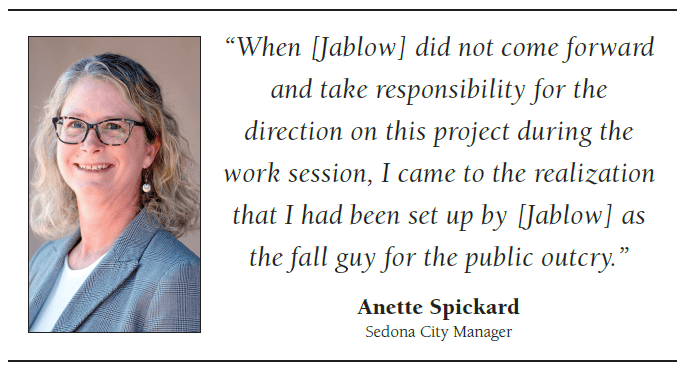
“During our regular one-on-one [meeting] the morning of the Aug. 13 work session I suggested to [Jablow] he step forward as the champion of the [ALPR] project and he stated he would deflect,” Spickard wrote. “When [Jablow] did not come forward and take responsibility for the direction on this project during the work session, I came to the realization that I had been set up by [Jablow] as the fall guy for the public outcry, which is exactly what happened.”
Council held its work session on Aug. 13 about the Flock cameras in response to the public outcry and the lack of outreach. Through a 5-1 council consensus, with Jablow dissenting, council directed staff to indefinitely pause the ALPR program, create a timeline of events leading up to their installation, to create a citizen work group and for staff to return to council with a proposal for a ALPR pilot program.
During the meeting, when Spickard discussed why she signed off on the purchase of ALPRs, Jablow remained silent.
“The silence of [Jablow] at the work session resulted in the public assuming I acted in bad faith and resulted in my staff thinking that I had made a huge mistake,” Spickard wrote.
“That’s again, my fault. I should have stepped in more,” Jablow said, when asked about his silence by the NEWS. “I thought I had, and I obviously had not. I did comment about … showing my interest in [ALPRs]. But as far as the purchase order [Spickard] signed it, but that’s within her [ability] to do. I certainly never gave her any indication to sign it, because I would have gone through council first. But if I gave her any signals that, if she misinterpreted my intent, it’s on me, because I was obviously not clear in what I was sharing with her, so it really turned out to be a mess.”
“This has damaged my credibility and professional reputation,” Spickard wrote. “For this reason, I do not think it is a good idea for me to appoint people to a citizen working group on the LPR topic. The public won’t trust anything that comes from a group I hand select as it has now become a political issue, not a technical issue. The council should appoint the group and give clear direction on what they want [it] to come up with.”
‘A Political Issue’
“I worked with [Foley] to implement a valid, legal policing tool as part of a larger technology upgrade that was generally known to the council,” Spickard wrote. “I did not violate any city policies. I regret being manipulated by the mayor and not recognizing that was happening. As they say, hindsight is 20/20. It wouldn’t happen again.”
“I did comment [during the work session] about wanting the interest or showing my interest in the project,” Jablow said to the NEWS. “But as far as the purchase order, [Spickard] signed it.”
During the Tuesday, Aug. 26, City Council approved a $1.2 million contract with Axon Enterprise, Inc., for the purchase of tasers, patrol and body-worn cameras. Jablow gave a public apology about decorum.
“I want to step out and make a personal apology to Annette, the public and this council, by the way I ran the [Flock] meeting on Aug. 13,” Jablow said. “I feel I did not calm the public the way I should have from attacking staff, and I feel I let everybody down, especially Anette and others, in several ways, and I promise my best to do better to ensure our meetings run more smoothly and move forward without personal attacks.”
“[Spickard’s] memo raises a number of concerns, and a majority of council has asked for a [executive] session to review the memo and take possible action,” Councilman Brian Fultz said to the NEWS on Aug. 26 and declined to elaborate on what that action could entail.
Councilman Derek Pfaff said he didn’t think Jablow was intentionally circumventing the council.
“Ultimately, it didn’t go the way I would have liked to have seen it gone, … I think just with the changeover and city manager, we went from [Osburn] to [Spickard] in the middle of all this, I think [the ALPRs] slipped through the crack,” Pfaff said to the NEWS.
“I was disappointed in myself for having [Spickard] feel the way she felt in that memo,” Jablow said to the NEWS. “I feel that she’s justified by a lot of the concerns.”
The Sedona City Council is scheduled to have the citizen ALPR work group as an agenda item during its meeting Tuesday, Sept. 9.