















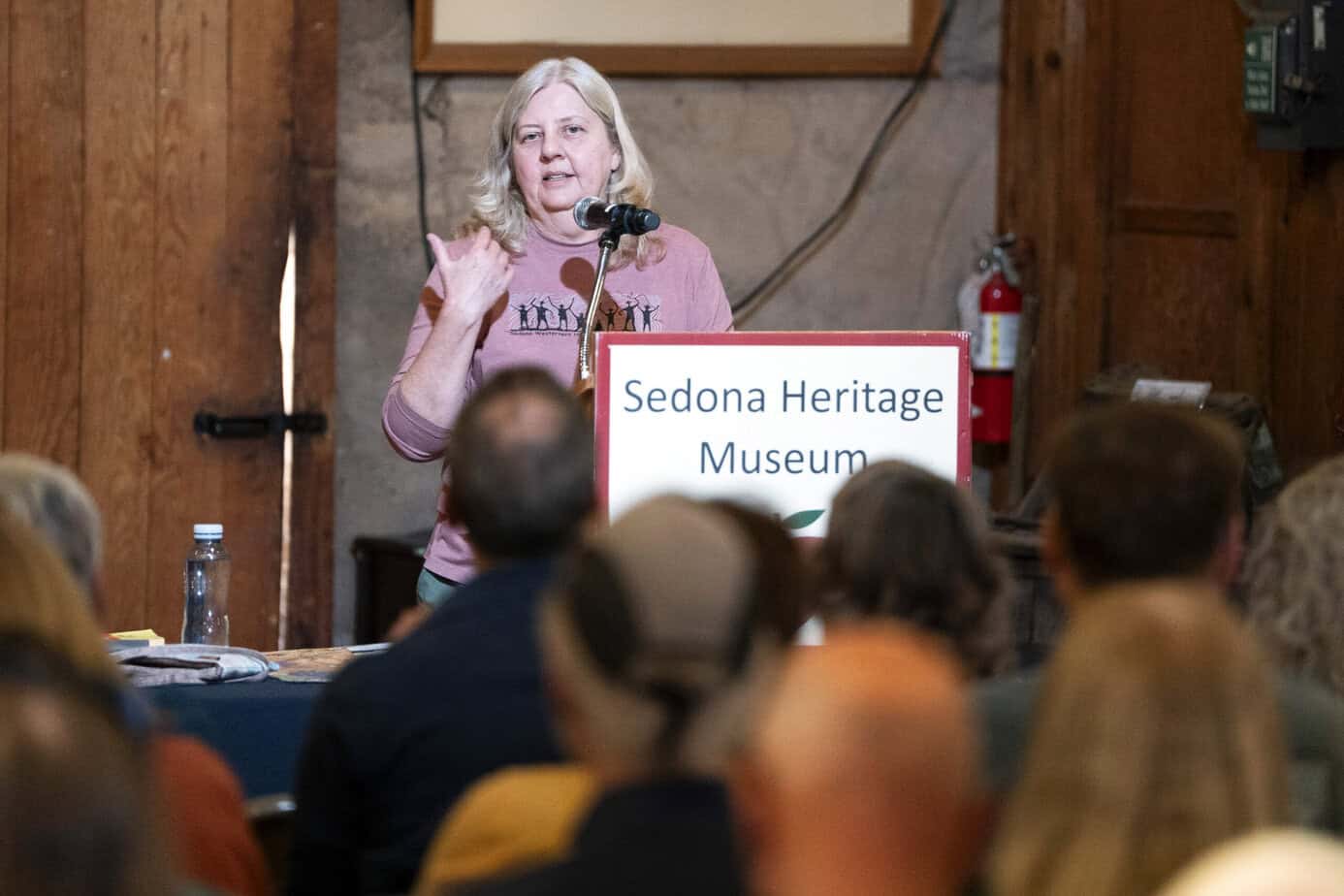
On April 9, Sara Stiffler spread maps across a table in the Sedona Heritage Museum’s apple shed and took a room full of hikers on a 150-year walk through the Red Rock Ranger District — without any of the 40 attendees leaving their seat.
Stiffler, a Sedona Westerners member with four years and more than 1,000 trail miles behind her, served two years as the club’s Roundup Boss and wrote 17 columns for the NEWS. Writing those columns — which first appeared weekly in the 1970s — sparked her curiosity behind the names.
She opened with Jim Thompson, the first settler to arrive in the area and the namesake of the trail with his name. In 1882, Thompson claimed land in what is now known as Indian Gardens in Oak Creek Canyon under the Homestead Act of 1862. He received his land patent in 1876 after meeting the law’s requirements to live on and improve the parcel.
“Thompson married Maggie James in 1880,” she said. “Her family had settled near the present-day Arabella Sedona hotel. There wasn’t a road to connect the two families, so Jim built a path south along the creek. But the canyon, and occasional floods, made the original roadway impractical for them. With the help of his sons, he built a new road that rose above the creek near Wilson canyon and Midgley Bridge.”
Originally wide enough for wagons and later cars, the route has since narrowed but it survives today south of Steamboat Rock as the Jim Thompson Trail.
North of the Thompson Trail is the A.B. Young Trail, which is a 5-mile route with 2,014 feet of elevation gain and 33 switchbacks packed into a mere 1.6 miles. The route was likely first used as a hunting path by the pre-Columbian Sinagua around 1,400 years ago, Stiffler said. It was later used by Charles Smith Howard, better known as Bear Howard, to haul supplies from Flagstaff down to the cabin he built near West Fork in 1880.
“Named after the 1930s Civilian Conservation Corps Foreman, A.B. Young, who with his team restored the original trail, built the USFS Pumphouse near Tlaquepaque, the Ranger Station Barn on Brewer Road, and several other trails and recreation sites in the area,” Stiffler said.
The next name on Stiffler’s map belonged to Richard Wilson.
“In June of 1885, Thompson left Wilson in charge of protecting his wife and children at their cabin in present day Uptown,” she said. “Wilson agreed to check in on the family nightly but decided to scope out some bear tracks first. Wilson never made it back to check on Maggie and her family. On the ninth day, she informed some friends who were fishing in the canyon about Wilson’s disappearance.”
His mauled body was found face down in a puddle near present-day Midgley Bridge. The Wilson Canyon Trail and Wilson Mountain’s south trailhead stand near that spot today.
“Fun fact,” Stiffler said. “Bear Mountain was not named for either of these early settlers, but instead for the Bear-like shape of the mountain itself.”
“Were it not for the U.S. Postal Service, the town of Sedona would have been named Schnebly Crossing after Theodore Carlton ‘T.C.’ Schnebly,” Stiffler said. “Schnebly and his wife built a two-story inn near Tlaquepaque in 1901. T.C. became the town’s first postmaster. He applied to have the town named after himself, but because the name was too long for the cancellation stamp it was rejected. At his brother’s suggestion, T.C. decided to name the town after his wife, Sedona. The name was accepted in 1902.”
“In 1965, the need for trail signs became apparent as an increasing number of hikers discovered Sedona trails,” Stiffler said. The Westerners, with the approval of the U.S. Forest Service, marked 10 trails with wooden signs attached to trees. The signs were simple, with only a white arrow indicating where the trail was. The Westerners’ brand — an S/W — was on the right side of the sign. The first trail marked was through Broken Arrow to the Devil’s Dining Room. But soon, these wooden signs became collector’s items and disappeared as quickly as they could be replaced.
As the Westerners worked to mark the trails, the club realized the human history behind them was also at risk of disappearing. Community Library Sedona asked the club to preserve that history, and in 1968 the Westerners published a pamphlet entitled “Those Early Days,” drawn from oral histories gathered from long-time residents and descendants of Sedona’s European-American settlers.
“The Sedona Westerners is still active after 65 years, and our 400 plus members are passionate about protecting and maintaining Sedona’s vast trail systems,” Stiffler said. “We have hikes for all skill levels, and scheduled hikes take place five days each week during the hiking season, September through May. The group is a great way to learn more about the trails and make friends along the way.”
For more information visit sedonawesterners.org. Stiffler also recommended the 2006 book, “Sedona Place & Names,” by Jean Matthews Kindig. The Sedona Heritage Museum’s current exhibit, “Hiking Sedona’s History,” also explores the stories behind more than 20 of Sedona’s most iconic trails.