











Like North Korea, the People’s Republic of China or Russia, Sedona is goose-stepping its way into creating a citywide surveillance system to spy on law-abiding citizens with the installation of a dozen automated license plate readers around the city.
The city of Sedona will use these ALPRs to track where residents and visitors go, with whom they associate and where they drive under the guise of public security, much as the similar Ministry of Public Security does in Beijing.
The city installed the cameras without any public discussion other than brief comments made during budget meetings this spring and then installed the cameras without any warning or public notice.
There were no public meetings.
No mailers sent out to residents.
No public debates.
No notices sent to or published in the NEWS.
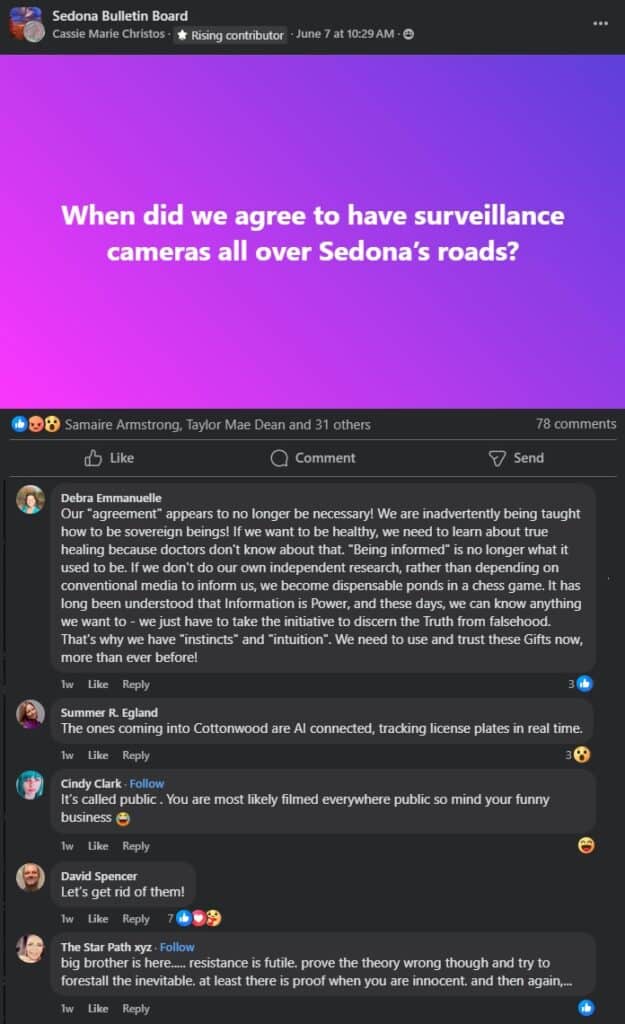
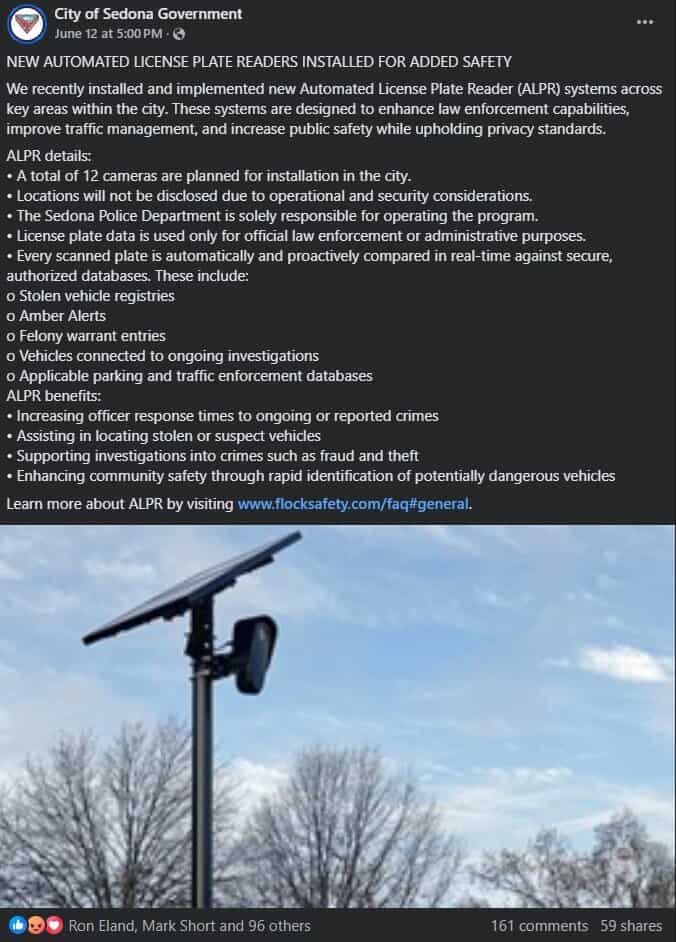
Instead, the city only made a single Facebook post some two weeks later after residents raised hell on social media, screaming about the Orwellian intrusion into our privacy and movement on city streets.
Surely if our city is so rife with crime that we must be renamed West Pyongyang, Sedona City Council and city staff would have held dozens of public meetings and town halls to discuss the urgent need for ALPRs to hold back the crime tidal wave swamping our city.
We’ve received no letters from residents nor statements from council members clamoring for such cameras, so why are they even necessary? Why are we spending tax dollars and committing to further annual spending to fix a problem that doesn’t exist?
A free and open society is predicated on the foundation that the government should not invade individuals’ privacy and collect information about their innocent activities without individualized suspicion of criminal behavior. ALPRs are a direct threat to that foundation.
They are pervasive mass surveillance that indiscriminately captures and stores data on hundreds or thousands of vehicles every minute; creates vast databases of motorists’ locations, regardless of whether they are criminal suspects; and pools data into regional systems so governments can monitor their citizens without warrants or due process. This data can disclose visits to friends, lovers, doctors’ offices, political gatherings, protests, places of worship, abortion clinics, substance abuse support groups or other sensitive locations, painting an intimate portrait of an individual’s private life, associations and habits — all on the speculative premise that a person might commit a crime in the future. Sci-fi author Philip K. Dick coined a term for this in 1956: “Pre-Crime.”
This “just in case” mentality of data retention transforms law enforcement from performing reactive, suspicion- based investigation to a mass surveillance operation akin to a totalitarian secret police force, blurring the lines between legitimate policing and indiscriminate monitoring.
The city claims that the cameras are lawful and no threat to privacy because they are out in the open, yet the Facebook post contradicts this false narrative by stating that the camera “locations will not be disclosed due to operational and security considerations.”
So the city claims law-abiding residents have nothing to fear, but openly and blatantly refuses to tell these same law-abiding residents exactly where its Big Brother cameras are spying on them.
If this false narrative and distrustful condescension is how this government defends its secret surveillance of private citizens, why are residents supposed to naively trust that same two-faced, misleading government when it assures them that monitoring the movements of private citizens and retaining that data is nothing to worry about?
It’s no coincidence that one of the first plate readers the city has installed is located at the intersection of Sanborn Drive and Rodeo Drive — facing west — to better track residents who may take the quieter back roads from Bashas’ or Safeway down Sanborn to Thunder Mountain Road and into the Harmony Hills neighborhood — which has the largest concentration of Hispanic and Spanish-speaking residents in Sedona city limits.
ALPR surveillance will exert a chilling effect on citizens’ lawful activities and the exercise of fundamental rights when individuals are aware that their movements are being constantly monitored and recorded. This constant monitoring also has a detrimental effect on public trust in police and government, actually making law enforcement less effective.
“Don’t break the law and you don’t need to worry,” ALPR proponents claim. But that’s not accurate. ALPRs have major technical limitations and inherent error rates, with even the best systems only claiming 90% accuracy.
That means 10% of license plates may be misread. Some studies have found misread rates as high as 35% to 37% for “hits” by both fixed and mobile ALPR units. So if your plate is misread by an ALPR as a stolen car, owned by a wanted felon or as a stolen plate, there’s a 10% to 37% chance of wrongful stops by police of law-abiding citizens. Not only do mistaken readings pre-assume guilt, they are also a colossal waste of police time spent chasing down the wrong vehicle simply because an ALPR can’t differentiate between a “0” and an “O” like a human officer in traffic can do at a glance.
This technical fallibility poses a direct threat to both public safety and individual liberty as innocent, law-abiding citizens may be subjected to police intervention based on erroneous data.
Proponents of ALPRs, like camera manufacturers, “security” consultants and “law and order” politicians seduced by the allure of technological advancement, claim ALPRs reduce crime. However, empirical evidence on ALPRs shows that their effects are negligible at best, apart from vehicle thefts and property crime in very specific contexts. Vehicle thefts are already statistically rare in Sedona.
The existing data shows that ALPRs have almost no effect whatsoever on preventing violent crime, which is better done through other law enforcement actions. ALPRs provide only “perceived” increases in efficiency, with no data to back up that claim.
When pressed for that hard data for our story, Sedona Communications Director Lauren Browne, in the city’s Ministry of Truth, evaded answering or providing any, other than anecdotal “shared success stories.”
So Sedona’s new spying operation is based solely on the logic of “my cousin’s sister’s ex-roommate’s podiatrist said … ”?
“Mission creep” is inevitable, and it’s certain that the cameras will be used for tracking other pre-crimes offensive to the state. “First they came for the communists, and I did not speak out because I was not a communist …” Pastor Martin Niemöller’s poem begins about the creeping oppression in 1930s Germany.
Proponents also claim that public spaces are already subject to observation by cameras or that there is no expectation of privacy in public. While both are true, public spaces are areas of relative anonymity, where individuals can move freely without expecting constant governmental monitoring. Government cameras turn these public spaces into zones of perpetual, recorded surveillance from which there is no escape. Being captured on camera or video by a private security camera or on a smartphone by other citizens doesn’t have the same weight as state intrusion into individuals’ private lives.
In less than a second, a single ALPR scan provides the observer with the full legal name, home address, age and driving history of the driver, and, by cross-referencing with state or national databases, can also provide the criminal history, martial status and other private data to whomever has access to that ALPR’s database.
This turns every driver into a potential future criminal suspect whose movements are logged for retrospective analysis, shifting the burden from law enforcement needing a reason or warrant to investigate to citizens being under continuous, passive observation without their consent.
Civil libertarians rightly argue that such extensive collection and retention of ALPR data aggregated over time constitutes a “search” under the Fourth Amendment, which should require a judge’s warrant.
In Carpenter v. United States, the U.S. Supreme Court ruled in 2018 that accessing just seven days of historical “cell-site location information” was a Fourth Amendment search because it provided access to information that would be “otherwise unknowable” without the technology and revealed an “intimate window into a person’s life.”
The city of Sedona plans to retain the same location information for 30 days.
In Commonwealth of Massachusetts v. McCarthy, the Massachusetts Supreme Judicial Court ruled in 2020 that “with enough cameras in enough locations, the historic location data from an ALPR system … would invade a reasonable expectation of privacy and would constitute a search for constitutional purposes.”
A federal judge in Norfolk, Va., also ruled in February that the city’s 172 ALPRs violated the Fourth Amendment, writing that it is a breach of society’s objective expectations of privacy to “secretly monitor and catalog an individual’s every movement over a long period.”
Unfortunately, Arizona has no laws permitting, prohibiting or governing ALPRs.
Flock Safety — a third-party, for-profit “privatization of surveillance” company — will be collecting and managing ALPR data. Flock’s goal is profit margins for shareholders, not the public good or public safety. As a private corporation, Flock is not bound by constitutional safeguards and protections, like the Fourth Amendment, as government bodies are. This diminishes public transparency, making it difficult for the public to know who holds their data, for how long it is retained and with whom it is shared or to whom it is sold.
While Sedona police may only hold the data for 30 days, Flock can and may retain the data far longer and sell that data to third parties, either specifically or in the aggregate. A data breach would be catastrophic for millions of Americans, not just Sedona residents. Because Flock is a private corporation, it is not subject to public records laws or government oversight, and any nefarious actions will only come to light via lawsuit or court order years or decades from now.
The Sedona City Council claims it is a transparent public body — why then did it withhold public notice of these cameras until the outcry after their installation became deafening? Why no public meetings or notice? Why install them without public debate or proving adequate legal oversight?
The lack of transparency and a willful disregard for civil liberties fundamentally undermines the social contract between citizens, government and law enforcement.
Should any resident believe their council members are being honest when they appear to have willfully hidden this intrusion, hoping no one would ask questions?
Ask questions.
Demand answers.