













It would seem that Yavapai College District Governing Board District 2 Representative Deb McCasland’s days as board chairwoman may be numbered.
College-watchers are overjoyed that her dictatorial grip on power — silencing dissent from her colleagues, keeping board members’ issues off the agenda and gagging college staff from expressing their concerns to the press or their own elected officials — could be coming to an end.
Representatives Bill Kiel [District 1], Toby Payne [3] and Steve Bracety [5] voted 3-1 on March 31 to hold a new board election for chair and secretary on Tuesday, April 21.
Representative Patrick Kuykendall [District 4] had to leave before the vote, but his vote would not have changed the outcome.
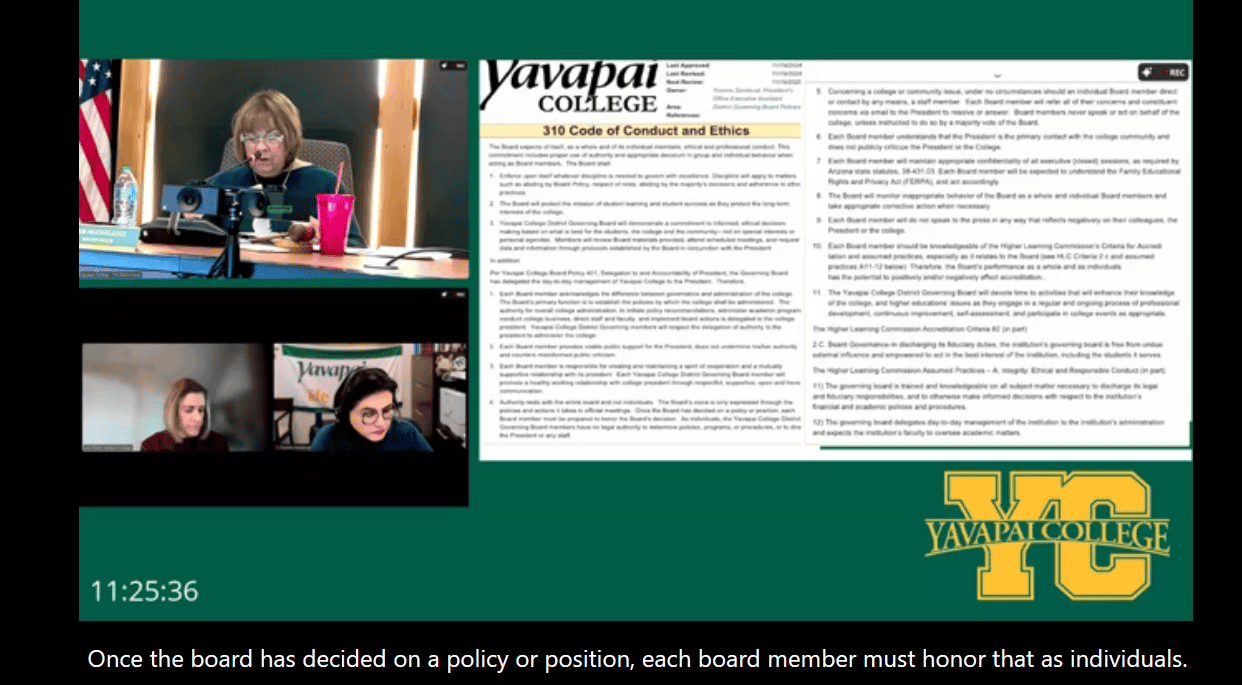
The reasons for her needed ouster is best encapsulated with how she conducted herself at the March meeting. Bracety requested at the start of the meeting to move up discussions of board policies so Kuykendall, who needed to leave early, could be heard. Under Arizona state law, boards can vote to rearrange their agenda items during meetings pretty much without restriction.
McCasland originally told Bracety “no,” because the presenters had set times to present their materials. When McCasland was outvoted 4-1, she unilaterally declared “Well, we don’t have a meeting, then,” McCasland and started to pack up to leave, as did President Lisa Rhine, Ph.D.
Both had to be reminded by board attorney Sarah Lawson, “If the majority votes to move around the agenda items, that’s fine,” and that the board has to vote to adjourn. Ending a meeting is not something the chair can do on a whim when she doesn’t get her way or loses a vote. Rebuffed in public, McCasland and Rhine remained as the board rearranged the agenda and resumed the nearly-aborted meeting.
The failed display of naked abuse of power should be humiliating for any responsible elected official. Thus it is right and proper for the board to remove McCasland from leadership if she utterly failed the basic understanding of how to run a meeting — and the statutory limits to her power.
McCasland is the last acolyte of former District 1 Representative Ray Sigafoos, who ran the Governing Board with an iron fist for most of the 20 years he served on the board. Sigafoos was an institutionalist who seemed to believe that the college as an institution should serve its own interests rather than the concerns, needs and desires of the Yavapai County taxpayers he was tasked to represent.
Like the Yavapai County Board of Supervisors, each college representative is elected by one of five geographical districts concurrent with the county Board of Supervisors. By law, supervisors and college representatives are supposed to wholly represent the voters in their jurisdiction regardless of what the best benefits their institutional body or constituents in other districts.
So, for instance, if the college was looking to build a new satellite campus in either District 1 or 5 — and all things being equal like construction cost, time to build, etc. — the representatives of Districts 1 and 5 should advocate in the strongest possible terms for the college to build the campus in their district, just as a count supervisor would.
However, Sigafoos and now McCasland adhere to the outdated Carver Model of policy governance from the 1970s, which prioritizes the institution over those it serves, severely limits staff authority to act independently to protect the institution from public criticism and pushes boards to undemocratically speak “with one voice,” rather than as a collection of diverse representatives from diverse communities.
hankfully, Kiel dramatically ousted Sigafoos in the 2024 election, leaving the second-rate McCasland to run the board in Sigafoos’ image. But the March 31 meeting shows she lacks the skill, tact or influence to dictate her colleagues on how to obey the chair.
Good.
No single official on a democratic board should dictate how things are run, anyway.
If board members disagree, that is not a problem, but the design in a representative democracy. Disputes lead to compromise and the institution is truly reflective of the community it serves. McCasland appears to be the last remnant of a failed governance model and the board should select someone better suited to the 21st century to run a county community college.