














With the primary election on Tuesday, July 21, Sedona voters have weighed in on the two major propositions facing us: The alternative expenditure limitation aka “home rule” as Proposition 400 and the future of the Sedona Cultural Park, aka the Western Gateway, as Proposition 403.
The races for Sedona mayor and the three Sedona City Council seats seem pretty much decided, but still technically close. The mayoral is relatively narrow with current Vice Mayor Brian Fultz having a 104-vote lead over newcomer Henry Silbiger as I write this, and there are still enough outstanding votes that could shift that contest [Editor’s Note: Brian Fultz’s final margin of victory was 161 votes].

The race for Sedona’s council seats has varied a bit, with Jean-Christophe Buillet, Tony Hauserman and incumbent Councilwoman Melissa Dunn in a tight race for the three seats with Rich Gay shortly behind Dunn and Lita Loesch Boyd in a distant fifth.



[Editor’s Note: The final tally of votes is as follows:
Jean-Christophe Buillet, 565 Coconino, 1,329 Yavapai, 1,894 total votes
Tony Hauserman, 497 Coconino, 1,360 Yavapai, 1,857 total votes
incumbent Councilwoman Melissa Dunn, 463 Coconino, 1,345 Yavapai, 1,808 total votes
Rich Gay, 547 Coconino, 1,209 Yavapai, 1,756 total votes
Lita Loesch Boyd, 481 Coconino, 1,132 Yavapai, 1,613 total votes]
The votes on the propositions were decisively decided in the first drop of ballots on Tuesday and don’t appear to be at any risk of shifting by any substantial margin and show that Sedona voters seemingly prefer the status quo. That is to say, they like our municipal government that fully functions with the tax revenue it collects and they want the Sedona Cultural Park, which has been a derelict and vacant arts venue for over two decades, to remain a space ostensibly dedicated to some future arts and culture facilities and not be used for future housing.
The city’s decision to sue Proposition 403 organizers may have played a role in the vote, but was unlikely to have been a game-changer for most.
The home rule vote was really not ever in doubt, despite the clamoring online and the glut of signs all around Sedona. The alternative expenditure limitation that the state imposed in 1979 for towns, cities and counties from 1980 onward is a relic of a bygone age of fiscal mismanagement by towns and cities statewide that well-meaning legislators aimed to remedy.
The legislature only amended the law to allow for brief temporary overrides to allow governments in which a home rule fails to brace for the cuts, but otherwise has allowed the original formula to stay in statute. The base limit with multipliers for inflation and population growth, without any other caveats or exclusions or updates to how towns, cities and counties spend tax dollars on programs and projects mean that for nearly all governments, the expenditure limitation is far below what these bodies spend.
While every Arizona county or municipal government is a snowflake with unique geography, needs and constituencies, by and large, small, local governments don’t run roughshod — liberal, conservative and mixed councils and boards of supervisors build, create and manage things that their constituents want and voter elected them to do. So when home rule comes to a ballot, the potential cuts are so drastic in comparison to what voters have grown accustomed to that voting against home rule is a rarity statewide. This is generally why when permanent base adjustments are floated to make the home rule formula irrelevant forever, they almost invariably pass.
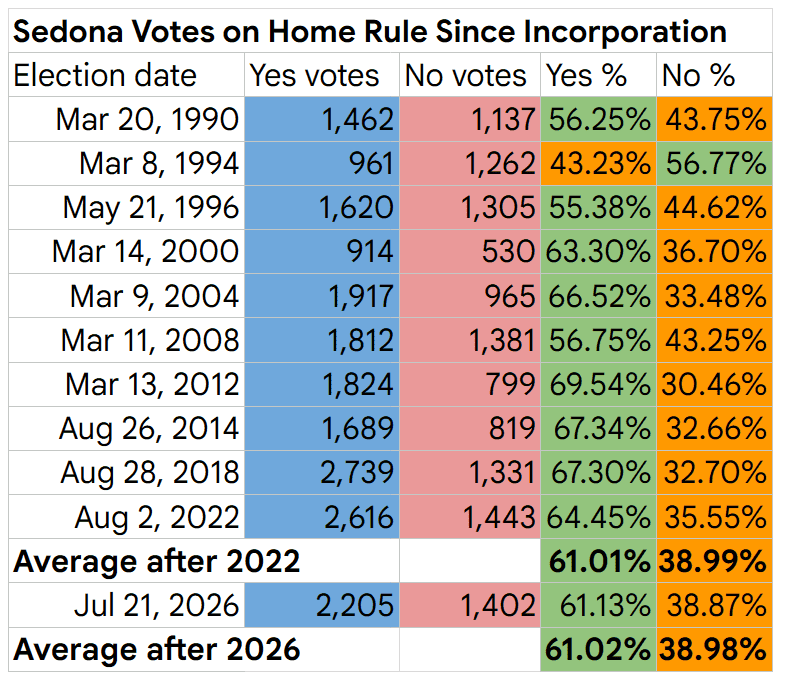
In any event, home rule has passed in Sedona in every election cycle except for 1994, and generally with 60% of the vote. As of press time, home rule is passing at 59.74% and is on a glide path to the nearly the same average [Editor’s Note: The final tally was 61.13%].
It should be noted that the 1994 vote wasn’t a natural trend by the electorate, but came after some financial irregularities and the then-city manager in the midst of resigning.
The opponents of home rule never really made a legitimate case for why city government should not use its tax dollars on projects residents want. Opponents could point to the cost of the Uptown parking garage, but the project itself was something that Uptown business owners, most of whom are Sedona voters or residents just outside Sedona in the Village of Oak Creek or Red Rock Loop Roads pushed the city to build for a decade. The Forest Road Extension was also costly, relatively speaking, but residents take advantage of this alternative route and it has loosened traffic pressure on Cooks Hill.
Opponents’ attacks on the city building shared-use paths, giving grants to Sedona area nonprofits or funding Community Library Sedona were non-starters and instead engendered public mockery rather than any support, getting savagely ratioed on social media — and their math calculations were fictional at best, which voters noticed. Attacking the completely unaffiliated school district, a government separate from the city of Sedona, might have been the icing on the cake, telling voters that the anti-home rule folks were just not serious people.
Voter turnout was very low, but this could be attributed to an earlier election in July rather than August, a lack of enthusiasm for uncontested statewide partisan elections and two propositions that seemed sure things, not edge cases.
We look forward to reporting the final results for mayor and council when the numbers are nearer to being final.
Christopher Fox Graham
Managing Editor
Fiscal Year 2025-2026 Expenditure Limitations from the Arizona Department of Revenue
Of the 46 cities and 45 towns in Arizona, 85 have adopted an alternative expenditure limitation, with 38 using the Home Rule Option and 47 with a Permanent Base Adjustment.
The Home Rule Option replaces the state-imposed expenditure limitation with an annual budgeted revenue figure set by the town or city council annually.
Permanent Base Adjustment changes the FY 1979-1990 base limit, effectively raising expentiture limitation to a budget level so high and well above the city or town’s actual budget that the new state-imposed limit competely negates the need for a “home rule” elections every four years.


