













Museum rides through exhibit on Route 66 & local influence
To celebrate the centennial of the legendary U.S. Route 66, the Sedona Heritage Museum has opened its newest exhibit “The Road is Life: Sedona & Route 66,” which until the end of the year is celebrating the Mother Road’s legacy and how it helped drive Sedona’s economy from agriculture to tourism.
“So often, you think of Route 66 and you think of the communities listed in the song,” SHM Executive Director Nate Meyers said. “But it had a much greater impact than just the communities along the route. It changed the country, and you can see how it changed Sedona in this exhibit.”
The exhibit covers the period from the completion of Route 66 in 1926 into the 1980s, when the completion of Interstates 17 and 40 largely made Route 66 obsolete. It also mentions how, in the 1980s, the portions of Route 66 that still existed were decommissioned and began to be recognized as historic highways.
Route 66 & Sedona’s Connection
“Obviously Route 66 doesn’t go through Sedona — it passes about 30 miles north,” Meyers said. “But after it was completed in 1926, you see this massive uptick in motor vehicle traffic. People start discovering Sedona, and people who live in Sedona realize they need to have that connection to Route 66 and the outside world.”
That realization sparked a 12-year improvement project to build what is now State Route 89A through Oak Creek Canyon, linking Sedona to Route 66.
In 1927 and 1928, the road, then called State Route 79, was expanded to two lanes and many of the creek’s original approximate 12 crossings were eliminated, according to Meyers. The switchbacks at the top of the canyon were also constructed during that period. By 1934 and 1935, the road was finally paved, and the W.W. Midgley Bridge, built in 1938, finished the last leg of the connection.
“After that, you start to see a massive growth of the tourism business in the 1940s, with motels, hotels and service stations popping up,” Meyers said. “Route 66 is really the reason that all of that kind of started.”
State Route 79 was redesignated US 89A in 1941 until it was again redesignated as State Route 89A in 1993. State Route 179 began as a 1935 spur off of State Route 79.
Artifacts on Display
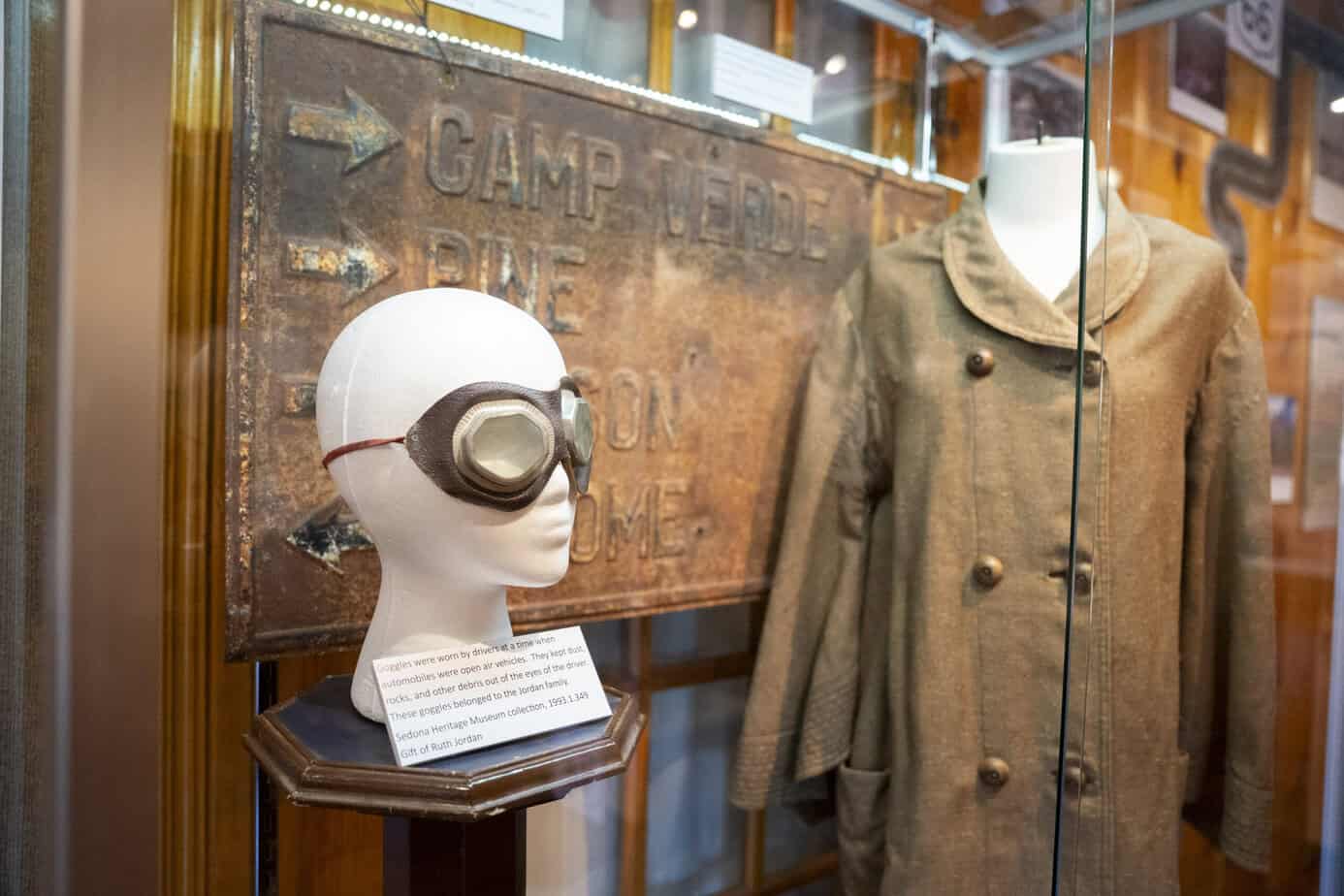
Among the artifacts on display are a duster worn by Dorette Schuerman, one of Sedona’s original founding families who grew grapes near the base of the mountain that bears the family’s surname near Red Rock Crossing.
Early automobiles were quite different from today’s vehicles, Meyers said, and people had to dress accordingly. Many were open-air, unless the driver was wealthy enough to own a luxury car with a roof, and the roads were dusty and unpaved. The exhibit also includes goggles of the era, a safety necessity in open-air vehicles where dust and rocks were a constant hazard.
Other pieces of equipment on display include an early car jack and a canvas desert water bag — handy both for drinking on a road trip and for pouring on an overheated radiator. The water bags were canvas, filled with water and hung from the hood ornament. As the automobile was driven, wind and evaporation kept the water cool, perfect for the motorist to drink or to add into a thirsty radiator.
Oral Histories & Broader Impact
The exhibit draws heavily on oral histories from SHM’s collection, with residents who lived in Sedona from the 1920s through the 1940s describing how the automobile changed every facet of daily life.
“A lot of the folks who were here in the ’20s through ’40s talk about how [the automobile] changed every facet of life,” Meyers said. “It changed schooling, because school buses suddenly were available and students in Oak Creek Canyon, who had been going to schools built at places like Slide Rock, now had buses to take them to Cottonwood and Flagstaff. It changed farming, because with the rise of motor vehicles and trucking as the preferred way of taking goods and produce to market, Route 66 and 89A suddenly became their lifeline.”
Sedona’s roads, of course, remain a topic of conversation more than a century later.
“That would be for the people in charge of that to figure out. It certainly was a massive undertaking, and it took lots of folks in the community to get it done,” Meyers said about any lessons from the history of Route 66 for current transportation issues in Sedona. “Route 66 took a lot of collaboration with the county and the state. Maybe that’s the lesson there. It takes everybody working together to get something like that done.”
Call 928-282-7038 or visit sedonamuseum.org for more information.