


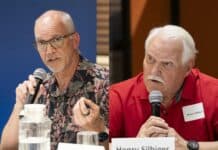









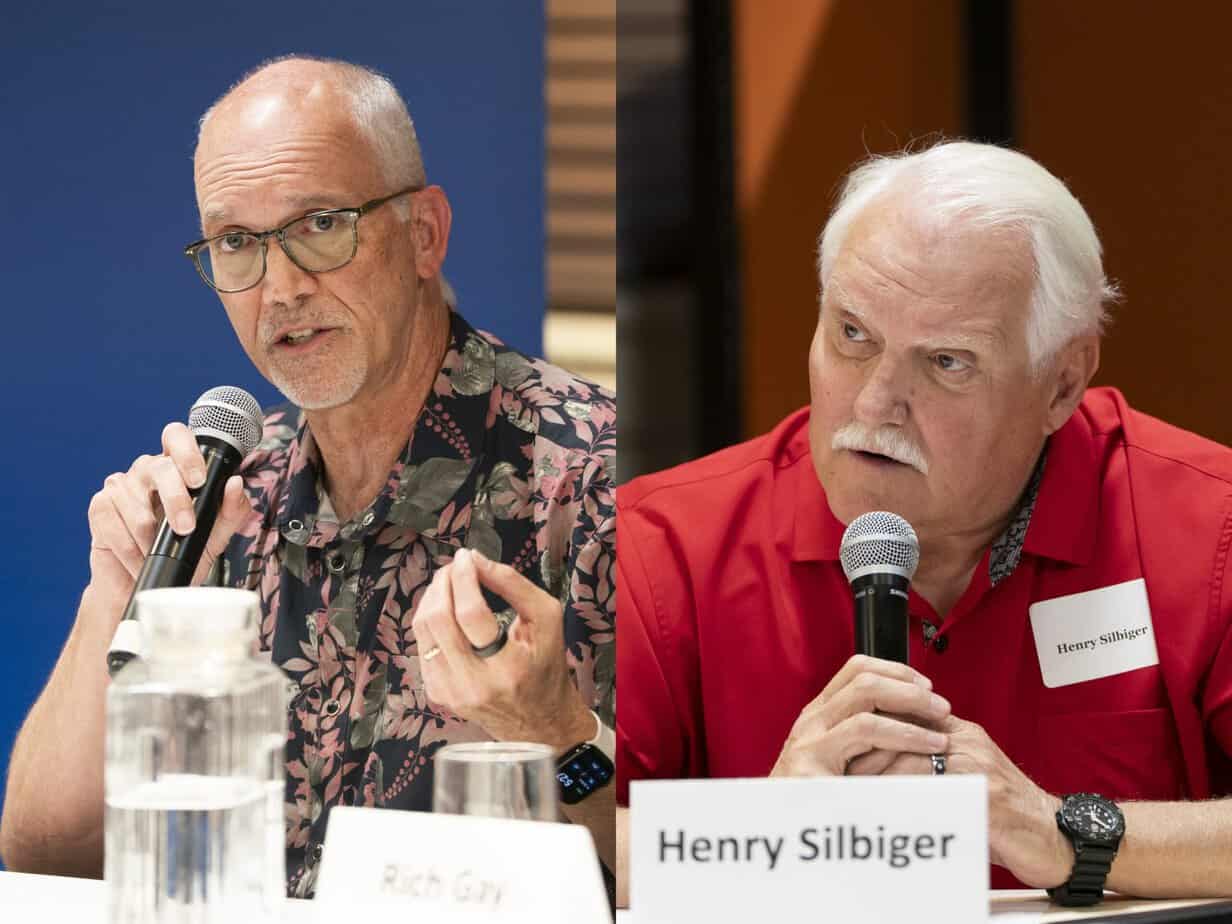
Brian Fultz and Henry Silbiger outline to voters their competing priorities
Keep Sedona Beautiful hosted a forum on Thursday, May 21, featuring current Sedona Vice Mayor Brian Fultz and political newcomer Henry Silbiger — both of whom are seeking to become the next mayor of Sedona. About 25 residents came to the Pushmataha Building to hear the mayoral candidates weigh in primarily on conservation issues. The forum also included most of the Sedona City Council candidates discussing the issues prior to the Tuesday, July 21, primary election.
“I’m a 21-year homeowner and a five-year fulltime resident,” said Fultz, who was elected to council in 2022. “I believe I have the experience, the skill, the will, the desire to continue to meet with residents and other stakeholders to find common ground on complex issues that we face as a community, because unfortunately nothing is simple to get done in Sedona, and I believe I’m the right person to continue to work forward and get those new tasks accomplished.”
Born in Poland, Silbiger became a U.S. citizen in 1966. He spent his career in sales and specialty packaging, including over 25 years with Stephen Gould Corporation. He became a Sedona resident about a year ago, according to his October application for an appointment to a City Council vacancy. He said his background has given him the skills to connect people with opposing goals.
◼ The first question of the forum was how the candidates would balance workforce housing needs with Sedona’s scenery. Silbiger said there are over 200 housing units built or in development in the city, but he wants to hear directly from workers what their desires are — anonymously, so they never fear employer repercussions.
“I advocate for smart growth that respects neighborhood character and environmental carrying capacities,” Silbiger said. “I will never allow another cultural park situation where the community is felt left in the dark, where your voice will be heard, and I will never sue to silence it.”
The city sued the Save Sedona Committee political action committee on March 31 to keep Proposition 403 off the ballot, arguing the ballot proposition was unconstitutional “zoning by initiative.” Yavapai County Superior Court Judge John D. Napper ruled against the city and ordered the initiative must go to the voters.
“We, as council members, swear an oath to defend the Constitution and the laws of the state of Arizona, and consequently we needed to … get clarification from a competent court on is it or isn’t it [constitutional]?” Fultz said to the NEWS. When asked, Fultz denied the lawsuit was politically motivated, arguing the most self-interested move would have been to accept the initiative as is. “That would have been far more politically expedient,” he said.
Later in the forum, a resident asked candidates to discuss their positions about the Georgia Frontiere Performing Arts Pavilion at the Sedona Cultural Park/Western Gateway.
“The City Council has a responsibility to learn to understand what the potential is or isn’t the renovated amphitheater, so I’m neither for it or against it at this time,” Fultz said, adding that he wants to hear the business plan for concerts at the venue from the Sedona Cultural Park 2.0 group before making a decision.
“If the initiative passes, there’s no housing at the cultural park — and at that point, a community discussion about an amphitheater becomes feasible,” Silbiger said.
Council is scheduled to discuss and possibly approve a non-binding letter of intent with Sedona Cultural Park 2.0 for the group to develop a business plan for amphitheater operations on Tuesday, May 26, after press time.
◼ Candidates were asked “what is your top priority regarding controlling or reducing visitor impact on the quality of life for Sedona residents?” Both candidates cited mostly transportation solutions.
Fultz pointed to expanding the trailhead shuttle service to parking areas south of the city limits, “and we’ve been talking with the Forest Service about that.” Along with expanding the Verde Shuttle and potentially promoting coach bus service from Phoenix Sky Harbor International Airport. “You don’t need to rent a car to come to Sedona,” he said.
Silbiger said he would fix what he called Sedona’s underutilized transit system so visitors can leave their cars behind, and to work directly with neighborhoods to design bypass roads to divert traffic away from residential streets.
“But safety is our ultimate priority,” Silbiger said. “The current council has failed to make disaster preparedness a focus. I will change that by integrating advanced AI wildfire monitoring and high tech early warning systems. If disaster strikes, both our residents and tourists will have clear immediate evacuation procedures.”
The city completed an Evacuation and Re-entry Plan for residents in July 2023 and established 12 Evacuation Zones as part of the city’s “Know Your Zone” program.
Silbiger was asked by a resident later in the meeting how he has learned how the city works, since his first campaign is for mayor, not council. He said he has been meeting with the various department heads.
◼ The final question from KSB was how will the candidates educate and prepare residents for the city’s new Dark Sky code.
“We need to launch a bulb for bulb swap, allowing neighbors to trade in harsh, unshielded floodlights for free warm-amber LEDs,” Silbiger said. “Second, let’s use pride instead of penalties by introducing a volunteer-led dark sky homes certification.”
Fultz called for open houses and “assembling a catalog of options. Here’s an example of lighting that is Dark Sky-compliant,” and to expand the home energy retrofit program to be expanded to include Dark Sky lighting.
The candidates differed on the city’s Sustainability Department’s proposed Fiscal Year 2027 budget of $846,931 and staffing levels.
“I think it needs to be looked at to understand exactly what they’ve been doing and what it’s cost us and what our return on investment is,” Silbiger said.
Fultz pointed to the department’s goal of having the city cut its greenhouse gas emissions by 50% by 2030, and existing initiatives such as the Sustainable Communities Program. “I think there probably is enough staff when the day is done,” Fultz said about the department. “You can’t calculate an ROI on this, we’re trying to do what’s right by the planet. Climate change is real. We need to do our part. So I’m comfortable with where we’re at right now.”
The last day to register to vote in the Primary Election is Monday, June 22.