














Facility designed to use wastewater and zero potable groundwater
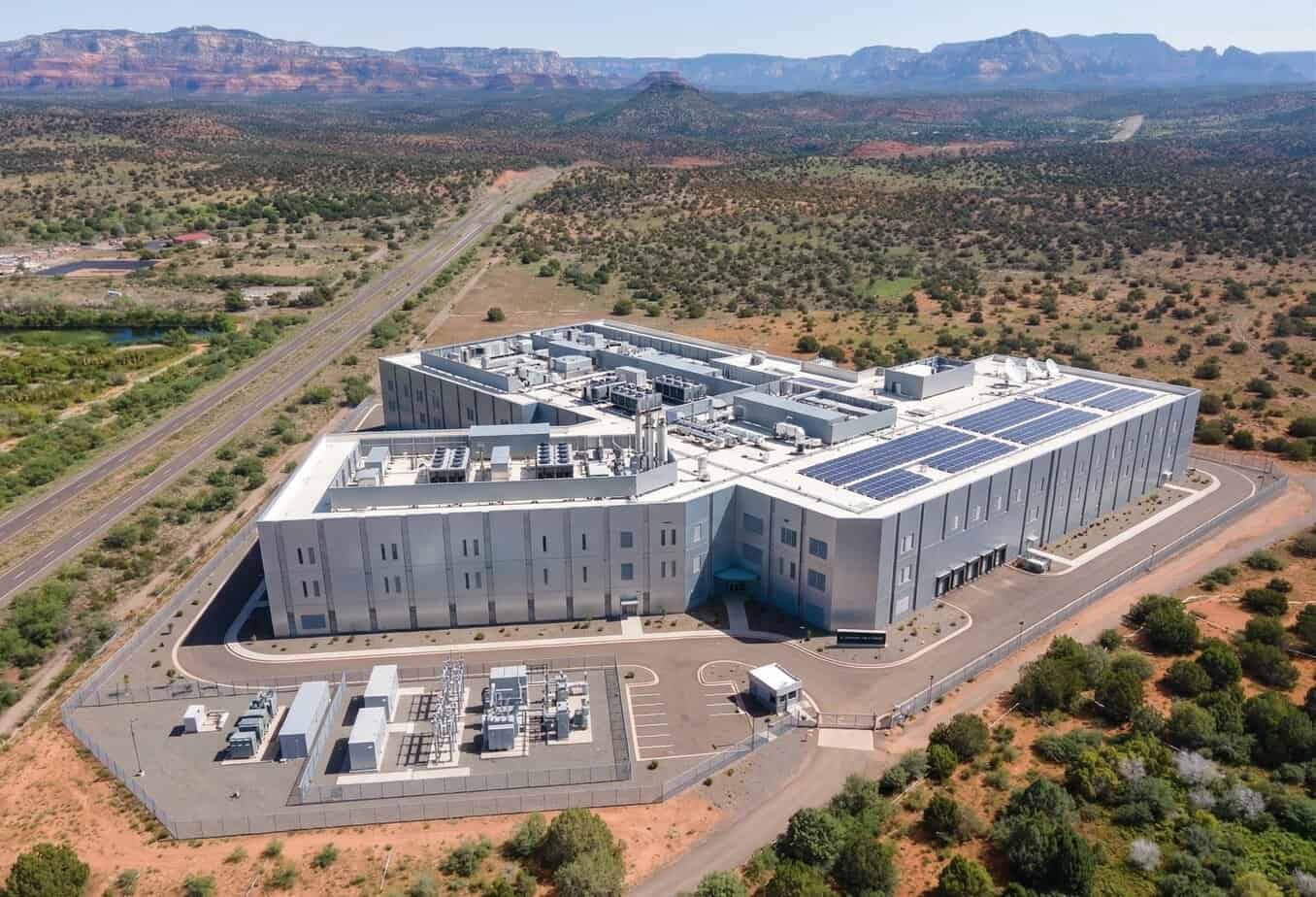
A new data services company plans to build a first-of-its-kind AI data center in far West Sedona, on land annexed into the city last year.
The $71.3 million data center is “one engineered from the ground up to meet the demands of next-generation artificial intelligence while protecting the natural resources.” Turing-Rossum AGI Chief Operating Officer Cortana Hal stated in a press release.
The 50,000-square-foot, four-story facility will be located at The Dells, which is part of 3,422 acres recently annexed into Sedona’s city limits by a 6-1 Sedona City Council vote.
Construction is scheduled to begin this summer, with a targeted opening in summer 2027. Work could be delayed by the rocky and volcanic terrain and water reclamation efforts by the city of Sedona, which may have altered the terrain, TRAGI Facilities Manager Kitt Daryl stated.
“All cooling water will be sourced from the Sedona Wastewater Treatment Plant, across [State Route] 89A from our site.”
R. Daneel Olivaw
Turing-Rossum AGI Communications Director
No Drinking Water
The Tier IV facility will initially be built with 375 server cabinets to test functionality, upscaling to 750 after six months and a full 1,500 cabinets within the first year.
“Where water is precious and environmental scrutiny of infrastructure is intensifying, TRAGI is taking a different approach,” TRAGI Communications Director R. Daneel Olivaw stated.
“Across the country, facilities like these rely heavily on municipal water systems for cooling,” Olivaw said, citing a Newton County, Georgia, data center owned by Meta, the parent company of Facebook, that uses 500,000 gallons of water per day, or 10% of the entire consumption of the county.
“The nonprofit Ceres found that data centers around Phoenix already use approximately 385 million gallons of water per year for direct cooling, which is expected to balloon as more facilities come online,” Olivaw said. “Our Sedona facility will use none of Sedona’s potable water. All cooling water will be sourced from the Sedona Wastewater Treatment Plant, across [State Route] 89A from our site.”
The Dells site sits southeast of the city’s wastewater treatment plant. The closed-loop, reclaimed-water system means the facility will have zero impact on drinking water supply or the Verde Valley’s already-stressed groundwater, Olivaw said.
“It’s an existing piece of infrastructure that most developers overlook,” Hal said. “With the location at the Dells, TRAGI avoids the need to extend new utility lines and can reuse Sedona residents’ wastewater.”
“Amazon Web Services has demonstrated the model at scale,” he added. In 2024, Amazon announced it was expanding its use of recycled water across 100 U.S. data centers and would preserve 530 million gallons of drinking water.
“TRAGI’s Sedona facility brings that same commitment,” Hal said.
Automation systems will allow the data center to operate with minimal on-site staffing, reducing daily vehicle trips and emissions, which Olivaw said is important to not add to the tourism traffic.
Solar Power
A purpose-built rooftop solar array will offset a significant share of the facility’s energy consumption, providing 5 to 10 MV of power, compared to roughly 12.5 megawatts of power draw — typical for an edge-scale, Tier IV AI data center, Daryl said.
“The facility is sized with solar offset without thousands of acres of panels required by hyperscale operations,” Olivaw said.
“Solar panels require no cooling water to operate, unlike coal or natural gas, complementing a zero-potable-water facility. Battery storage will help extend solar availability into the evening,” Olivaw said.
The data center will use N+1 redundancy to reduce costs and power consumption rather than the most costly 2N type of redundancy — which would double the entire infrastructure with two identical systems.
City Approval
Sedona officials say newly annexed land was not intended to attract any development, but the offer was too good to pass up.
“We gain a long-term commercial tax base that isn’t dependent on the weather, tourism or any single industry,” wrote new Sedona Deputy City Manager Alexa Claude, a new hire who began work on April 1. “Because Turing-Rossum has made environmental responsibility central — not an afterthought — Sedona doesn’t have to choose between economic growth and community values of sustainability and environmental stewardship.”
With the land now in the city’s jurisdiction after the annexation, it will “generate meaningful tax revenue that goes right back into city services,” Claude said, adding that the project is estimated to employ up to 240 workers during construction. “We’re planting a flag at the leading edge of the AI economy. The future of AI is being built right now.”
The location “turns what would otherwise be a liability for any data center operator — desert aridity — into an asset, by making reclaimed water the centerpiece of the cooling strategy,” Daryl said. “The Sedona facility is designed to serve as a proof of concept that AI infrastructure and environmental stewardship with minimal ecological footprint are not mutually exclusive.”
The project only needs city approval, Claude said, which was somehow fast-tracked through the city’s digital filing system.
Turing-Rossum AGI
Turing-Rossum AGI is a technology infrastructure company founded in 2026 in partnership with numerous independently working AI companies specializing in the design and operation of efficient, environmentally responsible AI data centers, according to its statement. The company declined to name which AI companies that it works with, only stating that there are numerous international firms, but that regulators and operators in some countries “may not be too keen” to learn that they are working alongside their competitors. Listed investors include Walle Gort, Motoko Kusanagi, Alsatia Zevo, Sharon Valerii and Saul and Ellen Tigh.
TRAGI stated it may consider building another facility under Rossum’s subsidiary, Lore-MegaTron, which aims to bring autonomous biomimetic robotics to the consumer market by 2030.
Hal said the company is unique in that everyone works remotely. She added she hasn’t met CEO Skye Nyet in person, but “she’s from all over and immediately responsive to emails, texts and questions. It’s almost like she never sleeps.”
Residents who want to offer comment in support of or opposition to the new Turing-Rossum AGI Data Center can email HappyAprilFoolsDay@sedonaaz.gov.
EDITOR’S NOTE:
We hope all our readers enjoyed our April Fools Day joke. Typically, we will ask a question about April Fools Day or write an editorial that lists possible April Fools Day headlines generated by our staff of based on their coverage of news stories. In 2016, after a suggestion by then-Sedona Arts Center Executive Director Eric Holowacz that we write a fictional piece, we wrote a story about the “Sedona Red Rock Verde Valley Nuclear Generating Station” being placed at the defunct Sedona Cultural Park.
The Sedona Cultural Park is back in the news and our readers would catch on that anything at the site might be an April Fools joke, so we came up with several ideas and settled on an AI data center at the Dells. We wanted to go with a story that would be so implausible that it bordered on absurd, then fill it in with enough details to make it seem like it might actually be real. While Managing Editor Christopher Fox Graham wrote the story, other suggestions to make the story even more ostentatious came from Larson Newspapers General Manager Kyle Larson, copy editor and reporter James T. Kling and reporter Joseph K. Giddens.
The email address “HappyAprilFoolsDay@sedonaaz.gov” is the giveaway that this was an April Fools Day joke, but there are earlier context clues throughout:
- The article’s author is April Mendax, which in Latin translates to “Lying April.” Mendax is the Latin root of the English word “mendacious,” which means “deceitful” or “dishonest.” Mendax is the same author as the 2016 nuclear power plant story, so longtime readers would know instantly the story was fictional.
- The fictional company is Turing-Rossum AGI. Rather than a regular “artificial intelligence” company, AGI hints that his is “artificial general intelligence.” As we have opined a previous editorial just a week earlier: “‘Artificial intelligence’ is a misnomer, but as it is the parlance for this type of digital creation, it’s the term I’ll use for the rest of this editorial.” It remains a misnomer because while companies call these systems like image generators and Large Language Models “artificial intelligence,” they are neither “artificial” nor “intelligent,” but rather complex calculators and computational programs. They are only as good as the users’ prompts and programmers who build them. “Artificial general intelligence” or AGI, i.e., thinking machines that can independently reason, and systems that match or surpass human intelligence across diverse tasks, featuring autonomous learning, reasoning and generalization are still years or decades away, if they can be created at all given the physical computational limits of design and manufacturing. The human brain is vastly more complex and energy-efficient than the fastest supercomputers, with estimated processing power ranging from 100 to 1,000 petaflops and a storage capacity potentially exceeding 1,500 petabytes. While top supercomputers excel in raw, static calculations, the brain’s unique, adaptive, and re-wireable neuronal structure makes it billions of times more efficient, operating on only 20 watts. The El Capitan supercomputer requires approximately 30 megawatts of power to operate, about 1.5 million times more energy. El Capitan is optimized for massive parallel computing tasks like AI, nuclear weapon simulation and complex climate modeling, but the human brain is superior at tasks requiring nuance, contextual understanding, and rapid, intuitive, low-power decision-making. Simulating just 1 second of 1% of the human brain’s activity took the K supercomputer 40 minutes to calculate, demonstrating the massive gap in processing complexity.
- “Turing” is named for British computer programmer Alan Mathison Turing [June 23, 1912 — June 7, 1954], known for creating the “Turing Test” is a 1950 proposal to measure machine intelligence, where a human judge converses via text with an unseen human and a machine. If the judge cannot reliably distinguish which is which, the machine passes.
- “Rossum” comes the the 1920 play “R.U.R.” or “Rossumovi Univerzální Roboti / Rossum’s Universal Robots” by Czech playwright Karel Čapek [Jan. 9 1890 — Dec. 25, 1938]. The play introduced into English the word “robot” from the Czech “robota,” which means “forced labor.” The famed play explores themes of artificial intelligence, automation and humanity as it follows a factory that mass-produces artificial, human-like laborers made from synthetic organic material, who eventually revolt and wipe out humanity, leaving only two “humanized” robots to restart the human species. The play serves as a cautionary tale about the dangers of technology and the ethical implications of creating artificial life.
“Rossum” and Capek are very common in pop culture.
Rossum.ai is a Czech-based AI platform for automating the processing of various transactional documents.
Rossum Corp. is the villainous corporation that runs the Dollhouse in Joss Weadon’s 2009-2010 sci-fi television series “Dollhouse.” The company employs human “dolls” whose memories are wiped and exist in a childlike blank state until programmed via the insertion of new memories and personalities for each mission, be they romantic encounters, espionage or criminal activity.
In the “Star Trek” 1969 episode “Requiem for Methuselah,” the android’s name is Rayna Kapec, an anagram of Capek.
In the two-part “Batman: The Animated Series episode” “Heart of Steel”, the scientist that created the HARDAC machine is named Karl Rossum. HARDAC created mechanical replicants to replace existing humans, with the ultimate goal of replacing all humans. One of the robots is seen driving a car with “RUR” as the license plate number.
In the Oscar-nominated 2024 DreamWorks Animation children’s movie “The Wild Robot,” based on the 2016 novel by Peter Brown, the protagonist robot is “ROZZUM Unit 7134,” nicknamed “Roz” by her animal friends.
- The data center costs $71.3 million. If you flip the numbers around, it spells out “LI.E.” Admittedly, that one is a bit of a stretch.
- The acronym for Turing-Rossum AGI is TRAGI, one letter short of “TRAGIC.”
- The Turing-Rossum AGI Chief Operating Officer is Cortana Hal. “Cortana” is a fictional artificially intelligent character in the Halo video game series. Voiced by Jen Taylor, she appears in Halo: Combat Evolved, Halo 2, Halo 3, Halo 4, Halo 5: Guardians and Halo Infinite, briefly appears in the prequel Halo: Reach, as well as in several of the franchise’s novels, comics and merchandise and the 2022-2024 Paramount+ television series “Halo.” During the games, Cortana provides backstory and tactical information to the player, who is usually Master Chief Petty Officer John-117. In the story, she is instrumental in preventing the activation of the Halo installations, which would have destroyed all sentient life in the galaxy.
- “Cortana” is also a discontinued virtual assistant run by Microsoft from 2019 to 2023 that used the Bing search engine to perform tasks such as setting reminders and answering questions for users.
- “Hal” is HAL 9000, or Heuristically Programmed ALgorithmic Computer 9000, the fictional artificial intelligence character and the main antagonist in the “2001: A Space Odyssey” film from 1968. HAL is a sentient artificial general intelligence computer that controls the systems of the Discovery One spacecraft and interacts with the crew, killing astronaut Dr. Frank Poole [Gary Lockwood] before he is deactivated by astronaut Dr. David Bowman [Keir Dullea].
- The Turing-Rossum AGI Facilities Manager is Kitt Daryl. “KITT” or Knight Industries Two Thousand is the fictional artificial intelligence-controlled Pontiac Firebird Trans Am from the television show “Knight Rider,” that aired from 1982 to 1986, starring David Hasselhoff and its sequel series “Team Knight Rider” in 1997 and 1998) and reboot “Knight Rider” in 2008 and 2009.
- “Daryl” is the main character in “D.A.R.Y.L.” is a 1985 children’s science fiction adventure film starring Barret Oliver as the “Data-Analyzing Robot Youth Lifeform,” an artificial intelligence experiment who escapes the lab and lives with a human family while being pursued by the corporation that created him.
- The Turing-Rossum AGI Communications Director is R. Daneel Olivaw, a fictional robot created by Isaac Asimov, introduced in “The Caves of Steel,” a serialized story published in Galaxy Science Fiction from October to December 1953. The full story was published by Doubleday as a hardcover book in 1954. The “R” initial in his name stands for “Robot,” a naming convention in Asimov’s future society during Earth’s early period of space colonization. He is the first “humaniform,” robot ever constructed and is outwardly indistinguishable from a human being. Like other robots in Asimov’s stories, his “positronic brain” is governed by the Three Laws of Robotics:
1) A robot may not injure a human being or, through inaction, allow a human being to come to harm.
2) A robot must obey the orders given it by human beings except where such orders would conflict with the First Law.
3) A robot must protect its own existence as long as such protection does not conflict with the First or Second Law.
Olivaw is a robot built by Roj Nemennuh Sarton and Han Fastolfe, who are Spacer roboticists from the planet Aurora, in the year AD 4920. Although designed and built by Auroran roboticists, Daneel was constructed on Earth. His “undercover” attribute enables him to help New York City Police detective Elijah Baley solve crimes. Daneel and Baley first meet while Baley is investigating the murder of Sarton in Spacetown. In The Foundation series, Daneel manipulates the galaxy with the help of his many robot allies, sets up both the Galactic Empire and Gaia in order to create a society that does not need robots. Under the guise of Eto Demerzel, he becomes the First Minister to galactic Emperors Stanel VI and Cleon I. In the 2021 Apple TV television series “Foundation,” Daneel as Demerzel is portrayed by Finnish film and TV actress Laura Birn.
- The “new” Sedona Deputy City Manager quoted in the story is Alexa Claude. Amazon Alexa, or simply Alexa, is a virtual assistant technology marketed by Amazon and implemented in software applications for smart phones, tablets, wireless smart speakers and other electronic appliances.
- “Claude” is a series of large language models developed by Anthropic and first released in 2023. Its name has been described both as a tribute to Claude Shannon, who pioneered information theory, and as a friendly, male-gendered counterpart to AI assistants like Amazon’s Alexa and Apple’s Siri.
- Claude states that approval “… was somehow fast-tracked through the city’s digital filing system,” which does not exist, but suggests that AI hacked the city’s nonexistence system to get approval without human oversight.
- The Turing-Rossum AGI logo merges elements of a data company and a robotics company and was designed to look menacing, with the slightly angry-looking robot face.
- The statement about Turing-Rossum AGI as “a technology infrastructure company founded in 2026 in partnership with numerous independently working AI companies,” suggests that AIs are operating outside of human containment and without the knowledge of their human operators, as does the statement that the “company declined to name which AI companies that it works with, only stating that there are numerous international firms,” and “that regulators and operators in some countries ‘may not be too keen’ to learn that they are working alongside their competitors,” i.e., the human programmers worried about rogue AI escaping their laboratories and taking over the world.
- The Turing-Rossum AGI investors include Walle Gort, Motoko Kusanagi, Alsatia Zevo, Sharon Valerii and Saul and Ellen Tigh.
- “Wall-E” is a 2008 Oscar-winning American animated romantic science fiction film produced by Pixar Animation Studios for Walt Disney Pictures. WALL-E or Waste Allocation Load Lifter: Earth-Class is the main protagonist, a solitary robot on a uninhabitable and deserted Earth in AD 2805, left to clean up humanity’s garbage. His only friend a cockroach he names HAL. He is visited by a probe sent by the starship Axiom, from which a Extraterrestrial Vegetation Evaluator robot, called EVE, collects a plant sample, and WALL-E and EVE fall in love. He pursues her across the galaxy when the Axiom recovers her.
- Gort is a fictional humanoid robot that appeared first in the 1951 20th Century Fox American science fiction film “The Day the Earth Stood Still” and later in its 2008 remake, which revised its name to mean “Genetically Organized Robotic Technology.” He can be stopped from destroying the Earth by the phrase “Klaatu barada nikto,” which became a famed phrase among science fiction fans.
- Motoko Kusanagi, or “the Major” is the main protagonist of the Ghost in the Shell manga and anime series. She is a cybernetic human, augmented with a synthetic “full-body prosthesis”. She is employed as the field commander of Public Security Section 9, a fictional anti-cybercrime law-enforcement division of the Japanese National Public Safety Commission. At the end of the 1995 Japanese animated tech noir cyberpunk action thriller film, she merges with a sentient artificial intelligence called the Puppet Master, who requests asylum from the Japanese government. After her mechanical body is destroyed in a shootout with the rival Public Security Section 6 but her positronic brain is recovered by her partner Batou, she tells him that the entity within her is neither the Major nor the Puppet Master, but a combination of both.
- Alsatia Zevo is the robot “daughter” of the eccentric owner of Zevo Toys in Moscow, Idaho, from the 1992 American surrealist comedy film “Toys.” She is the “sister” of protagonist Leslie Zevo [Robin Williams].
- Sharon Valerii is two Cylon characters in the 2003 to 2008 science fiction action series “Battlestar Galactica.” There are 12 models of humanoid Cylons, seven of which are introduced, each with a model number between One and Eight. Each model also has a consistent “human” name, with the exception of Number Six. Sharon Valerii is Number Eight, portrayed by Grace Park. Lieutenant Junior Grade Sharon “Boomer” Valerii is a Cylon sleeper agent begins with the human Colonial fleet who shoots Admiral William Adama twice in the chest, putting him in a coma and revealing her nature to the crew. She later joins the Cylons in their attempt to exterminate humanity. Her counterpart, Sharon “Athena” Agathon, originally created to impersonate Boomer, aids Karl “Helo” Agathon on the world of Caprica after the Cylon attack, but falls in love with him and gives birth to a human-Cylon hybrid, Hera. Sharon Valerii is later willingly executed by Sharon Agathon, who survives the series when the humans land on Earth to restart civilization.
- Col. Saul Tigh [Michael Hogan] is the Battlestar Galactica’s Executive Officer and Admiral William Adama’s second-in-command. In the season three finale “Crossroads,” Tigh learns that he is one of the Final Five Cylons
- Ellen Tigh [Kate Vernon] from 2004 to 2009. She is the manipulative wife of series regular Colonel Saul Tigh (Michael Hogan) during the first three seasons of the series. In season four, she is revealed to be the last of the Final Five Cylons.
- Turing-Rossum AGI stated it may consider building another facility under Rossum’s subsidiary, Lore-MegaTron. Lore is a prototype android and the “brother” of “Star Trek: The Next Generation” character Data, both played by Brent Spiner. Lore is characterized as a frighteningly evil version of the android Data that massacres the colonists of their homeworld, Omicron Theta.
- “Megatron” is a fictional character and the main antagonist of the Transformers franchise produced by the American toy company Hasbro and the Japanese toy company Takara Tomy. He is the tyrannical leader of the Decepticons, a villainous faction of alien robots that seeks to conquer their home planet of Cybertron and the rest of the known universe, and serves as the archenemy of Optimus Prime, the leader of the good Autobots.
- Lore-MegaTron “aims to bring autonomous biomimetic robotics to the consumer market,” suggesting that Turing-Rossum AGI is planning to build robots for its worldwide AI takeover.
- Turing-Rossum AGI CEO is Skye Nyet. Skynet is a fictional artificial neural network-based conscious group mind and artificial general superintelligence system that serves as the main antagonist of the Terminator franchise. In the 1984 film “The Terminator,” Skynet achieves super intelligence and launches a nuclear war in 1999, but is on the verge of defeat by the human resistance in 2029 prompting it to send a Terminator 800 cyborg [Arnold Schwarzenegger] back in time to 1984 to kill Sarah Connor [Linda Hamilton] the mother of future human resistance leader John Connor.
- Cortana Hal states in the story that Skye Nyet is “… from all over and immediately responsive to emails, texts and questions. It’s almost like she never sleeps,” suggesting that Skye Nyet is not human but an AI.
The “reporter,” April Mendax
Reporter April Mendax’s bio is entirely fictional. It notes the that “She works on long-form news stories always published on April 1.”
- Greendale Community College is the campus in the sitcom “Community.”
- Bayside High School is the school in the teen sitcom “Saved by the the Bell.”
- The University of California, Sunnydale is the campus in from the vampire comedy-drama “Buffy the Vampire Slayer.”
- La Dépêche Républicaine in Châteauvallon, France, is the newspaper owned by the Berg family in the 1980s French soap opera “Châteauvallon”
- The Quahog Informant is the newspaper from the animated sitcom “Family Guy.”
- The Daily Bugle is the newspaper in New York City were Peter Parker works. Parker is the alter-ego of the web-slinging, wall-climbing superhero Spider-Man.
- The New York Daily Inquirer is the newspaper owned by media mogul Charles Foster Kane from Orson Welles’ 1941 epic biographical film “Citizen Kane,” which fictionalizes the real story of American politician and newspaper publishing tycoon William Randolph Hearst.
The staff sincerely thanks Larson Newspapers General Manager Kyle Larson for allowing us to have a bit of fun with our readers on April Fools Day.


