

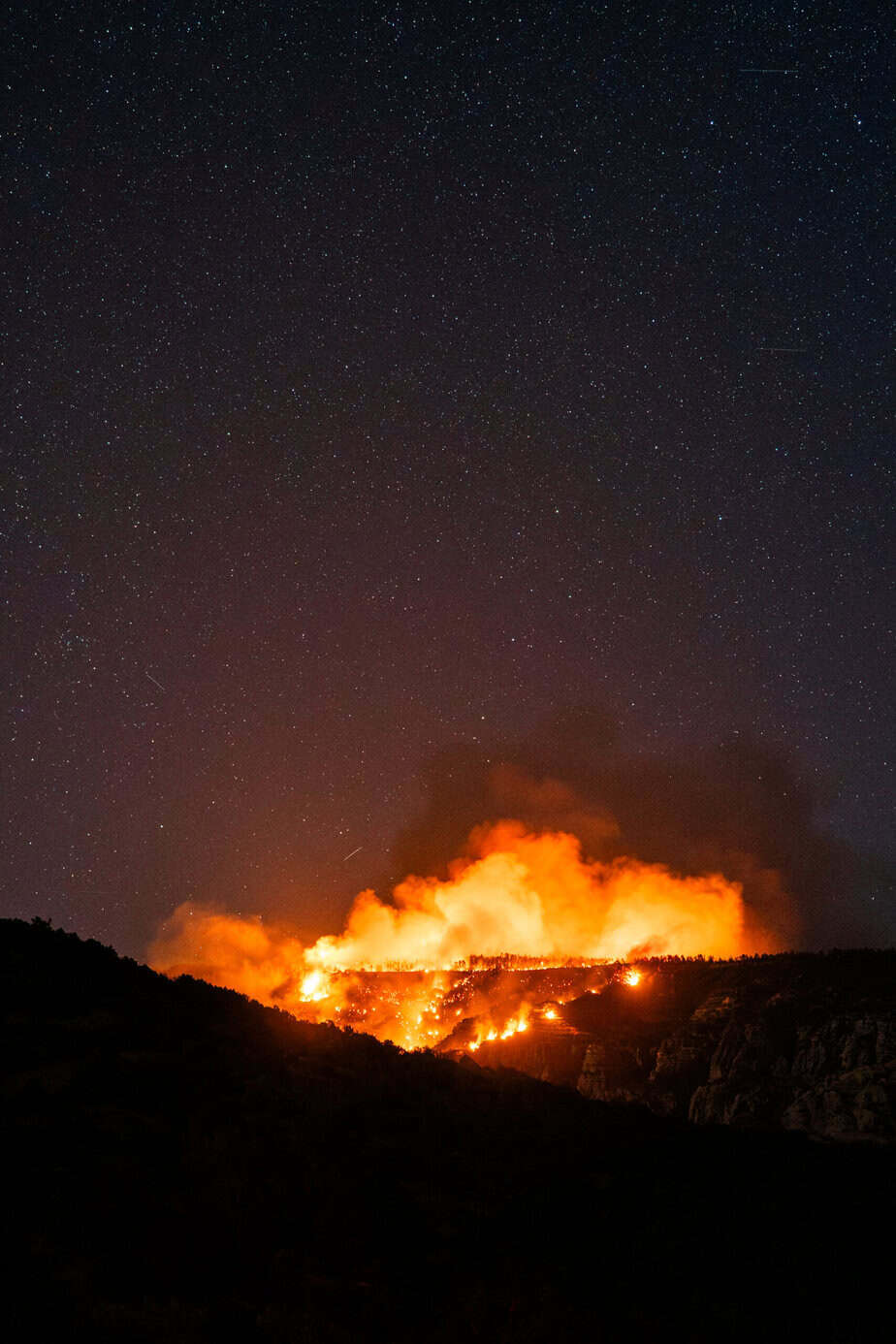

The Pocket Fire was first reported about 5 p.m. on Friday, June 19, approximately 7 miles north of Sedona. Firefighters were able to construct a dozer line off of Forest Service Road 231, the Edge of the World, to halt the fire’s movement from dropping down into Oak Creek Canyon.
The fire’s size doubled on Tuesday, June 23, starting the day at 341 acres and growing to 691 acres, according to the Wednesday, June 24, morning update report from the Coconino National Forest, with 678 personnel on the fire. The growth was driven by a series of backburns crews ignited to starve the fire of fuel and growth on the fire’s west side.
“At 1,467 burned and almost a thousand personnel now contributing to the effort of fighting the Pocket Fire, we are still in the thick of it,” Sedona Fire District posted to social media on the afternoon of Friday, June 26.
The fire’s cause is still under investigation and remains at 0% containment as of the morning of June 24 and is anticipated to continue burning for the foreseeable future because of the steep terrain and ample available fuels barring the summer monsoon.
“Tuesday, several spot fires were detected across Forest Road 231 to the north of the main fire perimeter,” the report reads. “Night shift was able to suppress those immediately, the largest of them reaching a half-acre. … Tuesday, crews continued work on Forest Road 231 to provide a robust firebreak.”
Aircraft dropped retardant on 90% of the fire area, though steep, difficult terrain prevented ground support in many areas, according to a Saturday update from Southwest Area Incident Management Team 2.
“This is going to be an incident that’s going to be with us for quite some time,” Aaron Mayville, forest supervisor for the Coconino National Forest, said on June 22. “This is located in some really nasty country. It’s steep, rocky terrain above Oak Creek Canyon, kind of out at the Edge of the World, below East Pocket Lookout.”
Where the fire is burning, decades of built-up fuel add to the incident’s complexity and long suppression timeline.

“We’ve got excessive fuel loadings over what you would naturally expect,” said U.S. Forest Service spokesman Dick Fleishman, noting that some terrain that naturally burns every three to 15 years hasn’t seen fire in roughly a hundred years.
“The brush, the manzanita that is in there, is taller than the ceiling in a lot of areas in this room,” Fire Management Officer on the Red Rock Ranger District Travis Mayberry said briefing the Sedona City Council on Tuesday, June 23.
Additionally the fire is burning in rugged terrain, making aerial water drops the preferred tactic for much of the acreage.
“If you’re on a paved path, it’s probably a zero to three degree incline, that’s known as easy. … Hard hikes, you’re looking at six to nine degree slopes,” Pearson said. “Above that is extreme, that goes up to 22 degrees. That’s where you need ropes and rigging, where the fire is currently burning, basically on this west flank, that is 36 degrees. … And as you go further to the northwest, it goes up to 50 degree slopes.”
The steep slopes make it unsafe to put fire fighters up against much of the fire line leading to aircraft being the preferred method to slow the lateral growth, however the fire is anticipated to move to the west, according to the Coconino National Forest.
“I think over the next week with this current forecast, where the fire currently is, the fire will continue moving north and start moving west,” Pearson said. “Once it hits [a] portion of the [Mogollon] Rim edge, it’s no longer in a heading orientation, it’s in a flanking orientation, which is generally less intense and slows the fire down, but it does not stop it. Meanwhile … the heel of the fire, the lowest portion of elevation is continuing to move north and west, following the vegetation.”
Seven Canyons is the main site where helicopters refill with water, Mayberry said, and that crews are developing plans to protect infrastructure to the west including Enchantment Resort.
“This is going to be a waiting game … knowing that there’s not a lot of good options to come from the top of the rim down to the bottom of the rim,” Mayberry said. “It’s a lot of exposure for the firefighters on the ground, it’s a lot of exposure for the pilots.”
Evacuation
Oak Creek Canyon was evacuated at 7:17 p.m. Friday, June 19, but that order was lowered June 23. Coconino County residents are now allowed back with proof of full-time residence shown to Coconino County Sheriff’s deputies at the Owenby Roundabout. State Route 89A remains closed to traffic.
CCSO spokesman Jon Paxton said he estimates that CCSO “had to have evacuated somewhere around 1,000,” people from Oak Creek Canyon because of Father’s Day weekend. During the evacuation, residents who left their home required a CCSO escort to gather their essentials. Paxton estimated that CCSO did 100 escorts as of Monday, June 22. None came from the north.
“Everyone who lives in the canyon thinks it’s an overreaction,” resident Katherine Wetzel said. She believes the closure was excessive, comparing the response to California’s handling of the Palisades fire.
“This is no different than the Brins Fire we had [in 2006],” Paxton said. “We had a fire that was above the canyon. The problem … [is] if that fire drops down in the bottom of the canyon, it will burn [uphill] pretty quickly. That is not a decision easily made. But we didn’t want to have to evacuate a full house on a Friday night or on a Saturday morning, should it have dropped down into there.”
“Fire managers are preparing for upcoming critical fire weather conditions and an anticipated uptick in fire behavior by securing areas a safe distance from the fire perimeter using a combination of hand line, dozer line, existing fire scars, rock outcroppings and other man-made and geographic barriers,” USFS stated June 24.
The long-term containment plan is still being developed, Mayberry said, and the fire has the conditions to allow it to continue to move west, “until we see a season-ending event,” citing the monsoon. The Pocket Fire is expected to outlast the crews currently assigned to it “unless we see a significant change in the weather,” Mayberry said.
USFS will have a community meeting at Sedona Red Rock High School on the evening of Monday, June 29, at 7 p.m.
Stage 1 fire restriction on the Coconino National Forest remain in place, and barring precipitation Stage 2 is “likely to come within the next couple weeks,” Schlueter said.
Call 928-260-0543 or email 2026.pocket@firenet.gov for more information about the Pocket Fire.
Follow @SedonaNews on Facebook to stay up-to date on the Pocket Fire with exclusive photos, videos and interviews as the fire develops.