











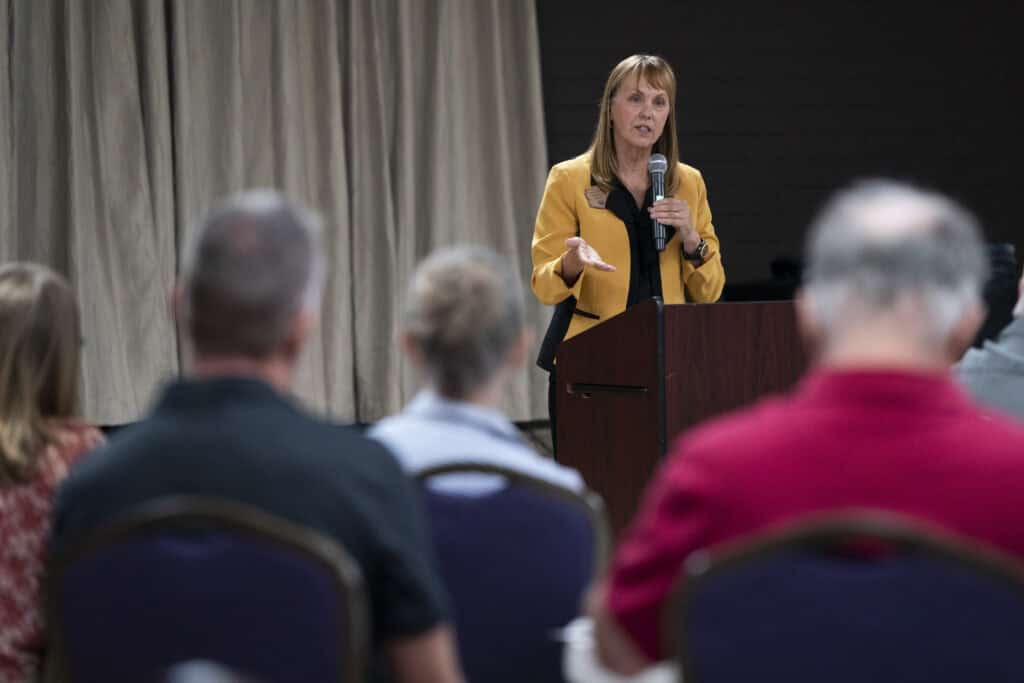
Arizona Rep. Selina Bliss’s [R-District 1] House Bill 2429, aimed at regulating short-term rentals, is likely dead. The bill moved too late out of the House, ran into a nearly expired Senate clock, and was ultimately passed over by two Senate committee chairmen who chose not to hear it while they had the chance.
“I pushed to the very end, I did everything strategically possible given the timeframe, and that’s how it ended,” Bliss said to the NEWS.
The bill sought to address parking issues by setting a maximum overnight occupancy of two adults per bedroom plus two additional adults, excluding minors. It would also allow municipalities to suspend licenses for STRs that accumulate three permit violations within 24 months, and would require sex offender background checks for renters.
HB 2429 didn’t pass out of the House until mid-March, after going up twice for a final House vote.
“We have an unwritten rule in the House and Senate floor that you have to have a majority of the majority party vote on your bill to get it out of committee or off the House floor and then on to the next chamber,” Bliss said.
The bill originally passed on March 10, but was voted on again on March 16. Background checks for sex offenders were added to secure a majority of GOP votes, and was sent to the Senate on March 16.
The bill was ultimately left off the Regulatory Affairs and Government Efficiency Committee agenda. Bliss hoped that the bill would have been heard on the March 31 meeting of the Appropriations Committee but was never heard there either.
“It’s so hard. I’ve never worked harder for a consensus bill,” city of Sedona lobbyist Kathy Senseman said during the Sedona City Council legislative update on April 14. “I was on emails where we actually had the Airbnb lobbyist emailing me, asking for the bill to be heard with us, and so I haven’t been able to figure out what went wrong exactly.”
Camp Verde Bill
House Bill 4064, that was supported by the Town of Camp Verde and sponsored by Bliss, similarly passed out of the House but was not heard by the Senate. HB 4064 would reform Arizona’s Municipal Improvement District process by moving the public petition requirement to the start of the process, before municipalities spend money on engineering and design. The bill aims to give rural communities a lower-risk tool to finance infrastructure by tying costs to properties that directly benefit rather than to existing taxpayers.
“It didn’t get heard in Senate committee, so I had to do the ‘strike everything’ onto another bill,” Bliss said.
A “strike everything” amendment, or “striker,” deletes the entire text of an existing bill and replaces the language completely. A striker can bypass deadlines for introducing new legislation or revive defeated bills without violating legislative rules.
“In this case, the chair told me ‘I’m not hearing your bill.’ … so the new bill number is Senate Bill 1016.”
“We are very optimistic that SB 1016 will pass,” Camp Verde Town Manager Miranda Fisher wrote. Sen. J.D. Mesnard [R-District 13] “aims to help with getting the votes needed.”
Bill Moratorium
Gov. Katie Hobbs [D] announced on April 13 a bill moratorium and that she would be vetoing all bills forwarded to her desk until Republican legislators announce their budget proposals and start negotiations.
“This is something that governors — Republicans and Democrats — have done over the year when budget negotiations break down,” Senseman said. “She wants the Republicans to release their budget that will include a plan for federal tax conformity that will address the Prop 123, education funding issue and figure out the cost shifts from the HR 1 Medicaid and staff.”
“The governor is required by the [Arizona State] Constitution to put forth a balanced budget by the first Friday of the legislative session, the legislature has no such requirement.”
In the Great Recession of 2008 and 2009, the state legislature chose not to release its own budget, according to Senseman, because legislators knew it was going to show a lot of cuts and didn’t want to publicize it, leaving only Republican Gov. Jan Brewer’s budget being put out publicly. The tension over the legislature’s budget details is what caused the moratoriums of recent years.
Two bills exempt from Hobbs’ policy were Senate Bill 1503, for first responders receiving state death benefits, and a bill to provide $4.75 million to the Arizona Department of Public Safety from the Highway Patrol Fund.
“Eighty-seven days ago, I showed the people of Arizona my balanced budget,” Hobbs wrote in her announcement. “Unfortunately, the legislative majority has done nothing but say ‘no’ and hide their budget from the people of this state.”
“We’re actively working on the budget,” Bliss said to the NEWS. “So for Hobbs to call a moratorium to have us fast track it; I don’t think it is productive. … I’m hearing we’re anywhere from a week to two or a month, depending who you talk to, on finalizing the budget. The appropriations committees, both the House and Senate, are meeting twice a week, about four hours at a time at least, trying to hammer something out to present to the public.”
This is the 14th week of the legislature, which has passed 105 bills, 31 of which were signed by the governor, 22 of which were vetoed, Sedona Deputy City Manager Lauren Browne said.