

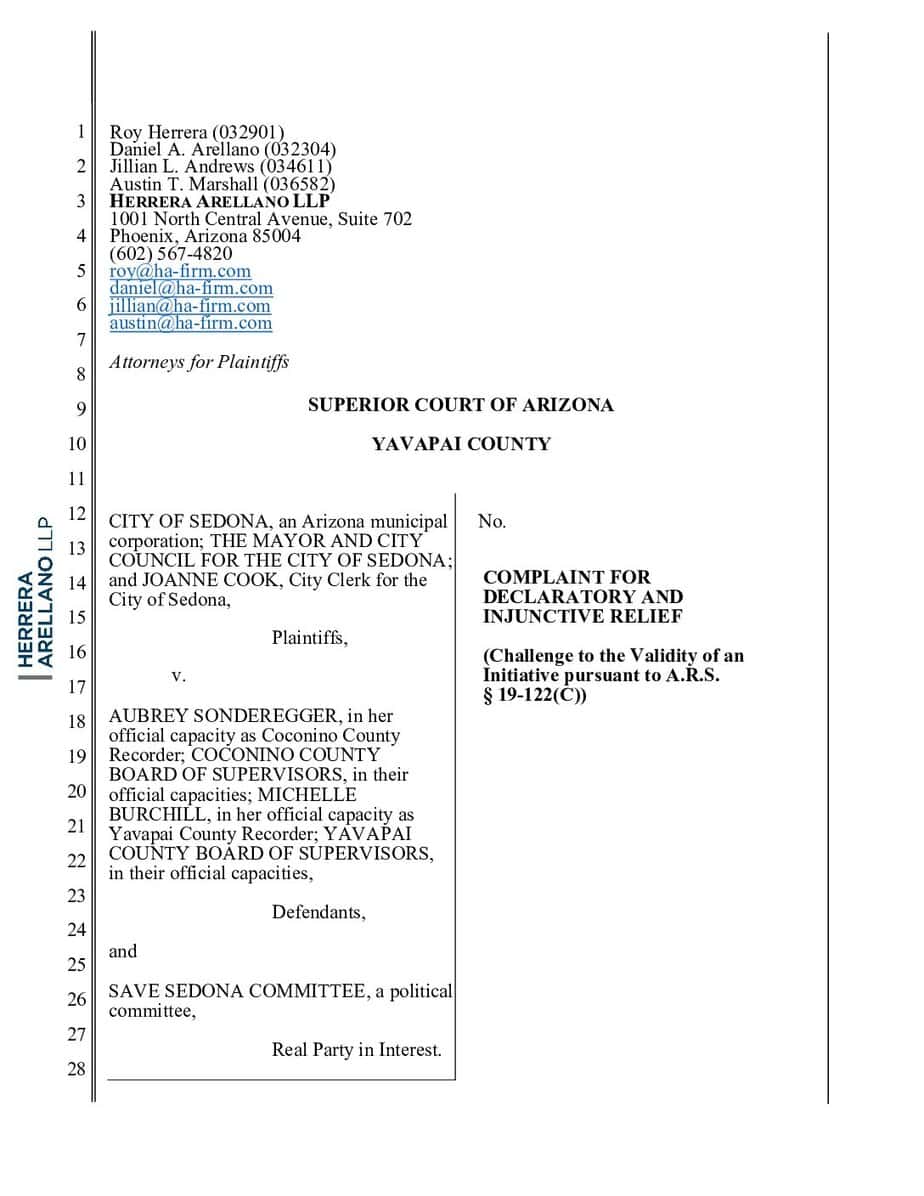
Late Tuesday afternoon, the Sedona City Council filed a lawsuit against the Save Sedona Committee, the Yavapai and Coconino county recorders and the Yavapai County Board of Supervisors “seeking clarity” on the legality of Proposition 403.
According to the suit, the question is whether municipal zone changes can occur through ballot initiatives when law provides official avenues for those changes to take place.
“This lawsuit is not about taking sides in a land use debate or telling residents what to think,” the city’s Tuesday press release stated. “It is about ensuring the city follows Arizona law regarding initiatives, zoning matters and the public’s right to notice and public hearing on land use matters.”
William “Bill” Noonan, treasurer of the Save Sedona Committee, said he had not been served as of Wednesday morning, and didn’t want to give much comment on pending litigation. He did say, however, he wanted to point out the irony of the city filing a lawsuit on the initiative the same week it sent out its Sedona Cultural Park poll.
City Attorney Kurt Christianson, did not respond to a request to comment before the following morning’s print deadline on Wednesday, April 1.
Attorneys with the Phoenix-based Herrera Arellano law firm, which filed the suit and represents the city, were not available for comment.
“That land is currently zoned as Planned Development in accordance with a rezoning in 1995 and amendments from 2002,” the lawsuit reads. “These ordinances allow for the land to be used only for an outdoor amphitheater.
“The Initiative would markedly change these restrictions. Specifically, it proposes to require the city to ‘maintain the Sedona Cultural Park as a city parks and recreational facility, including maintenance of its flora, fauna, geological features and its structural improvements.’”
The Save Sedona Committee’s petition stated the city would not be required to operate, build or improve the nearly 41-acre property, but it would be required to remain open to the public for recreational and cultural activities like hiking, biking, theatrical and musical productions.
The lawsuit also stated the initiative would require the city to treat the park more restrictively than others, because it would prohibit overnight camping, something the city could allow in other city parks, and prohibit residential development of any kind.
The suit’s demands include a declaration the initiative is invalid under the Arizona Constitution for violating due process of zoning changes and prohibiting the county defendants from certifying or printing election ballots that include the proposition.
The press release stated that Arizona courts have consistently ruled since 1968 zoning measures cannot be enacted through citizen initiative processes, and asks the court for an injunction.
“At the May 20, 2025 Planning and Zoning Commission meeting, attended by the initiative proponents, the city of Sedona’s City Attorney indicated that zoning by initiative is prohibited,” the press release stated. “This meeting occurred prior to beginning the official initiative process or circulating the petition for signatures.”
The citizen initiative includes a severability clause, which states if any part of the measure is held invalid, that invalidity does not affect other provisions in it, meaning a judge could strike certain parts of the initiative that are constitutionally invalid leaving the rest of the initiative to be placed on the ballot
City’s Rationale
According to the city of Sedona’s Tuesday press release, the decision to file a lawsuit against the initiative:
- Does not approve or finalize any development at the Western Gateway property.
- Does ensure compliance with Arizona election and zoning laws.
- Does not end the city’s commitment to open communication and meaningful public participation.


