














When the Woods Fire burned 59 acres east of the Village of Oak Creek on Aug. 13, the U.S. Forest Service and Sedona Fire District used AI fire detection cameras helped to keep the fire contained.
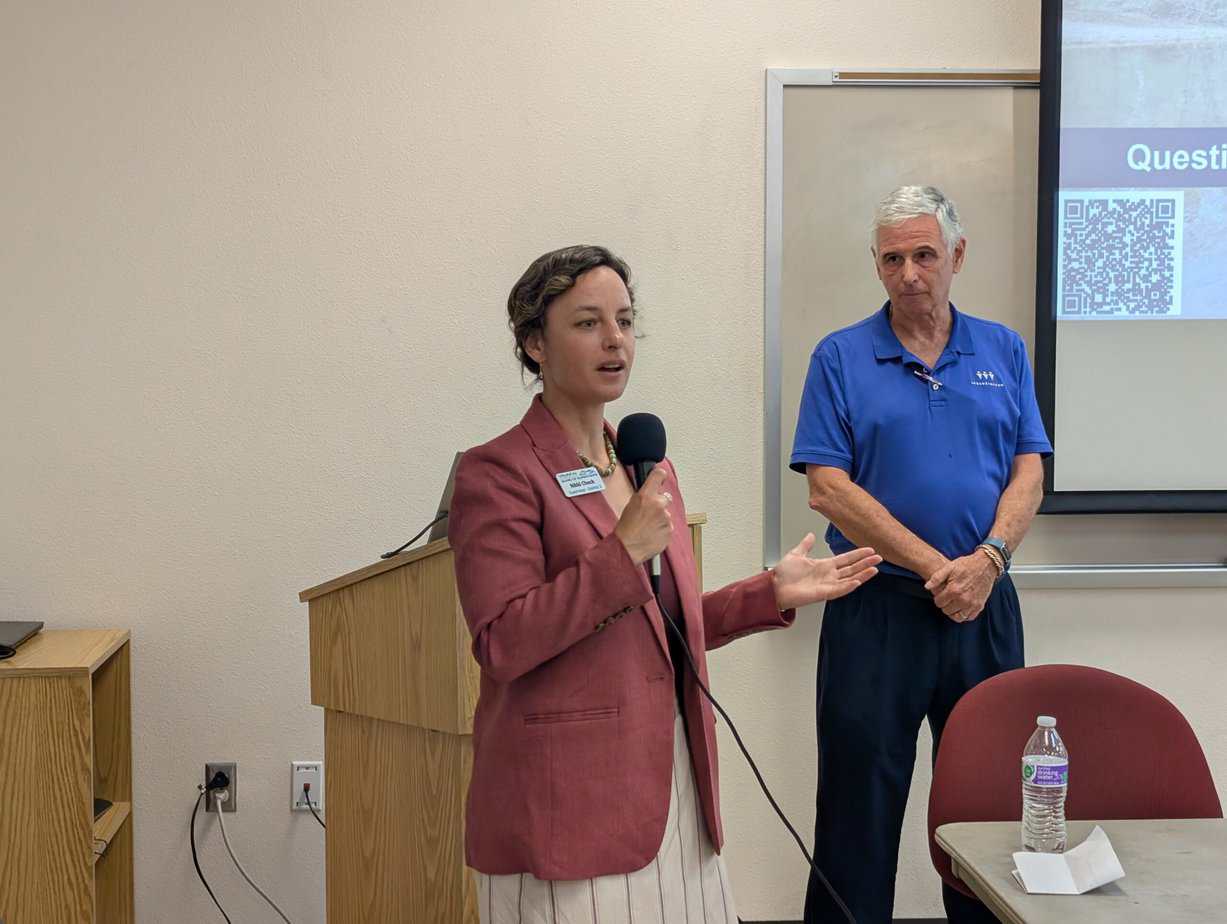
During an open house Wednesday evening, Sept. 10, hosted by Yavapai County Supervisor Nikki Check [D-District 3] at SFD Station 3 in the Village of Oak Creek, SFD Fire Chief Ed Mezulis said Arizona Public Service utility operates cameras around the county, which allowed them to deal with the fire early on.
“It’s a system called Pano AI, and it’s a system that APS is invested in,” Mezulis said. “Essentially, they’ve given us access to that system, and it’s been an invaluable resource for us, because as we’re responding, we can see what the cameras are seeing — and there are more cameras than I knew existed — and they start to populate and triangulate these fires.
“And they don’t read license plates,” he added, to which the crowd of about 30 people laughed. The city of Sedona voted 7-0 Tuesday, Sept. 9, to remove its controversial automated license plate readers.
The Woods Fire was started by a lightning strike, Forest Service staffer Larry Badger said. The cameras alerted the USFS, which had crews arrived on scene shortly after SFD crews did, but the fire was growing so quickly, the SFD and the USFS agreed to send in for help.
“We ordered quite a bit of aviation assets for that,” Badger said. “So if anybody’s around, you saw some air tankers and heavy helicopters. Those are national resources that are not from here. … Because the proximity of that fire to the [Verde] Valley … we were able to get some of those resources that came out of California, Colorado and New Mexico.”
While the recent Woods Fire was contained before too much was damaged, the theme from nearly every speaker was preparedness.
“Evacuation zones allow us to have those preidentified areas based on the hazards, based on the population, based on everything else,” Yavapai County Emergency Manager Ashley Ahlquist said. “It’s a very large initiative with many stakeholders involved to define those zones. … So, we do encourage you to know your zones. You can go to protect.
genasys.com.”
But there’s always more individuals can do to protect themselves and their property from fires, State Farm Insurance Agent Karen Cole said.
Cole passed around a photo of a neighborhood in Lahaina, Hawaii, that had burned down from a wildfire in 2023. Against the ashes and charred remains of houses and trees, a solitary house with a red roof remained untouched.
“That house had just been updated to be really Firewise,” She said. “So, they cleared all the debris around it. It was made of California … Redwood, which I learned later is kind of nonburnable, and they had just done in commercial grade metal roof, which also doesn’t burn, and they put five feet of river rock all the way around the perimeter of the house.”
These kinds of protections, she said, also makes the house more insurable, because the insurance companies are more likely to insure a home that’s made an effort to protect itself from a fire.
“Roofs need to be updated and maintained,” Cole said. “This is a big thing, lately. There are carriers out there that will not insure your house.”
Depending on the type of roof, it needs to be maintained at least within 15 or 20 years. She said she used to think tile roofs were the best because maintenance is needed less often and they are pretty good for fire protection as well.
But, she said, homeowners still need to consider the maintenance.
“For a tile roof, what a lot of people don’t know is that the tile will last about 50 years or more, but the underlayment does not,” she said.
Yavapai County Supervisor and Vice Chairman Brooks Compton [R-District 1], who represents Prescott and almost everything southeast of it to the county lines, said he requested to be on the Firewise board when he first became a supervisor because he came from Yarnell, where a deadly fire killed 19 people in 2013. He said since then, he’s always been an advocate for Firewise, especially in rural communities that make up most of his district.
“In the very beginning, … my insurance was doubled by AAA on my house,” he said. “And then I cleared 100 foot break around my house and said I was part of a Firewise community, and then it went back to my normal rate. So it does work sometimes, not always, but it does.”
Wildcat Subdivisions
Much of Wednesday’s presentations also circled around wildcat subdivisions, and the county’s efforts to hamper down on them.
Check said the county updates its comprehensive plan every 10 years, but the zoning ordinance that enforces the comprehensive plan hasn’t been updated since 1968.
“Most of what happened in 1968 was land was set aside and zoned so that there could be one house for every two acres,” Check said. “There’s a cap on the legal amount of lot splitting you can do. And then if you get a shell LLC, you can do a whole bunch of times over.”
It’s a loophole she said a lot of developers like to use to be able to develop property that wasn’t supposed to be used that way.
Roger Eastman, who works with Logan Simpson, an environmental services firm based out of Tempe, said they’ve been working on a project to find what parts of the zoning ordinance needs to be updated to address these wildcat subdivisions as well as other issues involving development, especially in unincorporated Yavapai County.
“What works in the code, what doesn’t work in the code, what’s missing from the code. How can we fix the code?” Eastman said are questions they’ve been trying to answer. “So, over the last few months, we’ve been working on that … but the final draft will be submitted to staff by the end of this week, because on [Thursday], Nov. 13, there’s a joint meeting of the Planning Commission and the Board of Supervisors.”
Compton said a wildcat subdivision that was being proposed in his district brought the lack of Firewise efforts in these subdivisions. The development taking place where it really wasn’t supposed put fire as a larger risk.
“You need fire protection now,” he said. “We have to get it now. So that’s why I brought it to the attention [of the board of supervisors]. So, that is being addressed, which is very important.”
VOC Drainage Study
The Yavapai County Flood Control District conducted a recent study on drainage in the unincorporated Village of Oak Creek, which is where the open house was held.
“We identified all the problem areas,” flood control Director Lynn Whitman said. “We started brainstorming what are the areas we want to focus on, and what are the solutions?”
Many of the issues are either too large or too individual to spend county funds on, she said.
“You can see we have one for $12.6 million,” she said. “Unless we get some help from donations, that one isn’t going to happen for us, but we keep it. All of this is on our website. So you’re welcome to go, you’re welcome to call me.”