













The Sedona Fire District had a busy 2025, responding to 207 backcountry incidents in the U.S. Forest Service lands surrounding Sedona.
However, this is an approximate number because of reporting differences between the various local agencies and because incidents can evolve from a routine medical call out to requiring more crews and vehicles to get a patient to safety, according to SFD Technical and Helicopter Rescue Trainer Lars Romig.
“It’s also important to note [207] reflects SFD and joint responses only,” Romig wrote. “Some wilderness incidents are only handled through Coconino County Search & Rescue or Yavapai County Search & Rescue, depending on jurisdiction, and call type. Sheriff’s offices’ SAR teams are typically activated when a subject is lost or overdue. SFD responds alone or jointly when there is an immediate medical need, as SFD has direct medical control and advanced life support capability.
“As a result, the overall number of rescues occurring in the region is higher than what is captured in SFD’s data alone.”
The Verde Search & Rescue Posse Inc. did not provide statistics about their local 2025 SAR operations despite multiple requests submitted through the Yavapai County Sheriff’s Office Records Division.
“While the term [backcountry] often brings to mind remote wilderness, many of these incidents occur on highly visited trail systems close to town and iconic destinations,” Romig wrote. “Operationally, they are still considered backcountry or technical rescues because crews must access patients off pavement, often hiking in equipment, navigating uneven or steep terrain, performing litter carries or rope operations, or coordinating aviation support.”
Backcountry call volume for SFD typically follows the ebb and flow of visitation numbers, peaking in the spring and autumn, with most incidents involving falls. Summer heat-related incidents make up a disproportionate number of medically complex calls despite the lower visitation.
“Across all seasons, most backcountry calls occur between late morning and mid-afternoon, with peak dispatch times around 1 p.m., reflecting late starts and problems developing after several hours on the trail,” Romig wrote.
Complex Rescues
Some of the more complex rescues include:
■ A technical rescue on Bell Rock on March 6 of a stranded hiker suffering from cold exposure.
“What began as a routine hike turned hazardous when cold temperatures, strong winds, and rain moved in quickly, leaving the patient violently shivering and unable to safely descend a exposed rock ledge,” SFD wrote. “Locating the patient proved challenging due to inconsistent cell phone location data, requiring crews to hike in and visually confirm the position. With steep, slick terrain making ground evacuation unsafe and aviation options delayed by weather, SFD implemented a high-angle rope rescue to safely extract the hiker.”
■ A helicopter rescue of two patients suffering from heat exposure on Bear Mountain on June 14.
“Initial reports suggested the party was several miles up the trail, but crews later confirmed the patients were approximately 1.4 miles from the trailhead,” SFD wrote. “While Bear Mountain is roughly a 4.6-mile round-trip hike, that point on the trail is already nearly 1,000 vertical feet above the trailhead, highlighting how elevation and exposure can quickly overwhelm hikers.”
The Bear Mountain incident shows the challenges of not being prepared for the heat. One patient had heat stroke symptoms and the second had dizziness and heart palpitations, according to SFD. Steep terrain made ground evacuation risky. A helicopter hoist minimized evacuation time and crew heat exposure.
■ A helicopter hoist rescue of a Flagstaff photographer in Long Canyon, who fell 40 feet on Dec. 10. SFD coordinated with Arizona Department of Public Safety Ranger helicopter, SFD wrote.
“Given the patients’ conditions and terrain, Arizona Department of Public Safety conducted two separate helicopter hoists due to low air density at altitude in high heat, extracting each patient individually and transporting them back to the … trailhead for medical care. SFD crews assisted with patient care … and hiking out remaining party members.”
SFD Training
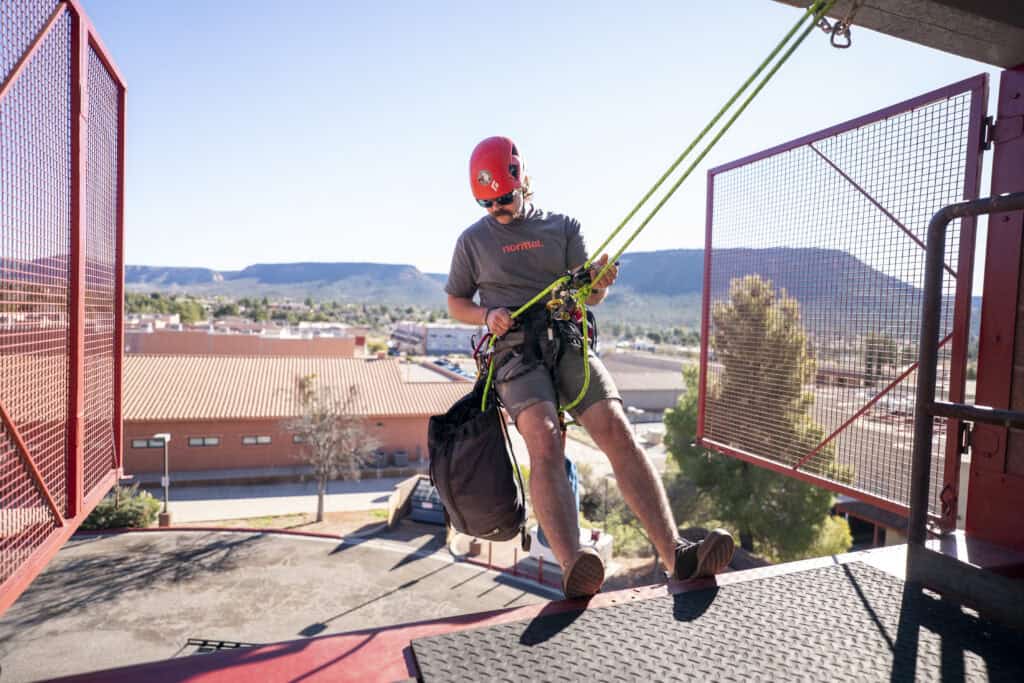
The district has an 18-member Technical Rescue Team trained for complex incidents. All SFD personnel are trained in rope rescues, which allows any crew to begin setting up an rope anchor system and patient care while specialized Technical Rescue Team members respond. Five members of the TRT work with DPS as helicopter rescue technicians, coordinating ground crews with the helicopters during hoist or short-haul operations.
Helicopter rescue training in particular was important for the Long Canyon incident in December, when SFD Rescue Specialist Brent Johnson, an engineer and paramedic, hoisted down to the scene by the DPS helicopter. Working on slanted, slippery rocks on a small ledge, Johnson and a DPS paramedic hoisted the patient into the aircraft and transported to him to Flagstaff Medical Center.
Johnson, 52, has been with SFD since 2005. Before that, he worked with the Harquahala Valley Fire District, 75 miles west of Phoenix. He graduated from Washington High School in Phoenix in 1992, where he met his wife, Kerry. The couple married in 1999 and have two children.
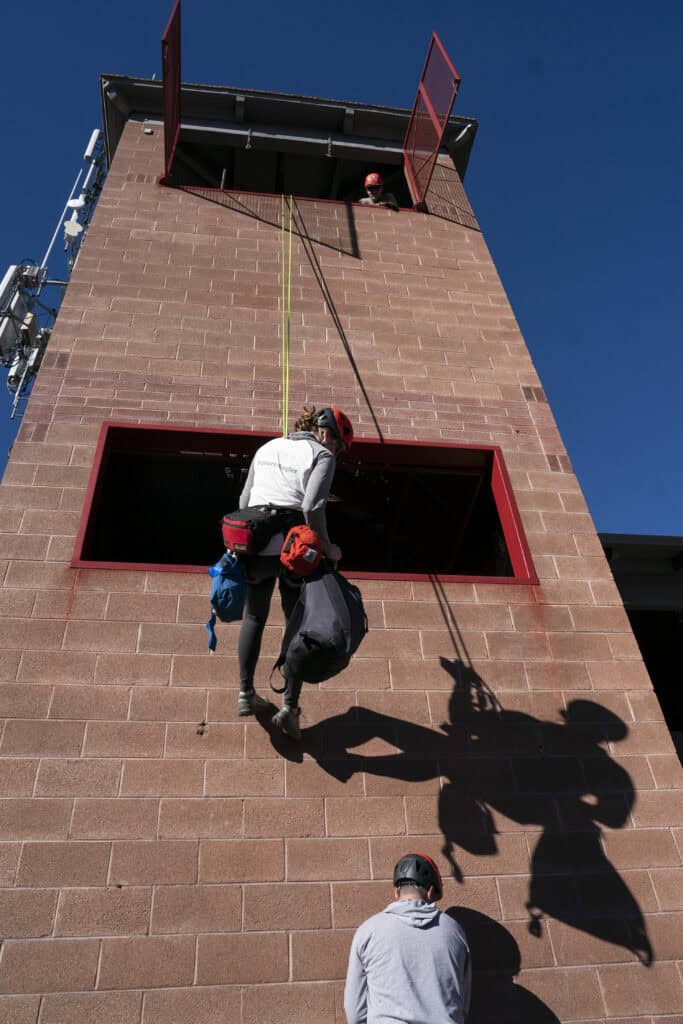
Johnson said what drew him to Sedona was the technical rescue work.
“Statistically, we’re on par with some national parks SAR units,” he said, with many NPS units reporting roughly 50 to 200 search and rescue incidents annually. “That’s a lot of business that a typical fire department doesn’t see.”
Johnson said while many people don’t realize the full scope of SFD’s services, the work is deeply rewarding.
“It’s satisfying to know that at the end of my career, I can look back and know that I’ve saved lives and helped people on some of their worst days,” he said.
DPS Partnership
While helicopter and high-angle rescues made up 10 of the calls to SFD in 2025, according to Romig, they remain some of the most challenging and complex incidents for the district.
“That capability carries added significance in light of the recent tragedy involving DPS Ranger 56 in Flagstaff,” Romig wrote about the Feb. 4 crash that killed DPS trooper and paramedic Hunter Bennett and pilot Robert Bruce Skankey. “Which underscores both the risks aviation crews accept and the critical role these assets play in modern rescue operations. SFD greatly values its partnership with DPS and recognizes hoist and short-haul rescue as essential life-saving tools for our community and visitors.”
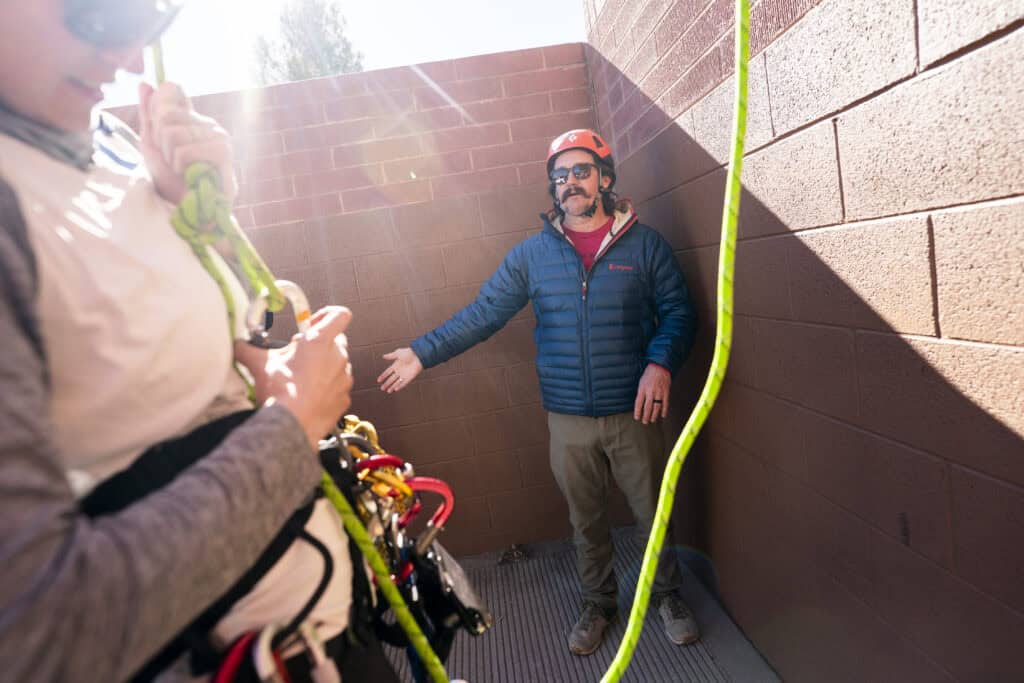
SFD maintains an agreement with DPS where the state agency trains SFD staff to operate on their helicopters while gaining access to specialists who know the terrain. When DPS responds to incidents in Sedona, crews can work with SFD’s Helicopter Rescue technicians, who serve as the third crew member for complex hoist operations. Johnson said the partnership has proven valuable since DPS transitioned to Bell 429 helicopters with hoist capability, reducing patient transport times to emergency rooms from over an hour to approximately 10 minutes, by allowing direct flights to hospitals rather than ground transfers into waiting ambulances.
“Our modern technical rescue program was born on the back of Brent and a few others, and they just have a passion for the outdoors,” SFD Fire Chief Ed Mezulis said. “They have a passion for rescue work, and they have a passion for doing it right. Early on, Brent spent a lot of time, working towards being a master trainer and a master of his craft, and that’s the same for all of our technical rescue instructors.”