















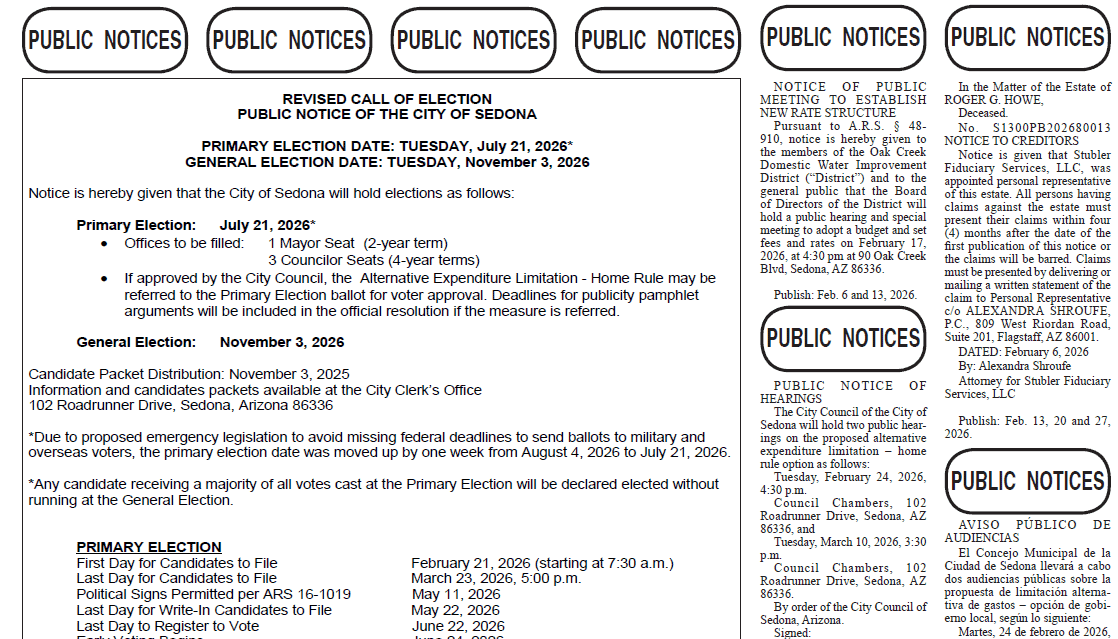
We want to the commend the Sedona City Council for taking a public stand in support of public records and the public’s right to know.
At the council meeting on Tuesday, Feb. 10, council members gave direction to staff to register the city’s official opposition Senate Bills 1167 and 1027, which would restrict the public’s access to public notices, which are currently required by law to be published in print in a newspaper of record, like your Sedona Red Rock News.
A notice published in a physical newspaper can not be deleted, removed or hidden when it becomes inconvenient for an incumbent running for reelection or a political hot potato for a local, count or state government.
If these bills were to pass, there would be no requirement to notify people in local newspapers of public meetings, road projects, government capital projects, which could instead be buried on obscure pages of government websites, placing the onus on residents, citizens and property owners to scour these websites daily to see what may be affecting them, their neighborhoods or the towns and cities.
The bureaucratic, officious and callous attitude by state lawmakers is reminiscent of the Vogons from “Hitchhikers Guide to the Galaxy.” That didn’t work out well for Earthlings, did it.
Fortunately, Sedona City Council is taking a stand and wants Sedona residents to retain their lawful access to government information through public notices by opposing these bills.
Arizona newspapers have been the primary fighters in the battle to keep government records open to citizens. The transparency fight moved to protecting the public’s right to know by keeping these notices in newspapers.
Public notices in the NEWS and other newspapers include notices on upcoming public hearings, proposed tax increases, ordinance changes, zoning changes, budget proposals, school district information and many other important government actions and information that impact people’s rights and lives every day.
Importantly, newspapers do this while providing independent, third-party verification information to the public.
In 2012, legislation attempted to set up a state website, but costs ballooned to a quarter million dollars before legislators realized the absurdity of having a government agency duplicate what newspapers do already far cheaper, more efficiently and with wider reach than a state hole-in-the wall.
House Bill 2554 in 2014 would have the Arizona Corporation Commission use taxpayer money to set up a website for legal notices. Arizona newspapers already publish public notices in their print editions, on and on a centralized statewide website — arizonapublicnotices.com — a database of public notices published in newspapers across the state since 1998. Simply put, the current system is working and working well.
Moreover, government has no business taking over a function currently being performed very well and cost-effectively by Arizona’s newspapers — thus taking private jobs and giving them to government — especially during tough economic times.
There are four elements that mark a valid public notice: The notice must be published by an independent party; the notice must be capable of being archived; the publication must be accessible; and the publication must be verifiable. If any one of these elements is absent, the notice simply cannot be properly authenticated and is subject to challenge.
The public must also be able to verify the notice was not altered once published. Websites are commonly hacked, go down for various reasons and website content can be changed — government websites are as fallible as any GeoCities site from the Internet’s early days. When published, however, an affidavit is provided by the newspaper, which can be used as independent, third party verification that the notice was made and proof of the true copy and exact text.
Lastly, the amount of money government spends on these notices is a very small part of the overall budget for cities, towns and counties. In almost all cases, the government spends less than one half of 1% of its budget on this valuable service. Now is the time to urge our legislators not to make changes to a system that works efficiently and cost effectively. If it isn’t broke, don’t fix it.
Contact Arizona State Sen. Mark Finchem [R-District 1] at MFinchem@azleg.gov; Rep. Selina Bliss [R-District 1] at SBliss@azleg.gov; and Rep. Quang Nguyen [R-District 1] at QNguyen@azleg.gov and urge them to oppose these anti-transparency bills.
We commend our Sedona City Council members for standing for you by protecting your right to know what’s going on in Sedona, your county and your state.