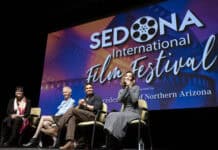

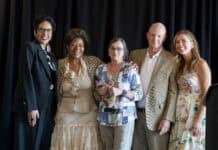

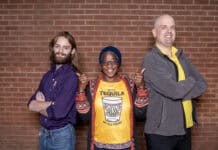







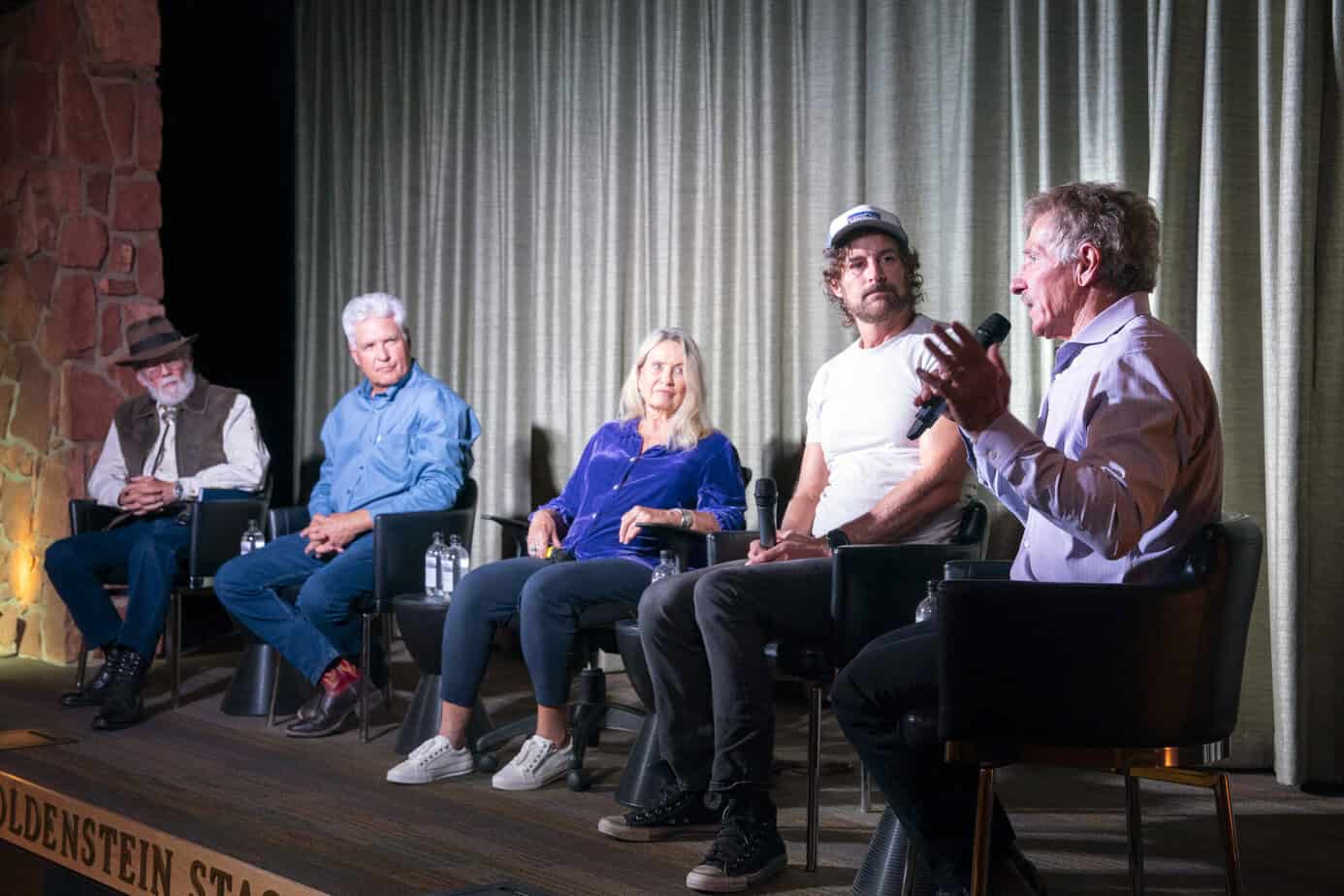
The Sedona Artists’ Consortium hosted its first Sculptors’ Symposium at the Mary D. Fisher Theatre on Tuesday, May 13, moderated by Goldenstein Gallery owner Linda Goldenstein and featuring artists Ken Rowe, Erik Petersen, Susan Kliewer, Chris Navarro and James Muir.
The Consortium is a project of Skip Daum, a retired lobbyist who moved to Sedona from Sacramento, Calif., eight months ago.
“I’ve been a modest collector, not big-time,” Daum said of his own forays into the art world. “I think I was 30 when I first spied a piece of art in Santa Fe, N.M. I didn’t know I had art in my heart. When I saw that bronze by Gene and Rebecca Tobey of a horse with a man underneath a horse, and the horse was sheltering him from the pelting rain, I started collecting after that.”
“Consortium to me means, ‘let’s get the people together in front of the public,’” Daum said. “I went to people I didn’t know from Adam or Eve, and I said ‘hi, I’m new in town, and I like your work’ … I was so fortunate.
“I go in galleries, I talk to an artist here, an artist there. They know about the other, but they don’t have coffee with them. They go back to their studio or their garage and they work for weeks not talking to anybody.”
Around 50 people turned out for the symposium on a Tuesday morning, which Daum said left him “very pleasantly surprised. People responded. And bronze isn’t the most popular medium.”
“Now I’m being asked, when is the next one and when will it be?” Daum said. “So I’m thinking about that. I learned a lot in this singular attempt, this brief foray into reality.”
Accidental Artists
The symposium offered an opportunity for the panelists to reflect on how their careers in art had come about not just by accident but as a result of the emergence of an internal drive to create.
“I fell into the weird world of taxidermy, and it wasn’t planned that I would become a sculptor, but it was a perfect foundation for what I was going to evolve to be,” Rowe said. “We’d go to social events outside the taxidermy world, and people’d say, ‘What do you do for a living?’ and I’d say taxidermy, and they’d step back. I found if I said taxidermy really fast, it sounded like ‘tax attorney,’ and then people would converse with you.”
“We took a college course in sculpture and I was hooked,” Rowe added. “It was one of those profound moments in life where this is it, I don’t care if I have to pump gas, I’m going to do this for a living in some way, shape or form.”
“When I was around 19, I walked into a bronze foundry to see a guy I knew who worked there, and the owner offered me a job. I didn’t know at the time that any kind of strong-looking young guy that walked into this place would be offered a job,” Petersen laughed. “He found out I was an artist too and I was hired on the spot.”
Petersen draws and paints as well as working in sculpture, attributing his early interest in art to an uncle who was a wild life artist. That uncle, Petersen added, now lives in his sister’s garage and collects Nerf guns.
“Typical artist,” Rowe commented.
Later, Petersen said, he received about five hours of training in how to patina a sculpture, “and I’ve just been doing patinas since then, for about 27 years … it’s by far the most creative. Some of the other processes, you don’t really have to consider yourself an artist to do them, but on patina you definitely do, so that was the most fulfilling for me.”
Petersen’s father also recently began sculpting at age 70.
“It’s never too late to get into the arts,” Goldenstein said.
“I always considered myself a painter,” Kliewer said. After moving back to Sedona from Marble Canyon, “I went to work at a restaurant called Rainbow’s End, which is empty right now, and that was nice, I knew everybody in town, and they’d all want to visit, so I got fired for being too slow. Thank God. That’s when I went to apply for a job at a foundry.”
“I didn’t even take art in college,” Navarro said, describing his journey to sculpture as a “roundabout” one that originated in his love of horses and cowboys and his early experience as a teenage bullrider. During a visit to Harry Jackson’s Wyoming studio in 1979, he encountered a sculpture of a bucking horse priced at $35,000.
“I said, ‘wow, I can’t afford one but maybe I’ll go make me one.’ That thing lit a spark in me,” Navarro said. He bought some supplies, took out a dozen books on sculpture from the local library and made his first sculpture of a bullrider that then won first place at the county fair. “I won a blue ribbon and $15. I said, I’m on to something here.”
“That dream of being an Army officer didn’t materialize, and thank God that it didn’t, because I would have been in Vietnam, and in hindsight I would have been responsible for someone getting killed,” Muir said about his two years at the West Point military academy. He described coming to sculpture at age 35 as finding a mission after having “squandered” years with jobs in the “bloodthirsty” field of real estate and as a private investigator and metallurgical chemist. “It just came through me, and it came through me for a reason,” he said of his very first piece, of a cavalryman, which he made overnight between 9 p.m. and 3 a.m. after working for several months with Kim Kori at Jerry Eaton’s foundry.
“Back then, you had to earn the right to live in Sedona … you couldn’t just buy your way into Sedona. You had to prove your self worthy,” Muir added.
‘Feel Those Muscles’
The sculptors also sang the virtues of live reference and depicting subjects with which they were familiar. Rowe said that the comment “You know, it’s really nicely done, but it’s dead” from another artist on an early mule deer piece he had sculpted from a photo was the best gift anyone had ever given him.
“Case in point, I was sculpting a grizzly bear,” Rowe continued. “On day three, [the handler] said, would you like to handle my bear? … The volume in that chest was like a draft horse breathing on me. When he breathed on me, I could see how big he really was. I looked at my sculpture. It was horrible. It was so weak in the chest. Because this grizzly bear just breathed on me, it changed every grizzly bear piece I ever did since then.”
“I’ve been to Yellowstone a couple times with Ken, and he’ll literally heap the clay up on the engine of the car to get it ready to sculpt. We’ll see some buffalo, stop, he has a little portable stand, go out there right in the field at Yellowstone and sculpt a buffalo live on site,” Petersen related. “My job is to handle the tourists.”
Kliewer quoted a piece of advice given to her by Cowboy Artists of America cofounder Joe Beeler: “‘You’ve got horses. Just go out and feel, just feel those muscles.’”
“The essence of the horse, even when you’re around them, I think it helps your work,” Navarro agreed, and also told the audience that his “Dream Catcher” sculpture for one of the Village of Oak Creek roundabouts was inspired by observing a raven perched atop a large dreamcatcher while bringing a load of horses through Page.
“Everyone up here is doing what that they know,” Muir said. “Do what you know, not what somebody else is doing, or what you think is popular, making money on it, heaven forbid.”
‘Faith, Confidence & Ignorance’
What did these artists think it takes to be an artist?
“You need three good things to be a good bullrider, and you need those same three things to be an artist: You need faith, confidence and ignorance,” Navarro said.
“Everyone has applied their God-given talent in a unique way,” Muir said, emphasizing the importance of “nichemanship” and specialization, in his case as part of “my quest for lighting the path towards human liberty, individually and collectively.”
“The ideal is to simplify, simplify, simplify, in life as well as in art,” Muir added.
“It’s a lot of work for very little money,” Petersen said of the work required in a foundry. “You have to hire people for close to minimum wage to start, and I think artistic young people, with the internet, they can get on YouTube and make videos and do art on computers … it’s really hard to find anybody wanting to do that.”
“The biggest problem is the labor force,” Navarro agreed.
However, Petersen also called attention to an exception to the trend.
“This is Natalie,” Petersen said, calling one of his students up on stage, who had come second in the Phippen Museum’s sculpture class at age 12 and had later asked him for a job when she turned 15. “She came in for a day, and I said it’s not going to be paid or anything — well, after she worked that day, I literally said, ‘you’re hired.’ She came back the next day and it wasn’t long before she was one of my most important employees. This was four years ago. She’s 19 now.”
“Some young people are willing to work hard,” Petersen concluded.
“I like acronyms, so I came up with SMART: Sedona Means Art,” Daum said afterward. “Art means business in this town.”