











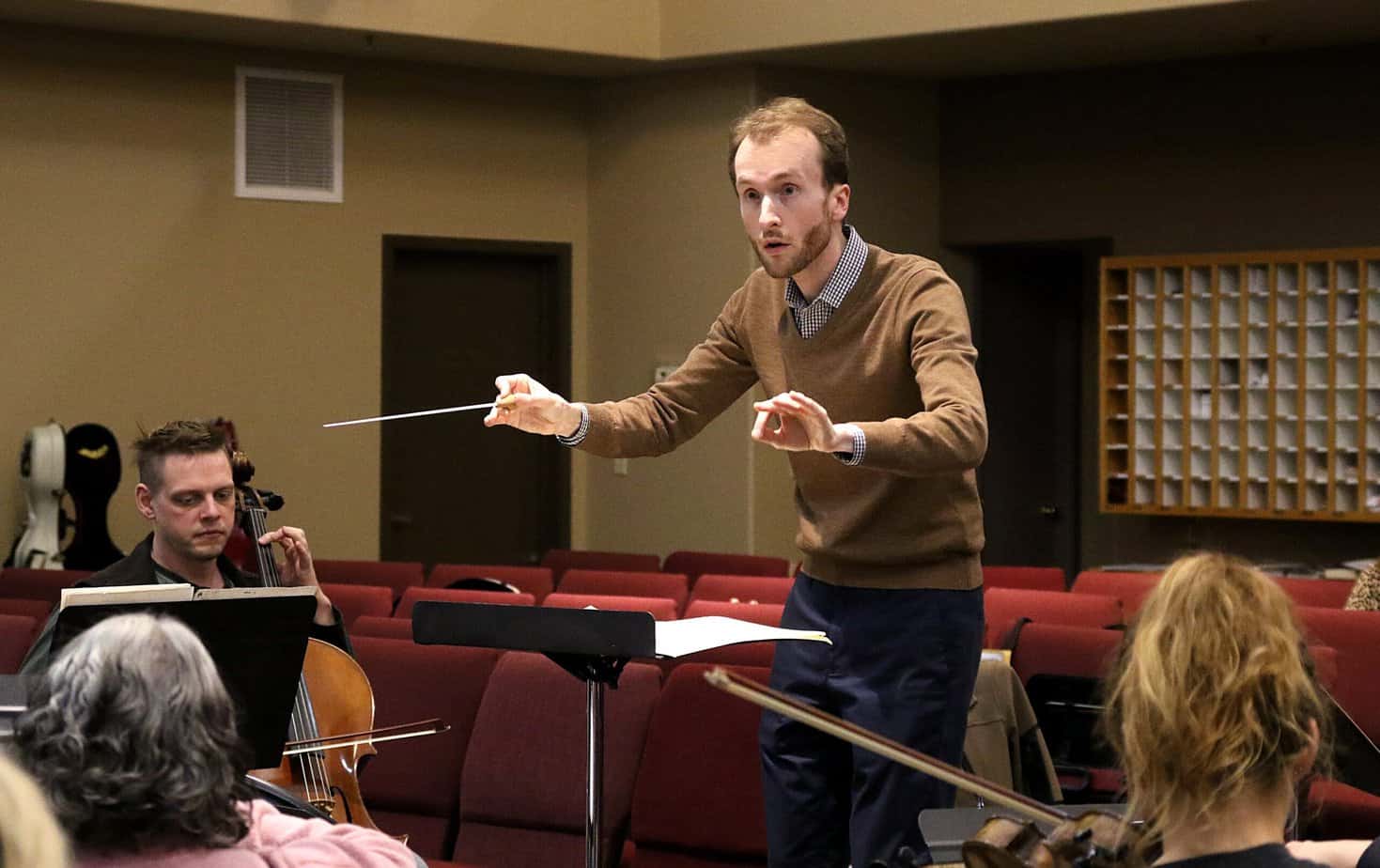
The Sedona Symphony has selected its new artistic director for the upcoming 2025-26 season and hopefully beyond: William C. White, since 2018 the conductor of the Harmonia orchestra and chorus in Seattle.
Selection
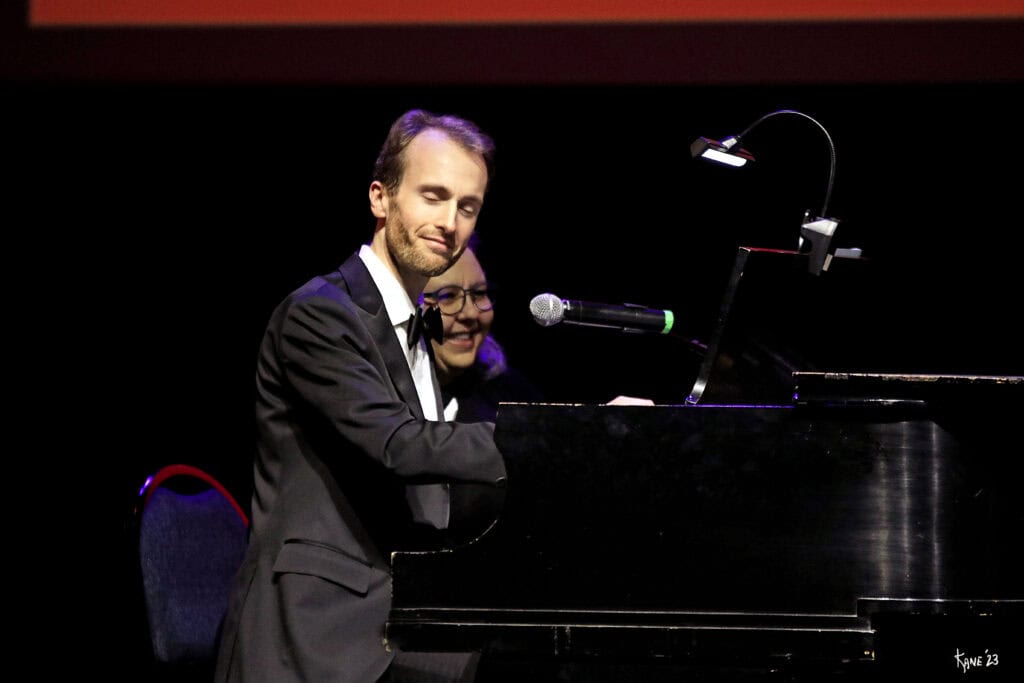
A composer as well as a conductor, White was previously one of the four finalists for the position during the Symphony’s 2022-23 audition season, during which he was faced with the last-minute disappearance of the orchestra due to a January snowstorm, and rose to the occasion with aplomb by first performing as an accompanist for soloist Rachel Priday and then delighting the audience with a song cycle he had written based on the Instagram posts of Martha Stewart.
“They still had me on their radar screen, and I think that they preferred not to have to a whole new search, so they called and asked if I would still be available and interested,” White said of landing the job this time around. “Didn’t take very much negotiating or coaxing or anything like that. It’s all pros, no cons.”
He described the Sedona Symphony as “a really complementary kind of organization” to his other orchestra.
“Because the orchestra in Sedona is definitionally a chamber orchestra, there’s a certain variety you can explore with them, but it’s different repertoire than my bread and butter up here in Seattle,” White said. “For example, this coming season, I’ve programmed a Mozart symphony, and I thought about this long and hard — this will only be the second Mozart symphony I’ve conducted in my 20-year career conducting orchestras … To do Mozart and Haydn and Beethoven and some of the Neoclassical stuff, and maybe some smaller Romantic works and Baroque music, I think that we’re going to get a really nice mix, and it’s some stuff that I wouldn’t get to do otherwise.”
He also alluded to the logistical advantages of conducting an orchestra without a choir.
“Leading just an orchestra is a lot easier,” White said. “When you conduct a choral orchestral work, it’s halfway to conducting an opera, you just don’t have the element of people moving around on stage. There’s a lot of extra stuff you have to understand — the text, which is often in a foreign language, you have to understand exactly how the text scans and what the composer was trying to do in setting the words to music. You’re constantly dogged by questions of balance … When I conduct just an orchestra, there is a certain freedom and a certain ease that you don’t always get when you’re working with vocalists.”
However, White added, “I can’t promise anything, but to include a choral element in the Sedona Symphony’s programming at some point in the future is certainly a goal, and I know that it’s a goal shared by the board.”
2025-26 Season
Another of his goals is to introduce more Franz Joseph Haydn works to a well-adapted Haydn orchestra.
“The problem is that I would program three Haydn symphonies on every concert program if I possibly could,” White laughed, revealing that the Symphony’s opening concert of the season will feature Haydn’s Symphony No. 99 alongside Wolfgang Amadeus Mozart’s reorchestration of the overture from George Frederick Handel’s “Acis and Galatea,” which will be the 10th or 11th Haydn symphony he has conducted. “I’m about as big a Haydn fan as you can get. It’s an unfortunate thing with Haydn — there’s just this perennial, I hate to say truism, but it might be so, that Haydn doesn’t sell tickets. So I’m going to use the excitement surrounding my first concert with the orchestra to plead the case of Haydn with the audience … Nothing would make me happier than to make Haydn a regular part of the musical diet.”
“I figured we’re doing Beethoven’s first piano concerto, and somehow, to do the 99th symphony of Haydn’s would somehow complement it,” White continued. The concerto will feature soloist Jon Nakamatsu, while the Symphony’s second concert will include marimbaist Abigail Fischer and the third will highlight concertmaster Sara Schreffler in a trio of pieces by Clara Schumann.
“On the final program we’ve got a young artist. I think there hasn’t been a young artist appearing in the season in a little while,” White hinted about the soloist in the Felix Mendelssohn violin concerto.
“One thing that I’m planning to add to the presentations overall are pre-concert lectures. That’s something that I’ve done a lot of, and I think it’s a great way to invite people into understanding something that they really want to know more about,” White also revealed. “Any conductor has to make the case for every piece afresh.”
In the long term, White said, “there’s a lot of ways to develop an orchestra. It could be development in terms of the number of concerts that are given in a season, it could be development in terms of the size of the orchestra, and that of course affects the repertoire you do … or it can be a development as people in the orchestra turn over.”
Self-Taught Keyboardist
“I never considered myself an instrumentalist. I was one of these weirdos who, from a very young age, knew that I wanted to be a composer and conductor,” White said. His first instrument was the viola before it was supplanted in his enthusiasm by the piano. “I learned piano on my own. I’m a self-taught keyboardist. I was obsessed with it as a kid, much more than I was ever obsessed with playing the viola and I just kind of fell in love with it.”
He nevertheless had high praise for the viola, which he described as “an instrumentalized instrument on my path to my true passion.” “I chose the right instrument, and somehow the instrument chose me, in terms of playing the viola, because when you play the viola, it’s not competitive like the violin,” White reflected. “You can get into playing pretty high quality orchestral and chamber music without the cutthroat competitiveness of going after violin. Viola was my entree into the orchestra, and it was the orchestra I always loved. Viola is a great instrument because as a conductor you work with the strings in a very primary kind of way. I always tell young conductors, if you don’t play a string instrument, learn the viola. You learn the technique in terms of violin and viola, you learn the strings of the cello and the viola and you’re forced to learn the alto clef, which is always a great hole in any musician’s training. To play in a string quartet, like a Haydn string quartet, you don’t have to get that far on the instrument to play those parts, which are not all that hard. In a short amount of time you’re able to exposure yourself to excellent music in a visceral way.”
“I’m afraid I barely play the piano at all anymore. I use the keyboard as a tool for composing and studying scores,” White admitted. “The one bit of performing that I do is I do play harpsichord for Harmonia here in Seattle. We have a performing tradition of Handel’s ‘Messiah’ which includes two harpsichords, so I play one and my colleague plays the other. That’s a lot of fun, and that’s a very improvisatory way of playing keyboard, so I really enjoy that.”
‘What Am I Adding?’
“It takes so long to get your 10,000 hours, shall we say, and to feel like you’ve really mastered working with an orchestra. For conducting, I’m still adding basic elements to my repertoire,” White said. “It’s really only in the past five to 10 years that I’ve regularly been conducting works for the second time. The second time you conduct something, it’s a whole different ball game from the first time … there’s so much more depth that you can go into. So I’m really enjoying this period of my conducting career.”
“Now, in terms of composition, that’s a little different,” White continued. “When you’re starting out as a composer, you just iterate really quickly. You just jump into it, you don’t think too much about things, there’s no hangups, you’re just getting everything on paper for the first time. Now that I am a more experienced composer, I spend a lot more time thinking about what I want to ‘say’ with my music … You really have to push yourself to think about, why am I composing this, what am I adding to the repertoire, what am I adding to a world that’s replete with music already? There is a little bit of slowing down, yet I feel like each piece is imbued with a little more personal significance.”
“Very few people get to be a full-time composer. I’ve had maybe a year or two here or there in my career where I’ve had that privilege,” White said. “Now that I’m going to have two pretty serious conducting jobs, the time for composition diminishes. I do have three pretty big projects that I’m embarking on this year.”
“A conductor should be an enabler of the composer’s voice and of the musicians on stage,” White said of the orchestra leader’s role, adding that he was not “rigid” about considerations such as metronome markings. “With any piece of music, from any composer, you do what works, and that’s going to change from orchestra to orchestra, that’s going to change from venue to venue and it’s going to change from performance to performance … At this point I trust my gut. Whenever I’m studying a score, I will listen to the metronome marking that is marked, and I will take that into account, but it’s just one piece of data that’s stacked against a number of things in terms of performing traditions, my personal experiences and my own preferences.”
His own preferences also include substantial tastes in nonfiction.
“I’m constantly reading long composer biographies,” White said. “I just finished reading Allan Walker’s three-volume multi-thousand page biography of Franz Lizst, who’s a composer whose music I’m not even very sympathetic with, but, boy, what a life. Now I’m rereading a Haydn biography.”
In addition to composing and conducting, White publishes a newsletter on all things musical at toneprose.substack.com.