













The stars looked very different Sunday, April 17.
The Sirius Lookers — one of the Verde Valley’s stargazing clubs — celebrated Astronomy Day with a slew of equipment in the parking lot of the Safeway complex as the sun faded behind the rocks.
The parking lot, with its lighting and proximity to the road, may not seem like an ideal place for stargazing — and it isn’t — but Sirius member Bill Smith said it was a good way to bring the public in.
The telescopes were brought in by fellow club member Dennis Young. The first focus of the evening is readily identifiable — the moon.
Several telescopes pointed in its direction, but it was Young’s own creation that made Earth’s sole satellite stand out. Young created a tubeless telescope with an 8-foot turning radius. He fabricated the whole thing himself, with the exception of the glass, which he said in today’s market costs around $18,000 with a $1,000 coating on it.
Shoppers-turned-stargazers waited their turn to climb up two steps of a ladder to look through the viewer. Young joked that the steps to the viewer were akin to walking on the moon, and looking through the viewer it nearly seemed so.
“And you’re on the moon, little Neil Armstrong,” Young said to a child as he ascended.
Young said the telescope brought the viewer to the perspective of being 200 miles above the surface of the moon. For the Apollo missions, orbit was achieved 60 miles above.
The wait for the viewer took several minutes, as crowds gathered.
“The best sights are the last ones,” Young said, though. He said that helped people be more patient during previous showings, he has had thousands of individuals line up through the years, and that it was pretty much true. As the night goes on, many objects move higher in the sky, where there is less atmosphere to look through and therefore, a clearer view. Another tip Young gave was to look at the terminator — the point where night meets day — on the moon for sharper contrast.
Before moving onto the next object, those in attendance were able to see the International Space Station make its orbit. Though traveling too fast to put a telescope on, the football-field size ISS could easily be seen as a bright spot of light.
Then it was on to the heavyweight of objects orbiting the sun — Jupiter. The planet was just above and to the left of the moon that night, and even through some of the smaller telescopes, some of its moons were visible.
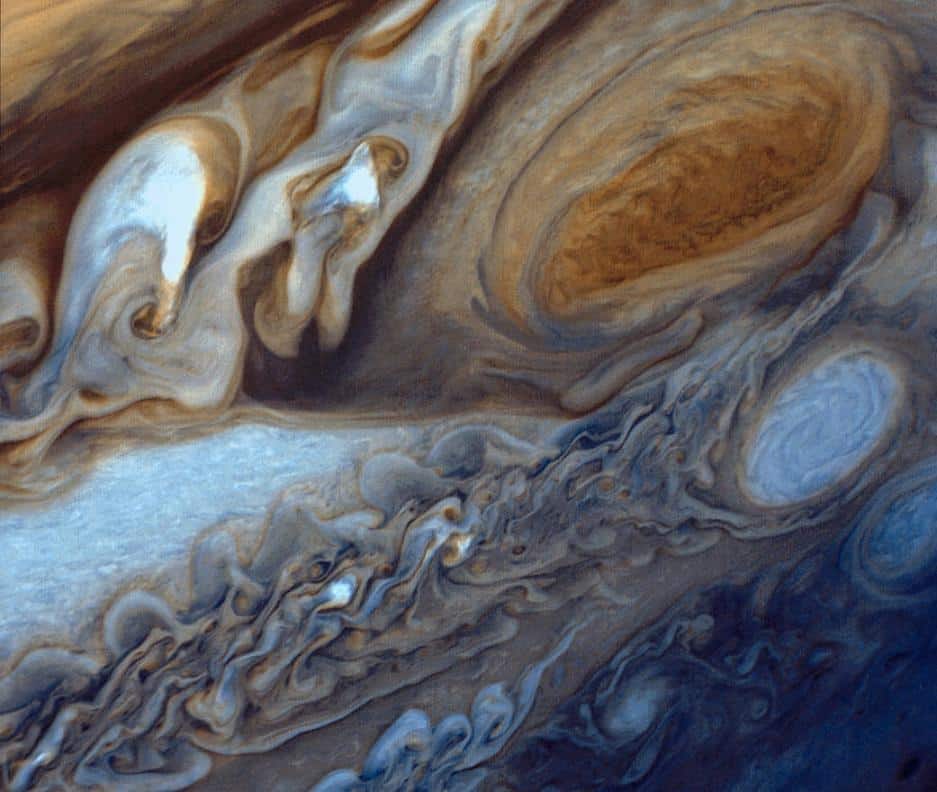
Jupiter has 67 known moons. Looking through Young’s creation, spectators could also see the planet’s swirling bands, with faint color, as well as its most recognizable feature — the red spot.
The spot is a hurricane some two-and-a-half times the size of Earth. It rotated as viewers took their turns, as Jupiter has a fast orbit compared with Earth.
Looking at the planet was also looking back in time. The light from Jupiter reflected from the sun takes about 40 minutes to reach Earth, whereas the light from the moon arrives in 1.3 seconds.
Young said that if Jupiter were as close as the moon — barring other effects — the disc of it would encompass 75 percent of the night sky.
After everyone had seen the planet bigger than all others in the solar system combined — it was off to view objects not visible with the naked eye.
The Sirius Lookers meet the third Wednesday of every month at the Sedona Public Library. The next one is one April 20, at 7 p.m.