













Sedona Poet Laureate starts new lecture series on Arizona’s rich past
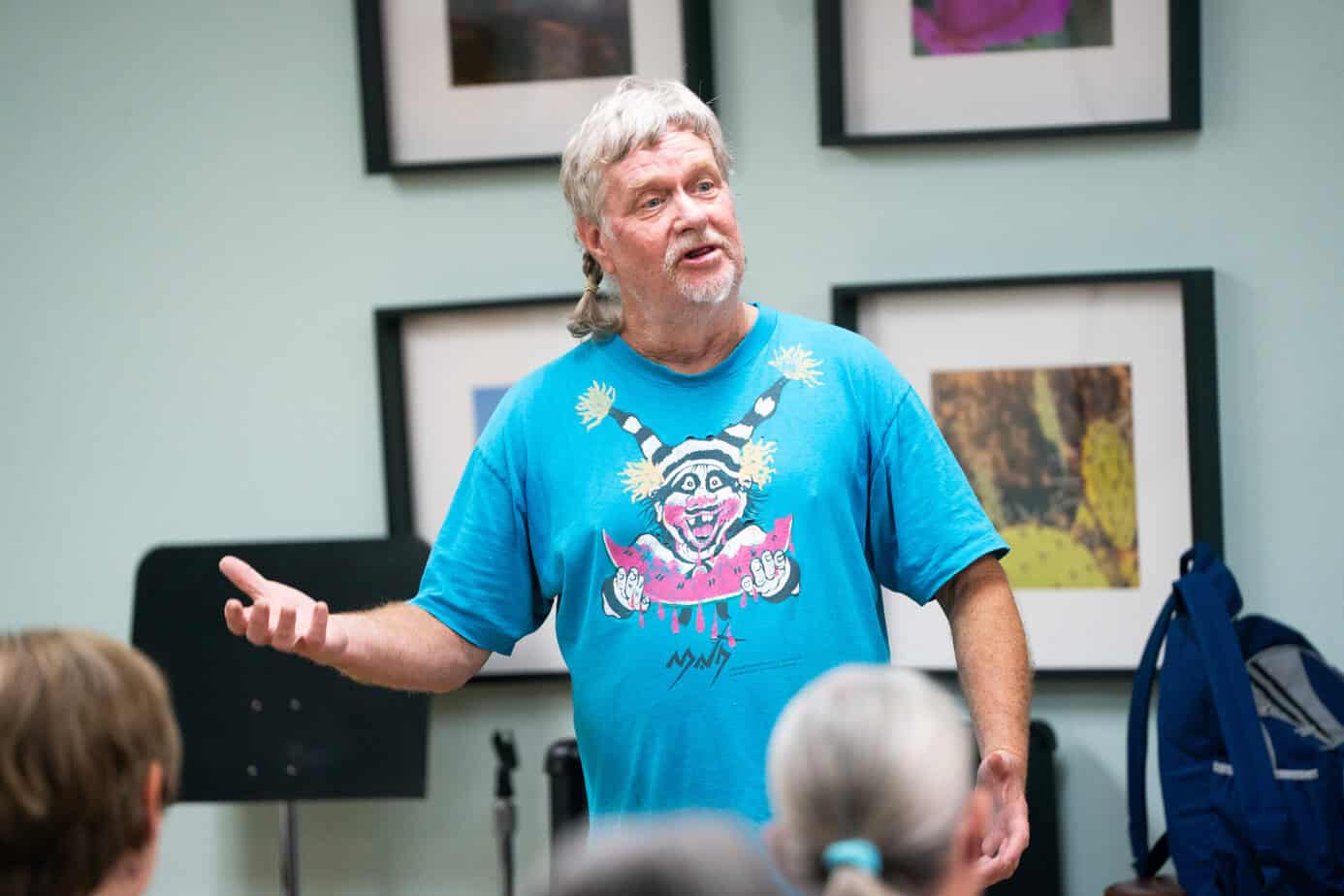
Sedona Poet Laureate Gary Every has started sharing his love of storytelling with free lectures at Sedona Winds Independent Living, most recently on Aug. 7, by diving into the history of the conquistadors.
Arizona’s chapter of that story, he said opens not with a Spaniard but with an enslaved African named Esteban de Dorantes.
“The first post-Columbian explorer, again and again in the Southwest, was this black Muslim man. Not how we picture conquistadors,” Every said.
When the ill-fated Narváez Expedition departed in 1527, with the goal of exploring Florida and building settlements, Esteban sailed as the slave of a captain, Andrés Dorantes, along with a crew of about 600 men.
“They would read something called the requerimiento on all the beaches, every place they landed, … saying ‘the Pope gave you to us,’” Every said. “‘If you don’t become a Christian immediately, we can do whatever we want with you.’ But they claimed it was a legal precedent.”
The document was read in Spanish, to people who did not speak it and occasionally, by later accounts, from shipboard or to villagers still asleep.
The Narváez Expedition went badly almost immediately. A hurricane and other storms destroyed two ships, they hunted gold in a land with none. Repeated defeats by Apalachee archers who could drive an arrow through Spanish plate armor.
By the time the survivors reached the Gulf Coast, Every said, the expedition had lost every perceived advantage.
“All the things they thought made them special — having iron for armor and swords and guns, having horses, being Christians — just aren’t working for them here,” Every said. “So they begin to eat the horses. They melt down all their weapons and armor to try and make these crude barges so they can escape. They no longer feel so superior.”
A September 1528 storm scattered the rafts, and roughly 80 men washed up on Galveston Island off the Texas coast.
The peoples who found them took them as slaves, and the survivors kept dying — leaving Álvar Núñez Cabeza de Vaca, Alonso del Castillo Maldonado, Andrés Dorantes de Carranza and Esteban.
“Life is hard. Disease and plague are going ahead of the conquistadors. Measles, smallpox, all these things. Eighty percent of the populations of the Native Americans in these regions are dying in a few years,” Every said. “What would you do if 80% of Sedona disappeared tomorrow? Where would you get gas? Would there be anybody stocking the grocery stores?”
The four spent eight years wandering 5,000 miles crossing Texas and the borderlands on foot, arriving at the Spanish outpost of Culiacán in Nueva Galicia, an autonomous kingdom in the Viceroyalty of New Spain, or what is now Sinaloa, Mexico, in July 1536.
Along the way, they began performing faith healings among the sick, and their following grew into the thousands.
“Native Americans communicated with a continental sign language. Esteban learned sign language. He learned bits and pieces of seven or eight different languages,” Every said. “They send him ahead as the scout in every village they go to.”
“The testimonies from their journey would fuel the rumors of wealthy civilizations in the north,” according to the Coronado National Memorial.
“Viceroy Antonio de Mendoza began dreaming of the expedition to find these fabled cities of ‘Tierra Nueva’ and desired experienced travelers to lead a reconnaissance expedition to scout the region. Who better to lead the journey than the surviving members of the Narváez Expedition?”
The other three Narváez members declined the journey, so Mendoza purchased Esteban from Dorantes de Carranza and had Franciscan priest, fray Marcos de Niza, accompany him to Cíbola.
The travels through New Mexico made Esteban the first nonnative person to make contact with the Zuni.
“Esteban walks up to the edge of the pueblo,” Every said. “He’s got his greyhound with him. He’s got servants carrying his plates so he can eat on plates in the wilderness. And the Zuni are offended.
“Remember, all they’re seeing is brown people. That’s all they have ever known since people have been on the continent. And here’s the first white people, and they sent a black ambassador. And so they drew straws. One man drew the short straw, and he had to be the one to shoot Esteban with his bow and arrow. Because if he’s a god, well, then they’re just mad at one person. If he’s not a god, then he’s going to die. Well, he died.”
Reasons for Esteban’s death differ with David J. Weber’s book “The Spanish Frontier in North America” writes that “the Zunis killed the black man, they explained to [conquistador Francisco Vázquez de] Coronado, because of liberties he had taken with their women.”
Every will give his next free talk at 11 a.m. on Friday, Sept. 25, at Sedona Winds on ghost towns, American Indian ruins and lesser-known places of the Verde Valley, for more information call 928-284-1021 and ask for Norene.


