












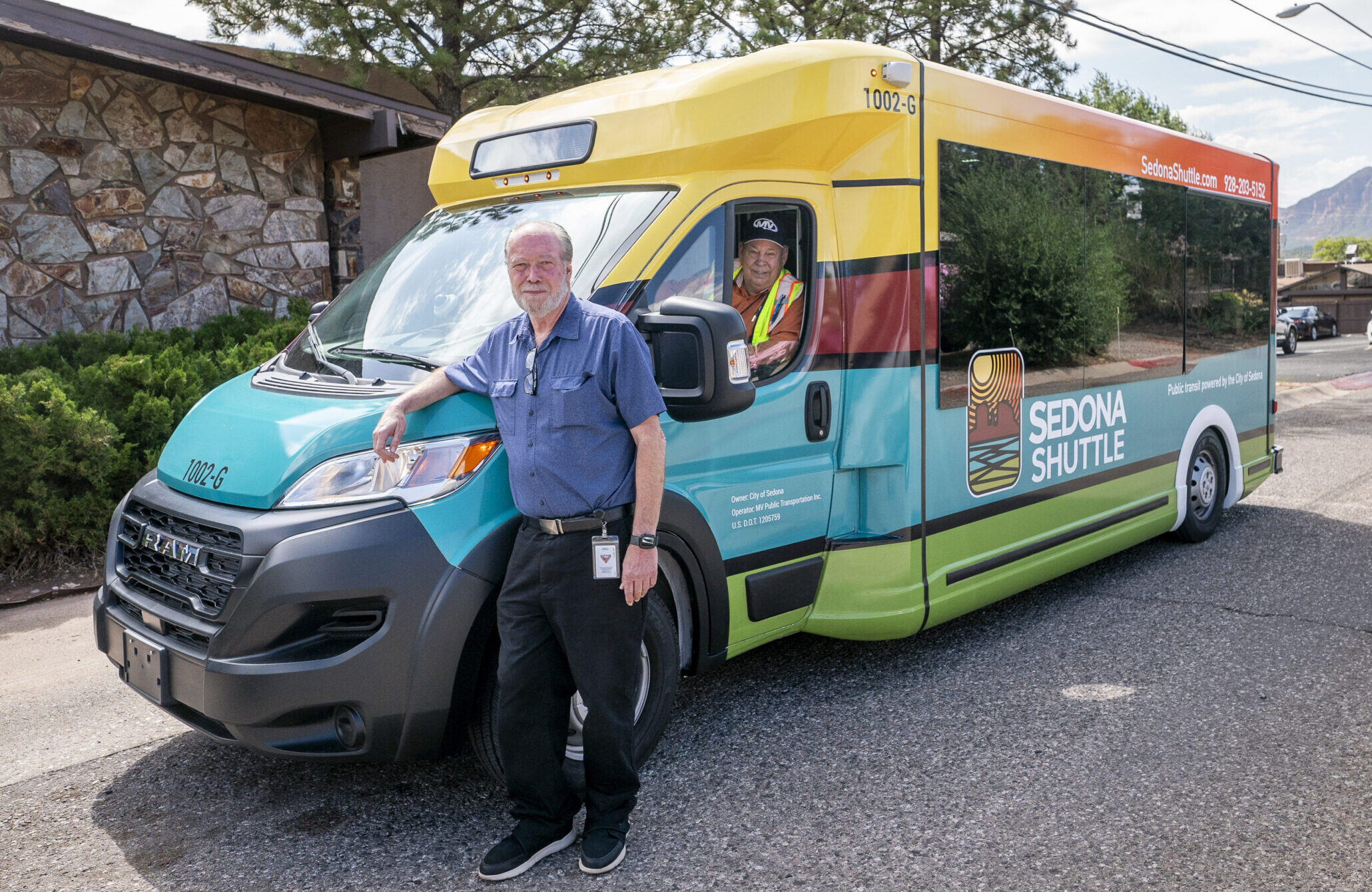
The annual numbers for the city of Sedona’s trailhead shuttle system indicate that the trailhead shuttles appear to have reached a fairly constant rate of utilization, with 2024’s numbers showing only a slight increase from those in 2023.
Figures for microtransit show slowing interest in the system in its fourth month, with ridership down by about 10% from October to December, Sedona’s busiest months, although per-passenger costs have now fallen below three figures.
Microtransit
On the lighter side, the microtransit shuttles carried a total of 825 passengers in the last week of August and the month of September, compared to 1,054 in October, 1,019 in November and 952 in December, for a total of 3,850.
Dec. 28 was the busiest service day, with 177 passengers, while Dec. 21 was the slowest service day with 18 passengers. Average daily ridership was 62 in October, 51 in November and 50 in December.
Former city Transit Administrator Robert Weber estimated the annual cost of microtransit operations to be $1.1 million, or $21,154 per service weekend, putting the system’s average cost per passenger at $98.90 over the 18 service weekends through the end of 2024.
The microtransit system booked 540 separate rides in October compared to 547 in November and 476 in December for a total of 1,563 completed rides and an average of 1.9 passengers per ride for the three month period, up from 1.7 passengers per ride in August and September, while 168 bookings were canceled and 24 were no-shows. The average number of rides per service day was 27.9 for October through December, up from 22.9 in September.
Weber previously stated that he was projecting an average of 150 trip requests per day.
Microtransit shuttles covered a total of 10,148 miles during the October to-December period, or 3,486 in October, 3,523 in November and 3,139 in December, making a total of 13,513 miles traveled since the system was introduced, for an average distance of 6.6 miles per ride.
On-time performance for the system was 87% in October, 88% in November and 83% in December. Forty-six percent of rides were booked using the system’s smartphone app, down from 54% in the August-September period, while the number of walk ups remained constant at 10%.
Maps provided by Weber indicated that the most popular pickup points for the microtransit system were the Church of the Red Rocks [178], the Uptown Verde Shuttle stop [149], Whole Foods [104], the Shadowbrook Apartments [102] and the West Sedona Marriott [100], while the most popular dropoff locations were the Uptown Verde Shuttle stop [175], the Church of the Red Rocks [148], the West Sedona Marriott [142] and the Shadowbrook Apartments [126].
Trailhead Shuttles
Total boardings for the trailhead shuttle system in 2024 were 342,575, a 2.4% increase from 334,481. Boardings for the first partial year of service in 2022 were 213,425. Average daily boardings for the entire year across the system were 1,458 in 2024, up slightly from 1,408 in 2023. The average daily boardings for each month of 2024 were:
- January: 1,255
- February: 1,469
- March: 1,951
- April: 1,953
- May: 1,684
- June: 967
- July: 649
- August: 735
- September: 1,129
- October: 1,488
- November: 1,908
- December: 1,670
Average daily boardings for February, March, August, November and December were up compared to 2023, while daily boardings for April, June, September and October were down.
For the period May through December of 2024, 12.5% of boardings took place on the number 11 Dry Creek and Mescal route, compared to 5.1% for the number 12 Dry Creek route, 20.4% on the number 14 Soldiers Pass route and 61.9% on the number 15 Cathedral Rock Route.
On-time performance declined significantly over the course of 2024, from 82.2% in May and 89.6% in June to 75.1% in July, 78.4% in August, 69.9% in September, 79.12% in October, 72.9% in November and 65.7% in December. Average vehicle miles traveled during the period were 11,308 per month.
The city’s fiscal year 2024 budget for transit, prior to the startup of the microtransit system, was $3,063,320. During the fiscal year, the shuttle system logged 348,674 boardings, for a cost of $8.79 per boarding or $17.58 per round-trip passenger.