















Rent Local, STR deed restriction programs may be discontinued; city has $19 million in fund
Sedona City Council heard an updated draft of the city’s Balanced Housing Strategy on Sept. 8, from Community Development Director Tony Allender and Housing Coordinator Laura Stewart.
The city aimed at a target of 775 new housing units over the next decade, following several public input sessions over the summer on the plan.
Council gave the initial plan mixed reception and Community Development will bring a revised version back for council consideration during its Tuesday, Oct. 13, meeting.
“The thing that I think makes this different is that we have very definitive data to defend,” Allender said to the NEWS about why he thinks the city is equipped to tackle housing. “Two: We have to think of this in terms of achievability. We can’t… It’s easy to say we need to fix affordable housing. We had a 2020 study that said we need to go out and come up with 1,300 [or] 1,500 units because of the number of cost-burdened households.
“The thing that makes the Balanced Housing Strategy different is we have dived further into the details. We have a better understanding of the types of units, the audiences we need to be attracting, the types of things that we need to be thinking about in order to make that type of housing possible.”
Additionally, Allender noted that the city has $19 million to spend in the city’s housing fund to help achieve its goals.
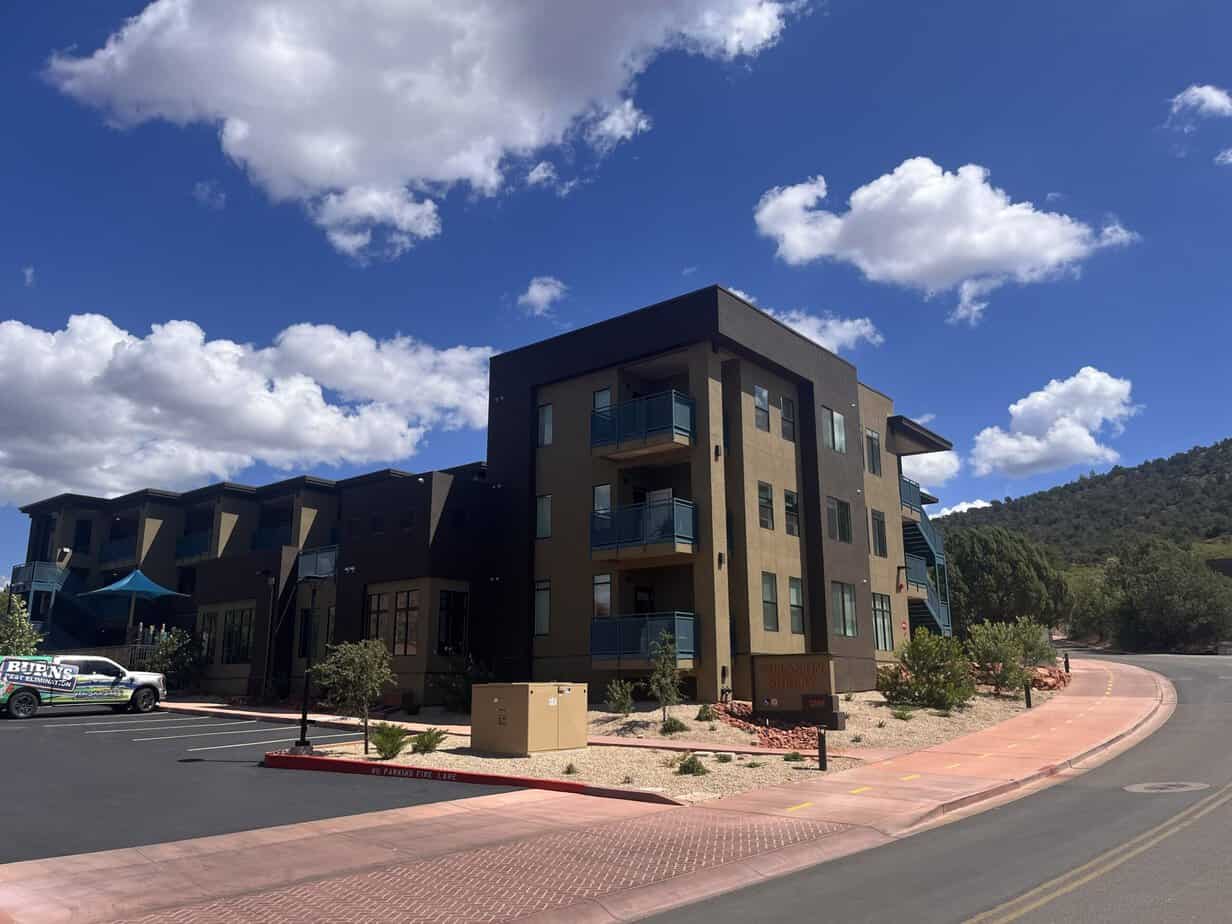
Some 29% of the plan’s 775-unit target are already in the works: Navajo Lofts at 10 Navajo Drive with 60 units under construction, Goodrow Housing at 60 Goodrow Lane has 51 units in its design, Village at Saddlerock Crossing at 82 Saddlerock Circle has 46 units in its design, the Villas on Shelby at 2250 Shelby Drive completed 30 units, Jordan Townhomes on Jordan Road has 19 units under construction and Alkemista at 2144 W. SR 89A has 15 units under construction. Of those 221 units, 73% are slated to rent and 27% to own, and 54% will be offered at market rate, with the remainder restricted at 60%, 120% or 150% of the area median income.
Among Allender’s directions from council stemming from the meeting are: Reduce the draft’s 22 strategies that contain 45 numbered actions down to a more manageable total, create annual benchmarks for the program over its 10-year duration and create a means to prioritize its goals.
“You guys did a great job on this,” Councilman Derek Pfaff said. “I just questioned the volume of it… but this seems to me like something that would need a lot of people. So in addition to prioritization and maybe whittling it down a little bit, take the extra time,” before it comes back to council, “to look at that and say, what is the bridge too far? The more goals you create, the less likely you’re going to be to achieve some of them. I’m not an optimistic person by nature.”
The plan identifies four priority groups the city is trying to close housing gaps for in Sedona:
■ Working-age households with children
■ Working-age households earning between $50,000 and $200,000
■Working-age households with people employed in hospitality and service industries
■Housing-vulnerable senior households.
The plan’s 10-year targets are to: Raise Sedona school enrollment 50%; increase the city’s under-65 population share to 60% (in 2025 the median age in Sedona was 64.1 and those 65 and older made up 48.1% of the city’s population); grow critical employees living in Sedona by 15%; cut senior households’ economic vulnerability 25% and functional vulnerability 35%; reduce cost-burdened hospitality and service households by 25%; lower the number of workers commuting into Sedona by 10% to 70%, and make at least half of working-age units ownership.
Discontinuations
Allender said he recommends the city’s Rent Local program be discontinued; it incentivizes short-term rental owners to convert the property into long-term rentals providing up to $10,000 annually for a three-bedroom unit. The $141,000 of its $240,000 budget has been paid out and only 14 properties have used the program; the remaining funds are recommended to be used and the program will remain open until the monies are exhausted.
Council originally approved the program on Aug. 9, 2022, and by December 2023, then-Sedona Housing Manager Shannon Boone said that only four units had been converted; it “has not been wildly successful.”
Allender said that the program was unsuccessful because the units in the program are “inevitably going back into the short-term rental market, so it’s more of a brief hiatus for them. So it doesn’t really, we don’t really capture affordability except for a short term, and so it doesn’t give us anything except for an incredibly short period of time. We don’t gain affordability by that program; we think we can use those resources elsewhere.”
The city is also slated to replace the Development Incentives and Guidelines for Affordable Housing policy that provides guidelines and incentives for affordable housing construction in the city, with the “Public Investment Program.”
“The DIGAH has been around for an incredibly long time, and so it’s long in the tooth as it is and right now, it only addresses two things,” Allender said to the NEWS. “The DIGAH is designed to create flexibility in the codes, so that you can have some additional height, or you can have some reduction of setbacks — some tinkering with the codes.”
Allender anticipates the Public Investment Program will be in place around the same time the city completes its Land Development Code update, estimated to be adopted in December 2027.
Community Development recommends discontinuing the Voluntary STR Deed Restriction program that has been in place since 2023.
“Owners have placed restrictions on 14 properties to date,” according to the council packet.
“The code critique is now open, so it’s available for people to review,” Allender said. “It’s located at engage.sedonaaz.gov, and that’s where we’re going to have public engagement for a number of our different planning-related activities.
“The other big thing we’re kicking off is the Uptown and Arts Community Focus Area study, and both of those will have spots for digital public engagement.”
Allender confirmed that Community Development is in the early stages of creating a land trust partnership, potentially with Housing Solutions of Northern Arizona or Verde Valley Community Land Trust.
“There is no question in my mind that a land trust is going to be a critical partner in our ability to move forward, particularly if we want to be considering permanent affordable housing,” Allender said to the NEWS.
Cold Weather Shelter
The city’s Cold Weather Emergency Shelter Program — given an initial budget of $15,000 and provides hotel rooms to the homeless on freezing nights — has now had 17 people use the program over 36 nights, according to the council packet. As of Jan. 13, only one person had used the program after the city finalized its contract Aug. 3, 2025, with Catholic Charities to administer the program.
Allender said he is not asking for any additional employees for his department under the Balanced Housing Strategy, but the vacant housing manager position will be retooled to be classified as a housing implementation specialist.
“We have to at some point make the decision that we are going to take the actions we need, or 10 years from now, we’re going to be having another discussion,” Allender said.