














A bit of movie magic is now part of Sedona’s official history.
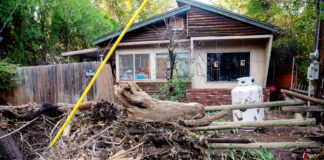
On Aug. 17, the city’s Historic Preservation Commission added the Johnny Guitar House, formerly known as the Tall in the Saddle House, at 705 Back O’ Beyond Road, along with the Pinewood House at 20 Pinewood Drive, to its list of historic landmarks.
“I’m glad that the big-picture story is still accurate, that it is still one of the few remaining set pieces from that era of moviemaking, and there isn’t a whole lot left outside of the telegraph office here at the museum,” Commission Chairman Nate Meyers said. “So to be able to point to another building that shares that history and documents that history is really great.”
Consulting firm Logan Simpson was commissioned to research the landmark applications for both properties, along with conducting a citywide survey to update Sedona’s historic property inventory, which was last updated in 2014.
The firm presented a draft of the inventory at the commission’s last meeting and will deliver its final report in November.
“As they went down that path, they couldn’t document that it was in ‘Tall in the Saddle,’ but what they were able to document was that it was in ‘Johnny Guitar’,” Meyers said. “They came up with some visual evidence that was then later supported by visual evidence in the museum’s collection.”
‘Johnny Guitar’ House
The building owned by Hermeen Peterson was originally submitted to the commission with the belief by the family that the home on-site was used in the 1944 John Wayne Western “Tall in the Saddle” and moved from its purported original location on Schnebly Hill Road around 1954.
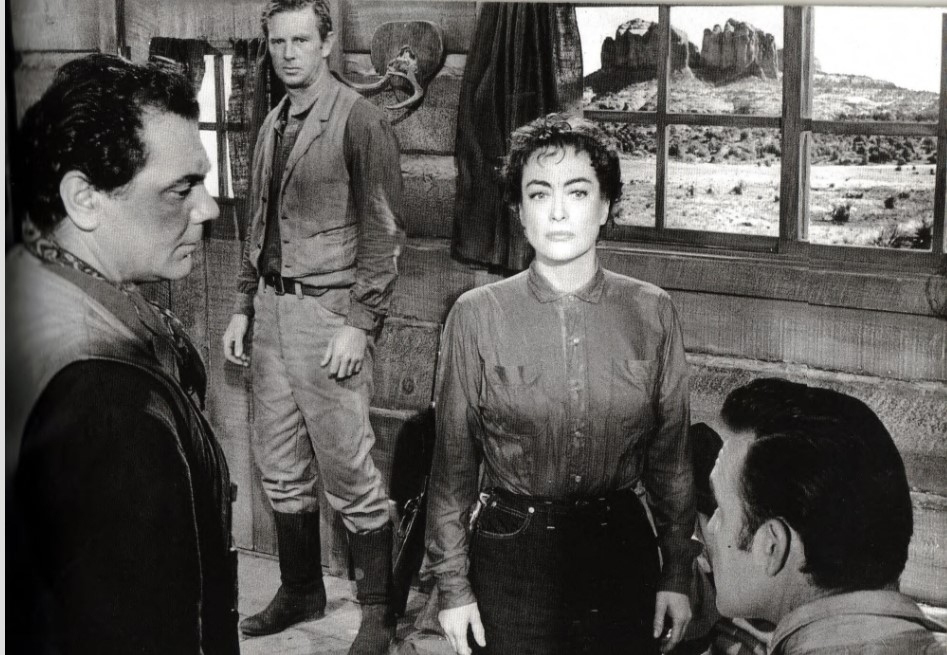
“On the outskirts of town, the hard-nosed Vienna [Joan Crawford] owns a saloon frequented by the undesirables of the region, including Dancin’ Kid [Scott Brady] and his gang,” according to the synopsis. “Another patron of Vienna’s establishment is Johnny Guitar [Sterling Hayden], a former gunslinger and her lover. When a heist is pulled in town that results in a man’s death, Emma Small [Mercedes McCambridge], Vienna’s rival, rallies the townsfolk to take revenge on Vienna’s saloon even without proof of her wrongdoing.”
The drama between Crawford and McCambridge wasn’t limited to the screen during director Nicholas Ray’s production, which began shooting Oct. 19, 1953, on Grasshopper Flat.
“Tensions between Crawford and McCambridge had been simmering almost since production began. In a curious twist on ‘Johnny Guitar’s’ fictional story, McCambridge had been teasing Crawford because she was married to a former boyfriend of Joan’s and took every opportunity to remind her of that fact,” according to Joe McNeill’s book “Arizona’s Little Hollywood.”
“At the same time, McCambridge had been infuriated by rumors that Crawford was having an affair with Ray, assuming this would earn her preferential screen treatment; curiously, Joan suspected that Ray was giving Mercedes extra coaching on her role behind her back, giving her co-star a chance to upstage her. It probably didn’t help matters that Crawford decreed McCambridge’s hair had to be dyed jet black to contrast with her own warm russet brown.”
Logan Simpson found no evidence connecting the building to “Tall in the Saddle.” But a review of “Johnny Guitar” and its publicity stills turned up multiple clear interior and exterior shots of the building, which serves as a hideout in the film, with Crawford, Hayden, McCambridge and Ernest Borgnine all photographed at the home.
“The film is a notable entry in Sedona’s film canon and extant built environment properties associated with ‘Johnny Guitar’ or other motion pictures filmed in Sedona are a rare and essential component of Sedona’s history in relation to Hollywood productions,” Logan Simpson’s lead historian, John Southard, wrote in his June 30 report.
“Once the researchers had that theory, a set photo in the museum’s collection clearly matched the cabin’s interior,” Meyers said. “The researchers also found a photo of Joan Crawford sitting in a director’s chair in front of the cabin.”
The home likely was not built explicitly for filming, Meyers said, because “it’s a very sturdy building, and it seems likelier that it probably was built for housing and then was used on the set, because if it was just built for a set, it would have been flimsier than it is. It’s a very substantial building.”
The building sits on private property and is difficult for the public to see. A plaque is planned for the home and the Pinewood House, but there is not currently an estimated installation date.
“We’re always happy when the owner wants to do it, but this is a tough one because it is difficult for the public to access unfortunately,” Meyers said.
The Johnny Guitar House is the first city landmark tied to Sedona’s film history. Although the Telegraph Office at the Sedona Heritage Museum was used in the 1947 John Wayne movie “Angel and the Badman,” it has undergone too many modifications to be considered.
“But I’d love to be wrong,” Meyers said. “Wouldn’t it be great if somebody reads this and says, ‘No, I have this. I’d like to have it landmarked,’ and it sets us off on a whole new path?”
The Johnny Guitar House has changed little since filming apart from two additions, updated door and window trim and the removal of a front porch, according to the report.
Where the building stood during filming is unsettled. Logan Simpson’s report, citing McNeill’s book, places it at Grasshopper Flat when cameras rolled and notes that the terrain in the film and publicity photos differs from the building’s current site. The firm found no relocation records but determined the building was on the Back O’ Beyond parcel by 1969.
Meyers believes the building was built on the Back O’ Beyond property and moved only within it.
“The picture that they have of Joan Crawford out in front of it shows it kind of up on a rise, and if you go out there now, it’s not on a rise; it’s on flat ground,” Meyers said. “So we believe it was probably moved somewhere on the property at one point, but that it was certainly built out there, and they used it as the set up there at that property.”
The parcel belonged to Otto and Zelda Hallermund, who acquired it in 1952.
“He was known as ‘the Swede’ around town, and he fancied himself — I don’t know if this is true or not, but he certainly fancied himself and told people around town he was Scandinavian royalty,” Meyers said. “And he came to town and he was a cowboy here. He started acquiring land, and he ranched. And then he got hooked up with the Hollywood studios. And he was the one who built the Western Town movie set on his land.”
Pinewood House
Owner Olivier Leroy brought the Pinewood House to the commission believing it was a Howard Madole design, and Madole’s company, the Madole Construction Company, built the home in 1959. Madole, a prominent midcentury architect often called Sedona’s first architect, already has two other city landmarks to his name.
“Logan Simpson did not locate evidence of Howard Madole having designed the property or having been involved in its construction,” the report reads. But the commission approved the designation because the house is a quintessential example of midcentury architecture.
The 1,086-square foot house on 0.43 acres “is in the Oak Creek Knolls Subdivision and is estimated to have been built around 1959,” the meeting packet reads. “It is a single-story ranch style house with a low-pitched side gable roof and a stacked stone chimney.”
The Oak Creek Knolls subdivision has been characterized as “Sedona’s first subdivision,” and the platting and buildout of Oak Creek Knolls marked a notable new chapter in the community’s story.
Logan Simpson’s inventory of historical buildings is an overall assessment of every property that could be nominated, Meyers said, since more homes and structures become eligible each year. Regular updates give the commission potential candidates and the stories they can tell.
“The next step is we are doing a final review of the document, and it’s been very well received by the Historic Preservation Commission, and so the next step will be adoption, and then we get to bring it to Sedona City Council,” Community Development Director Tony Allender said.