















Public, private experts gather to talk numbers growth & future
The Arizona Lodging and Tourism Association met at Enchantment Resort on Aug. 20, to present the Northern Arizona Industry Forecast along with public and private partners in the tourism industry.
Arizona Office of Tourism Director of Strategic Initiatives Kiva Couchon detailed her office’s recently released 2025 data during, which stated Arizona had 45.79 million overnight visitors split between 40.47 million domestic visitors a 1.7% decrease from 2024 and 5.380 million international visitors, a 0.08% increase from 2024’s 5,316 million. Overall, state overnight visitation had been down in 2025 by 1.36% from about 41.2 million visitors in 2024
International visitation to Arizona has yet to recover from 2019’s 6.125-million-visitor peak, falling off to 1.495 million in 2020 due in part to the COVID-19 pandemic. Numbers recovered to 3.0 million in 2021, 3.918 million in 2022, 4.799 million in 2023, 5.316 million in 2024.
In 2025, direct tourism employment was at 195,190 jobs in Arizona, a 0.7% increase over 2024 Total tourism employment from direct, indirect and induced jobs grew 324,136 in 2024 to reach a new high of 326,359 in 2025.
“Visitor spending went from $29.7 billion in 2023 to $30.1 billion in 2025, a 1.3% increase,” according to the state tourism department. “Tax revenue went from $4.3 billion in 2024 to $4.4 billion in 2025, a 0.7% increase Earnings went from $9.3 billion in 2024 to $9.8 billion in 2025, a 1.5% increase”
The share of 2025 over night domestic visitors in Arizona across the state broken down by their home metro region broke down as: Phoenix 19.1%, Los Angeles 10.5%, New York City 5.8%, Tucson 5.3%, Chicago 2.8%, San Francisco Bay Area 2.6%, with Las Vegas and Denver both at 2.3%, Dallas-Fort Worth 2.2% and Philadelphia at 2%
The purposes of the domestic overnight visitor trips were 32.9% “visiting friends and family, 16% “touring” 13.7% “outdoor recreation,” 7.6% “special events, city trips” 6.9%, 4.5% “casino” and 1.3% “golfing”
Public Lands
Outdoor recreation remains a major driver of Arizona tourism with water-based sports generating $11.7 billion alone in economic output annually in the state. Recreation along waterways like lakes and rivers added over $6.9 billion to the state’s Gross Domestic Product. Yavapai County alone “generates $720 million in economic output and supports 4,500 jobs in the state,” according to a March study hy Audubon Southwest with Southwick Associates.
“Comparatively, water-based outdoor recreation, as an industry, creates more economic output [$11.7 billion] than Arizona’s golf [56 billion] or wine $5.7 billion) industries,” a March 18, Audubon Southwest press, release reads “While mining creates more economic output [$21.2 billion), water-related outdoor recreation supports more employment throughout the state
“You may have seen some softness in those National Parks numbers, so that is obviously a concern for our industry,” AzLTA Public Affairs Consultant Garrick Taylor said. “I would imagine that those of you in Sedona are seeing some of this, some of these day trips that typically have visitors going to the Grand Canyon. Maybe you’re not seeing that as much as you have in years past.
Across Northern Arizona’s National Park Service sites, Canyon de Chelly National Monument saw visitation rise 24% year-over-year, drawing roughly 402,000 visits. Grand Canyon National Park, the region’s biggest draw, by far, recorded about 4,113,000 visits, down 9.6% from the previous year. Navajo National Monument logged around 48,000 visits, a 5.3% decline. Petrified Forest National Park drew approximately 368,000 visitors, down 15.3%
“Outdoor recreation is still one of the top reasons why people choose Arizona,” Couchon said, adding that many Northern Arizona communities “serve as destination gateways for these parks.”
Pipe Spring National Monument dropped 31.8%, with about 18,000 visits Sunset Crater Volcano National Monument had the largest decline in the group at 54.2%, totaling roughly 55.000 visits. Walnut Canyon National Monument bucked the trend with a 63.9% increase, reaching about 251,000 visits. Wupatki National Monument held nearly steady, down just 0.5% with approximately 214,000 visits.
“The story of the first half of this year was a government shutdown, so travelers are seeing on their screen long lines at TSA, and they’re reading headlines about reduced staffing levels at national parks, Taylor said. “It’s not a great advertisement for the travel industry and for destinations like this one, where you want to tack on these trips to places like the Grand Canyon.”
Pocket Fire
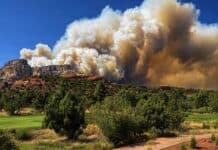
The economic effects of the Pocket Fire north of Sedona, which burned from June 19 to July 28 before being announced as 100% contained by July 30, were a major discussion point at the meeting, with speakers citing poor communications to the public from the city of Sedona and tourism industry.
Citing the fire’s numbers, “27,393 acres and 41 days,” NewGen Advisory Vice President Amiti Bhow said. “1 know it sounds enormous, but essentially, from a hospitality standpoint, the most important number is 24, that’s the number of days that [State Route] 89A closed, including over the July 4 weekend.”
State Route 89A through Oak Creek Canyon was closed from June 19 through July 13. No lives or structures were lost to the fire.
“The economic damage came primarily from access and perception, not the destruction of the lodging inventory… the reality of Sedona being open for business wasn’t properly communicated to all the inbound leisure,” Bhow said
Enchantment Managing Director Stan Kantowski also announced that his company has donated $25,000 to the Sedona Red Rock Trail Fund “to help with fixing” the trails affected by the Pocket Fire.