











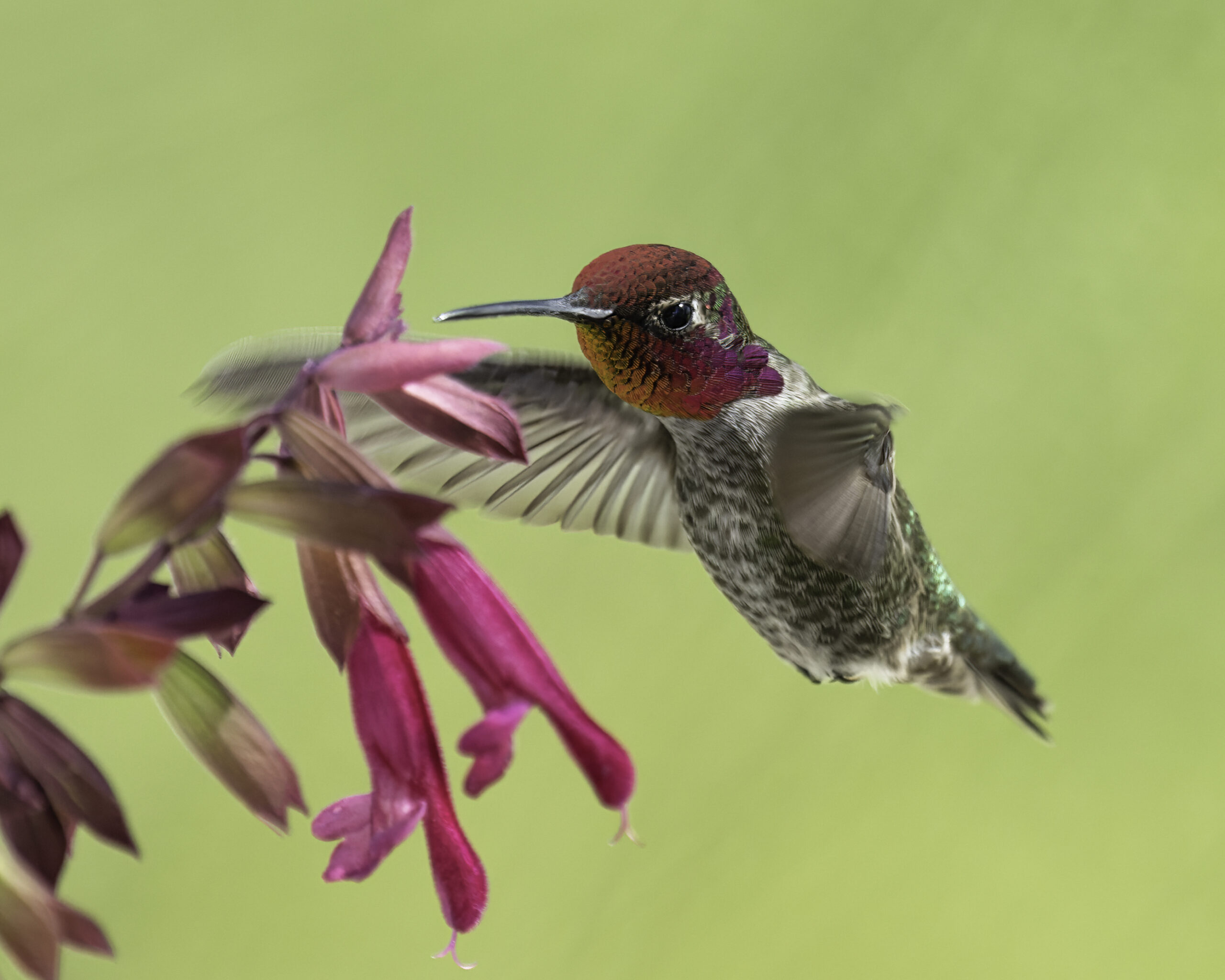
Ahead of the 14th annual Sedona Hummingbird Festival set for Friday to Sunday, July 24 and 26, the Anna’s hummingbird [Calypte anna] has been officially designated as Sedona’s city bird.
City Council voted unanimously to approve the designation during its meeting on Tuesday, July 14.
Nearly 40 people came to the meeting, several of whom were waving sticks adorned with hummingbird silhouettes. When asked who came to the meeting to support the designation of the Anna’s hummingbird, only two people remained seated.
Why Designate?
Alice Madar, the executive director of the Sedona-based International Hummingbird Society, told council the designation would cost the city nothing.
“It promotes sustainable gardening, planting native trees and flowers,” she said. “They’re naturally pest-resistant and droughttolerant, and the flowers that attract hummingbirds— I looked this up — are also fire-resistant. They’re green and less oily than some of the other plants.”
Additionally, she said birders are the “best kind of tourists,” because they avoid the crowds and come in the off season, when businesses need more revenue.
They’re also on the road early in the day, she said, meaning their impact on Sedona traffic is minimal.
“There are hummingbird images all over Sedona,” Madar said. “Many people have said they thought a hummingbird was already the city bird.
“Hummingbirds have inspired an annual Sedona Hummingbird Festival dedicated to them, and there is another separate hummingbird workshop scheduled for August, and that is run by an entirely separate organization from Colorado.”
Sedona is home to eight species of hummingbirds, but the Anna’s hummingbird is the only one that calls Sedona home year-round.
It’s also the fastest recorded hummingbird, comparing speed to body length.
“In body lengths per second [385], faster than a Peregrine Falcon or a space shuttle re-entering earth’s atmosphere,” Madar said during her presentation.
Support
In a letter Madar distributed to the council before the meeting, she said Sedona would be the first city in the state to designate a city bird, and the first city in the nation to designate the Anna’s hummingbird.
While it’s the only hummingbird to reside permanently in Sedona, the Anna’s hummingbird also ranges throughout the Southwest and up the West Coast, including parts of Oregon and western Washington.
In its application to designate the city bird, the Hummingbird Society included letters of support from the Northern Arizona Audubon Society, the Butterfly Enthusiasts of Northern Arizona and Keep Sedona Beautiful.
“We believe the designation of the Anna’s hummingbird as the city of Sedona’s City Bird will help raise awareness of the fragility of our high desert ecosystem and the necessity to preserve all aspects of the scenic beauty and natural environment of the Sedona Area,” KSB President Carla Williams wrote in her letter.
Madar said she put out petitions for the designation, which garnered 259 signatures from Sedona residents.
Out-of-town signatories included about 160 from the Village of Oak Creek, several hundred more from the Verde Valley and Arizona and more than 50 from out of state.
Process
In the beginning of discussion by council, several members expressed concerns about setting a precedent before there’s a process.
“A vote tonight doesn’t just pick a bird; it creates a de facto designation process,” Councilman Pete Furman said. “If we direct that a formal process be created afterwards, the next group lobbying for a flower or a tree or a crystal might arrive with their own petition and justifiably ask why the rules were different for the birders than they will be subsequently.”
In 2025, council designated the bird as the official bird of the Sedona Hummingbird Festival, but not of the city.
The July 14 vote was a simple resolution, which city attorney Kurt Christianson said could be undone if need be by a later resolution.
Other concerns included other birders wants a different bird designated.
Councilman Derek Pfaff said he’s not for a process because of the effort and energy the Hummingbird Society put into getting this to happen.
If “there are any champions for the ravens or the quails or whatever, we probably [would] have heard from them by now,” he said. “So, as much as I’m not in favor of the process, I don’t know how we could say ‘no’ to this.”