

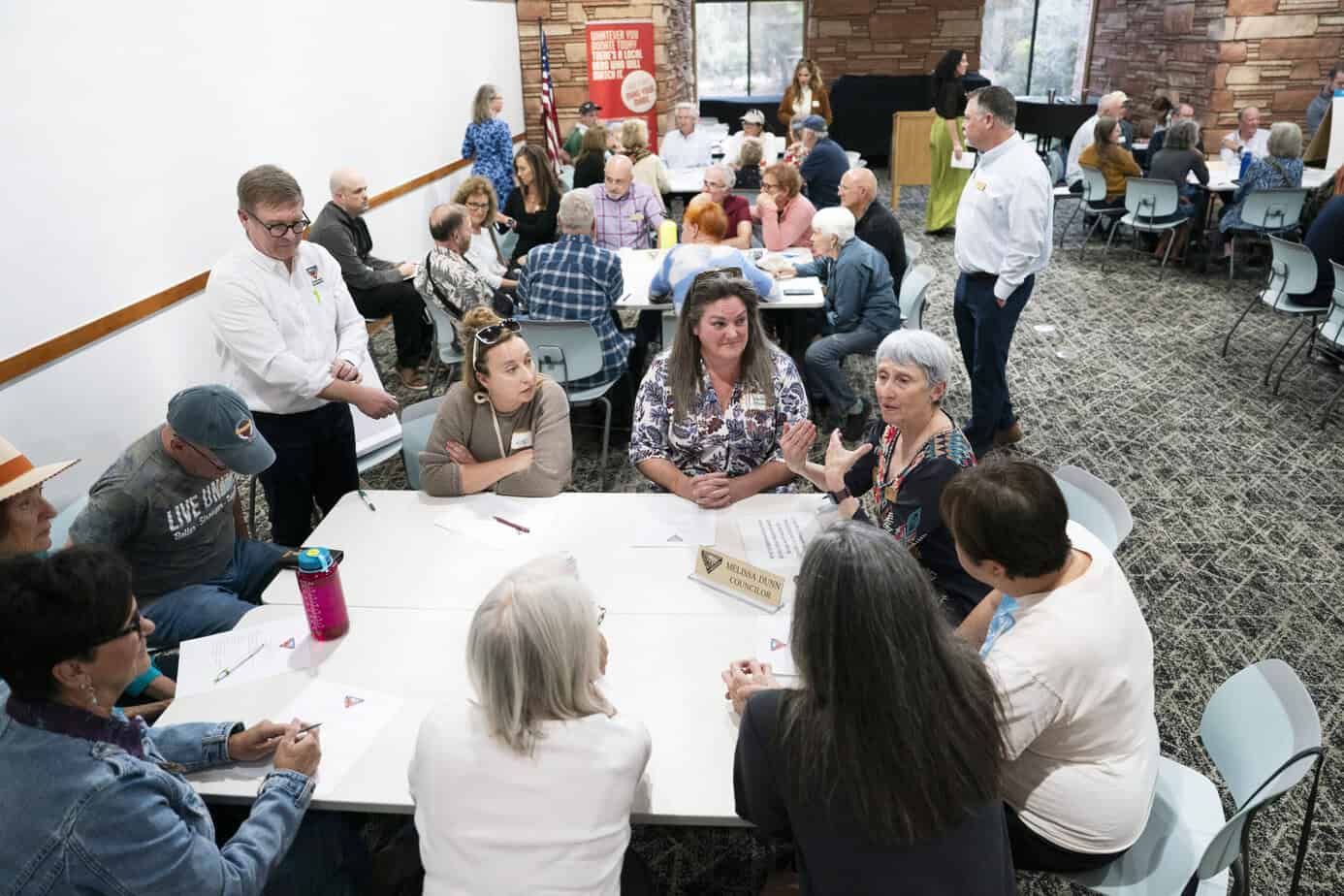
Meeting format aims to reduce friction between leaders & community
The format eschews the typical Wednesday City Council work session, in which city staff or outside organizations discuss municipal planning at the dais, in favor of meeting directly with residents to hear about their needs and vision for the city.
The main goal of the program that council decided on during its December priority retreat session is to engage residents earlier in the planning process, particularly on contentious issues. The April 29 session focused on the needs of families and seniors in Sedona.
“We would love to feel more supported by the city — there’s families that live here too,” mother of four Harmony Walker said to the NEWS after the meeting. “I would like to see more family-oriented life here instead of tourist-oriented life.”
About 60 residents participated, divided into six groups that rotated across six tables, spending 12 minutes at each. At each table, a council member and a staffer posed a discussion question to the group. At the end of the meeting, every council member gave a three-minute summary of what they heard from residents, and essentially amounted to a community brain storm session for no action by council taken at the meeting.
Several themes emerged consistently across tables, including the desire for seniors to pass knowledge down to younger generations and for the city to facilitate those connections.
“The seniors could read to the youth,” Sedona business owner Jennifer Williams said. “I’m sure there’s lots of things. The seniors could teach the youth how to sew because it is a lost art.”
A community or facility similar to the Cottonwood Recreation Center drew repeated mentions across multiple tables, with residents requesting subsidized programs, multilingual and multi-generational activities, expanded arts and wellness offerings, and a greater focus on teens.
“I think we are more united than we are divided, and we will be taking into consideration everything that we’ve heard, and we already are looking at expanding our parks and rec programs year round,” Mayor Holli Ploog said about council’s direction for staff to add a $214,775 annual after school camp program in the Fiscal Year 2027 budget that could start as soon as this fall. “The Rec Center is my baby … that’s what I want on my tombstone [is] ‘she got that rec center.”
The rec center desire is not new. Former City Councilman and Vice Mayor Paul Tutnick, a 33-year Sedona resident who served from 2000 to 2004, said the idea has been ruminated on for decades.
“I think council is pretty aware of what people’s wants and desires are and what they like about the city, hoping that some of this will be implemented,” Tutnick said. The Rec Center has been bouncing around for years. I remember 25 years ago, when I was on council, rec center came up, and it just kept getting more and more expensive.”
Tutnick said he believes the Western Gateway could be a good location for the facility.
A rec center was the second-most important item to include in the Western Gateway masterplan according to a survey of 1,620 registered voters and current residents conducted by polling firm HighGround Inc., scoring a mean of 3.58 out of 5, behind only community gathering space at 3.82 out of 5.
Before the discussion began, Community Development Director Tony Allender addressed community concern over remarks he made at a March 25 council presentation, in which he noted that if seniors chose to relocate to age-specialized facilities, it could free up as many as 88 housing units.
“If you live in your home, stay there,” he said.
Other specific suggestions included a social worker to connect residents with local resources, expanded senior transit options, wellness and fitness classes, a welcome wagon program, family-friendly festivals, pocket parks and an automated check-in program for seniors.
The event included six tables with different topics people could express opinions at. The tables were:
Table 1: What would make it easier for families to live here, long-term? What are the biggest barriers to success for families?
Table 2: What would make it easier for seniors to live here, long-term? What are the biggest barriers to success for seniors?
Table 3: What programs and services do you value most and which do you wish existed for families [i.e social activities, clubs or wellness programs]?
Table 4: How can we foster connections between seniors and families?
Table 5: What do seniors value most in Sedona? What do families value most in Sedona?
Table 6: What would make it easier for seniors to live here, long-term? What are the biggest barriers to success for seniors?
The city has not announced a date or topic for a follow-up session.


