
















Saturday, Feb. 14, is St. Valentine’s Day, which is either a quasi-religious secular holiday dedicated to expression of love or a nefarious commercial fabrication created by chocolate companies to sell heart-shaped boxes of confectioneries.
Adults make grand gestures of love, or schedule romantic nights out or at home. Children make valentines for their classmates, which my second-grader has been doing over the last weekend, making sure every classmate got a valentine and a sticker. Most of us remember doing the same thing as kids, looking forward to the valentines, lollipops, chocolates and the colored wafers inscribed with love-themed words, but which tasted like chalk yet were somehow still popular every year.
Whatever you may do to celebrate Valentine’s Day, make the day an important one for your loved ones. Many Sedona and Verde Valley businesses are offering specials and restaurants are providing romantically-themed dinners on Feb. 14, which we published on Pages 4B and 5B of today’s edition, along with some Valentine’s Day-related news content. Hopefully you’ll take advantage of their offerings and show a little love to local merchants. Whether a gift or meal or just some time together, use the date to express how you feel about those you love.
Valentine’s Day has its origins 2,700 years ago. Since the early foundation of the Roman Republic in 753 B.C.E., Lupercalia was a dual celebration of Lupa, the she-wolf who suckled Rome’s semi-mythical shepherd founders Romulus and Remus, as well as a licentious spring fertility festival dedicated to the pastoral god Faunus.
Lupercalia was traditionally celebrated from Feb. 13 to 15. At the festival of Juno Februata — Juno the Chaste, the wife of Jupiter — on Feb. 14, boys would draw the names of girls from a jar, with whom they would be partnered during the Lupercalia festival the next day on the ides of February — much like modern valentines. When the Romans conquered Greece in the second century BCE, Juno was syncretized with Greek goddess Hera and Jupiter with the Greek sky-father god Zeus.
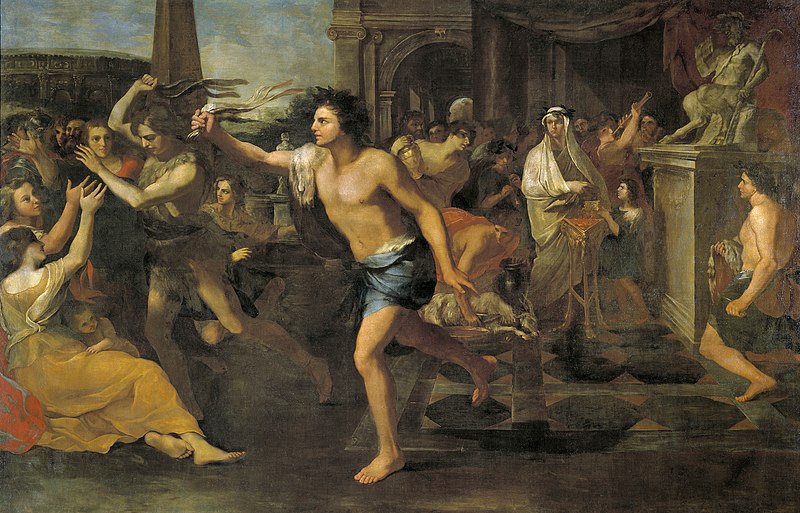
Early Roman Christians changed the practice after the late Roman Empire adopted Christianity as the state religion, substituting the girls’ names with those of martyred Christian saints — something far less fun for teenagers and less hedonistic for the Greeks.
Pope Gelasius I finally banned Lupercalia and by extension Juno Februata in A.D. 494. By then, Lupercalia had become a feast day for the martyred saint. Historically, St. Valentinus was either a third-century priest in Rome, or a bishop of Interamna in Italy’s Umbria province or an early Christian martyr in Roman-ruled North Africa. In his papal canon, Gelasius listed St. Valentine among other semi-mythical, semi-historical figures such as St. George and St. Christopher, “whose names are justly reverenced among men, but whose acts are known only to God” — i.e., the Catholic Church had no substantive documentation but didn’t want to surrender a popular tradition celebrated throughout the early Christian world.

The specific connection to the date likely had little to do with the saint, but like most conversions of pagan rituals into Christian tradition, syncretizing newly encountered fertility deities, spirits and demi-gods into the faith, to supplant the old religion with the new.
While there is no direct connection between ancient Lupercalia and modern Valentine’s Day per se, remnants of the old Roman holiday persisted as folk traditions in Italy and other parts of the former empire for centuries afterward. Some of these traditions were noted by writers in the Renaissance, connecting declarations and acts of love with the specific date on the calendar.
The first direct reference to romantic love and the day was made by English poet Geoffrey Chaucer in his 14th-century poem “Parlement of Foules,” a humorous satire of courtly love written between 1381 and 1382 to honor the impending marriage between Chaucer’s patron, the 15-year-old King Richard II and his future wife, 16-year-old Anne of Bohemia.
In the Middle English poem, set on Feb. 14, Chaucer dreams of three high-ranking eagles vying for a female bird’s affections. Birds of various species, representing various aspects of English social classes, offer their opinions. In the third-to-last stanza, Chaucer specifically references “Saynt Valentyn,” connecting the date and the saint. Valentine’s Day was culturally adopted as a romantic holiday in English culture which persists to the modern era.
Whether it’s dinner or a night out or just a simple card one child gives another classmate, a little bit of love can go a long way.