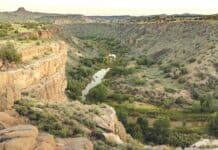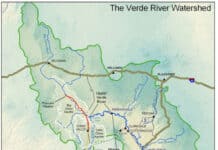











Steven Ayers’ new book “The River of the Kings: A History of Arizona’s Verde River” — named after the river’s designation by the first Spanish Conquistadors, El Rio de los Reyes — is now available at the Sedona, Camp Verde and Clarkdale historical societies.
“To my knowledge, this is the first book dedicated strictly to the history of the river, and it really constitutes the first attempt to tell it in a complete history,” Ayers said.
The retired Camp Verde economic development director, a 31-year Verde Valley resident, chronicles the last 70 million years of geology leading into the human history and centuries of Spanish conquest and colonization of the Verde Valley, from Antonio de Espejo’s 1583 silver-hunting expedition that found a “warm land with parrots” along what’s now Beaver Creek, to the failed missionary efforts of the 1700s that marked the end of Spanish attempts to settle the valley.
But the Verde River’s story began with the Laramide orogeny, a mountain-building episode that began approximately 70 million years ago and created the Rocky Mountains.
This uplift occurred when the Farallon Plate — a precursor to the modern Pacific Plate — began sliding at an unusually shallow angle beneath the North American Plate, compressing the continental interior and forcing rock layers upward.
“The ensuing uplift also gave birth to a geologic province that used to exist in southern and central Arizona that geologists call the Mogollon Highlands,” Ayers wrote. “ The Highlands stretched from northwest of Prescott to southeast of Payson, rising several thousand feet higher than the Colorado Plateau … to the north. Remnants of the Highlands are found today in the Black Hills, which form the Verde Valley’s southwestern margin, as well as the area of uplift extending farther southwest through and beyond Prescott.”
Starting around 20 million years ago, the compressional force from the Farallon Plate ended as it was consumed beneath the North American Plate. The boundary transitioned to a transform fault where the Pacific and North American Plates slide past each other, forming the San Andreas fault. This shift from compression to extension created the Basin and Range Province that characterizes the modern Southwest.
“A series of faults also appeared at this time near modern day Jerome, Sedona and Oak Creek that created another swarm of grabens,” Ayers wrote. “The Verde Graben, as they are collectively known, sank as the Black Hills and the Coconino Plateau lifted. The result was another tectonic basin some 35 miles long and 10 to 20 miles wide. Today we know the basin as the Verde Valley.”
The book is dedicated to Steve Ayers’ father, Alfred Corwin Ayers, who died in 2007.
A 20-year military veteran who served in Europe in the Army of Occupation after World War II, Alfred was diagnosed as dyslexic and often thought to be a slow learner, though he was highly intelligent. Despite difficulty reading, he loved books and compensated by memorizing what he learned. As the family traveled around Europe and the United States, he could recite history stories from nearly every place they visited — stories that Ayers said he still cherishes.
“My father was just a guy who was always involved with his kids from day one,” Ayers said. “He was involved in the Boy Scouting program. … After he retired, he took that passion for history and became a storyteller. He lived in Payson and would travel around to different organizations there in the rim country, often dressed [as] a mountain man, and told stories about the area and the history there. Then he gave all the money that he made doing that to charity.”
Ayers will be discussing his book at the Beaver Creek Historical Society in February with more events planned for Clarkdale, Camp Verde and the Verde Valley Archaeology Center.