















Scammers had a busy 2025 making off with over $400,000 from Sedona residents and visitors, according to the Sedona Police Department.
Cryptocurrency payments accounted for the largest source of losses though victims also paid through gift cards, wire transfers and cash for a range of scams including impersonation schemes, bank account compromises, overpayment frauds and online marketplace cons.
Cryptocurrency accounted for 65.8% of documented losses, representing a significant shift from traditional payment fraud. Three incidents alone accounted for $272,000: A $127,000 loss in May, a $90,000 fraud in April where a Sedona resident sent bitcoin and gift cards to a scammer and a Tucson resident discovering — while in Sedona in August — that she was defrauded of $55,000 in cryptocurrency by a person she was in contact with on social media.
“That’s the scammers’ preferred method of payment these days,” Yavapai County Sheriff’s Office Volunteer Fraud Investigator Ron Norfleet said. “You might remember that it used to be gift cards, but now they’ve graduated to cryptocurrency. I still receive a few reports of people getting scammed with gift cards, but those cases are pretty rare, especially compared to cryptocurrency scams.”
The April incident exemplifies a trend of impersonator scams, where fraudsters pose as law enforcement or government officials to first establish credibility, then pressure victims into immediate payment. It’s a tactic that cost Sedona residents at least of $115,140 in 2025.
The largest single loss occurred in April when a resident sent approximately $90,000 in bitcoin and gift cards to someone identifying himself as “David Rogers” from the nonexistent “Cyber Crime Department.”
In August, scammers posing as FBI agents convinced a victim to withdraw $20,000 in cash and hand it over to an “undercover agent” who arrived at their residence.
“It’s a scam that’s been going on for a long time, and people fall for it because of the respect and fear for law enforcement,” said Brian Watson, a community outreach specialist with the Phoenix nonprofit Resources/Outreach to Safeguard the Elderly, in a prior interview. “It’s usually something like you didn’t show up for jury duty, or you have an unpaid ticket to create that urgency that you have to do it right now.”
Other impersonation schemes included a June incident where a victim sent $3,680 after being told there was a warrant for her arrest, and a September case where a caller impersonating a Sedona detective claimed the victim had missed jury duty and pressured her into sending $460 to avoid arrest and fines.
Additionally, a Sedona Fire District employee lost $1,000 in after a scammer impersonated SFD Fire Chief Ed Mezulis and requested the employee purchase gift cards for staff.
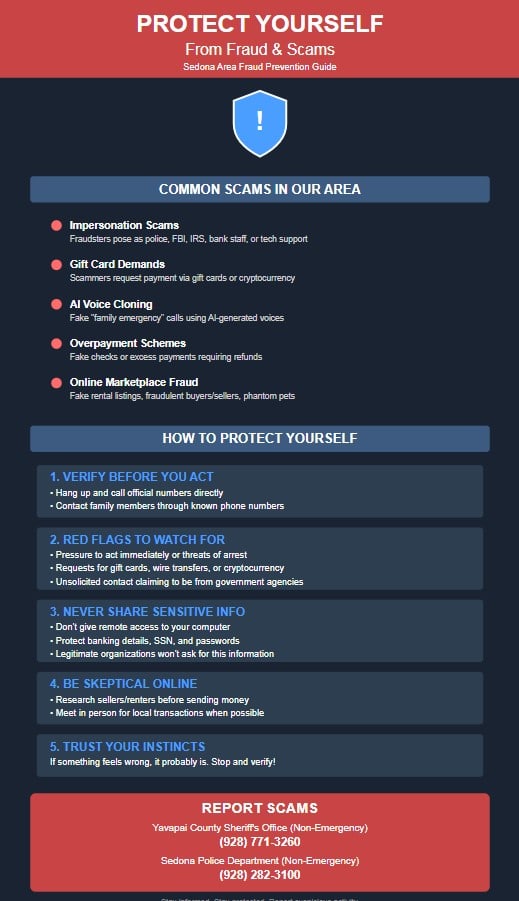
Real law enforcement officers will never demand immediate payment over the phone, threaten arrest for unpaid fines or missed jury duty or instruct you to make payments in crypto or giftcards.
Scammers have become increasingly sophisticated, using technology to spoof legitimate police department phone numbers and even clone voices through artificial intelligence. They exploit people into acting without thinking about why they are suddenly giving money.
If you receive such a call hang up immediately without sharing personal information, then contact the law enforcement agency directly using a verified number to confirm whether the call was legitimate.
Scammers used artificial intelligence to clone voices in family emergency scams, with one victim sending $500 to Mexico after a call falsely claimed her daughter was kidnapped.
Another resident received an AI-generated call mimicking her daughter’s voice claiming she needed legal fees after an accident. However, both daughters were confirmed safe.
To protect against these scams, always hang up and call your family member directly at their known number, and remember that actual emergencies allow time for verification.
Bank and financial account compromises cost victims $44,794 in documented losses in 2025, with the largest incident involving a Sedona resident who transferred $35,000 via Apple Wallet after receiving fraudulent text messages claiming to be fraud warnings from their bank.
To protect against these scams, never click links in unsolicited texts or emails claiming to be from your bank or, for that matter, from any organization considering the rise in scammers posing as state agencies. Contact your financial institution directly using the phone number on your card to verify any alerts about suspicious activity.
To protect against online marketplace scams, which cost Sedona victims over $11,000 in 2025, Norfleet emphasized the importance of safe transaction practices.
“For online marketplaces never pay for anything or give money ahead of meeting up,” Norfleet said. “[Also] if you’re selling something like a piece of furniture, arrange to meet in a public place, like a Walmart parking lot … avoid having buyers come to your house.”
You can report scams to the Yavapai County Sheriff’s Office non-emergency dispatch line at (928) 771-3260 or to the Sedona Police Department non-emergency line at (928) 282-3100.