








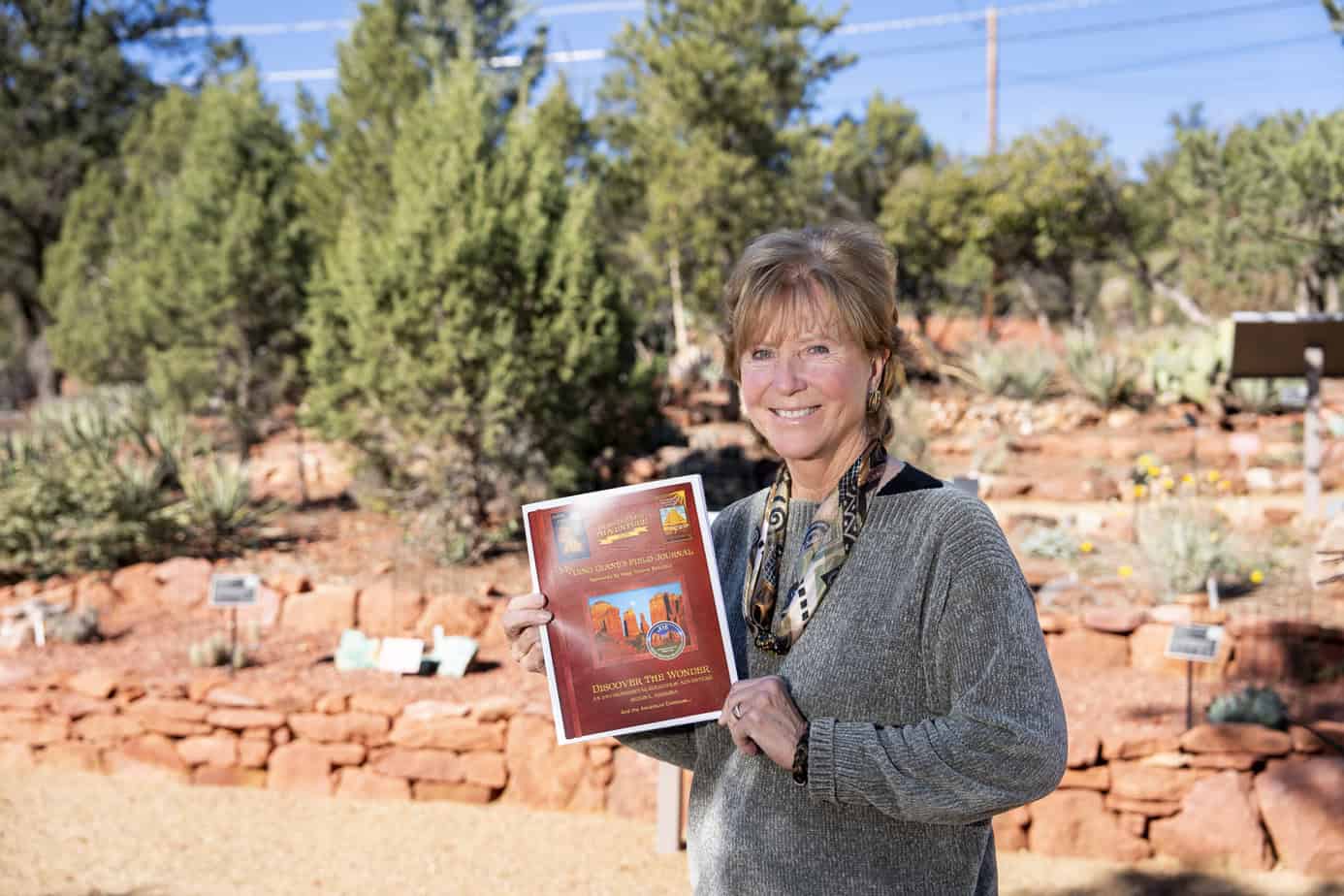
One of the things former middle school science teacher Diane Kristoff learned about Sedona after moving from Scottsdale last year is that it never had dinosaurs.
Clues to why that is, she found, is in the red rocks.
“They’re not in the Grand Canyon,” she said. “You don’t see them in Payson, and… like why? I couldn’t figure that out. I had to read ‘Geology of Arizona’ to figure out why that was.”
During much of the Mesozoic Era of the dinosaurs, Sedona was under the water of a shallow inland sea.
There are red rocks here and not at the Grand Canyon “because the sea reached here,” Kristoff said, “but didn’t reach the Grand Canyon” and the seawater trapped more iron in it.
Kristoff, who’s sometimes known as Dino Diane, used to take her middle schoolers hiking, including around the Sedona area, and would make field guides for them to learn the local rocks, plants and fossils.
“I’ve written a book called The Dino Diane’s adventure series,” she said. “The main character is like my alter ego at like middle school, age 12-and-a-half, … going into seventh grade, and she loves learning and loves dinosaurs, and carries a field journal in her knapsack, everywhere she goes. And she takes it out to draw things and jot down things.”
Shortly after Kristoff moved to Sedona, she decided to write a field journal for the Sedona area.
Kristoff said she wanted to teach the middle-schoolers across the Verde Valley about all the things she’d learned — the plants, rocks and history of the place.
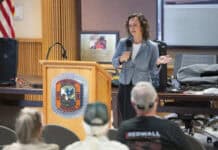
When Keep Sedona Beautiful Executive Vice President Craig Swanson met with Kristoff for the first time to talk about the role she could play, he KSB had to bring her on to help with their education initiatives.
“Once we met her, we realized this is a slam dunk,” Swanson said. “Everybody who met Diane, intuitively understood that this was going to work and this was a good thing.”
Kristoff’s role at KSB will be to bring education to the children of the Verde Valley, including from schools outside of Sedona proper. Every member of KSB, save two staffers, are volunteers, meaning no KSB funding goes directly to them, only KSB’s projects.
“One of our key parts of our mission is to educate people about environmental issues and about being responsible,” Swanson said. “We do a really good job with that for adults, but we haven’t historically found good ways to involve kids.”
To Kristoff, involving kids is simple.
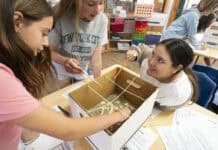
“I’m an award-winning science teacher,” she said. “The reason is because I did everything hands-on. Kids don’t want to read textbooks. They’re good, but they want to do things.”
Kristoff began to reach out to teachers in the area to see where the interest might be and soon heard back from teachers all over the region.
To teach middle schoolers hands on about the landscape of Sedona, they needed a place to everything in one spot.
Swanson said KSB’s garden next to its office in the historic Pushmataha building on Brewer Road had been in disrepair for years.
“The bones of it were here because about 15, 18 years ago, the organization put in irrigation lines and had something of a garden in here, but then it was neglected,” Swanson said. “If you neglect a garden for too many years, it falls apart. So we realized what was here, and started working on it, bit by bit, motivated to rejuvenate the garden and to make our property Fire Wise.”
Now, the garden is covered in educational signs and identifiers for all the plants and rocks it displays.
“We then realized that there’s all of these separate areas that are here and that we could make certain areas focus on some things, like that’s the xeriscaping area there,” Swanson said while walking through the garden during a brief lapse in rain on Nov. 19. “There’s an area that is for pollinator plants, another area that stresses native plants.”
“Xeriscaping is a systematic method of promoting water conservation in landscaped areas,” the U.S. Department of Energy’s website states. “Although xeriscaping is mostly used in arid regions, its principles can be used in any region to help conserve water.”
Originally, a test-run to have kids come to the garden to learn from Kristoff’s field journals was set for Nov. 19, but was canceled due to rain.
Without another date set, the first group of kids will likely arrive in January.
The garden can’t hold an entire class, so the plan is to have half the class outside noting signs and items in their field journals while the other watches a presentation inside.
“We did a test run with the board members,” Kristoff said. “It was really fun watching them out here doing it, but an hour here, an hour there and then we’ll switch, and that’s how our game plan is.”