













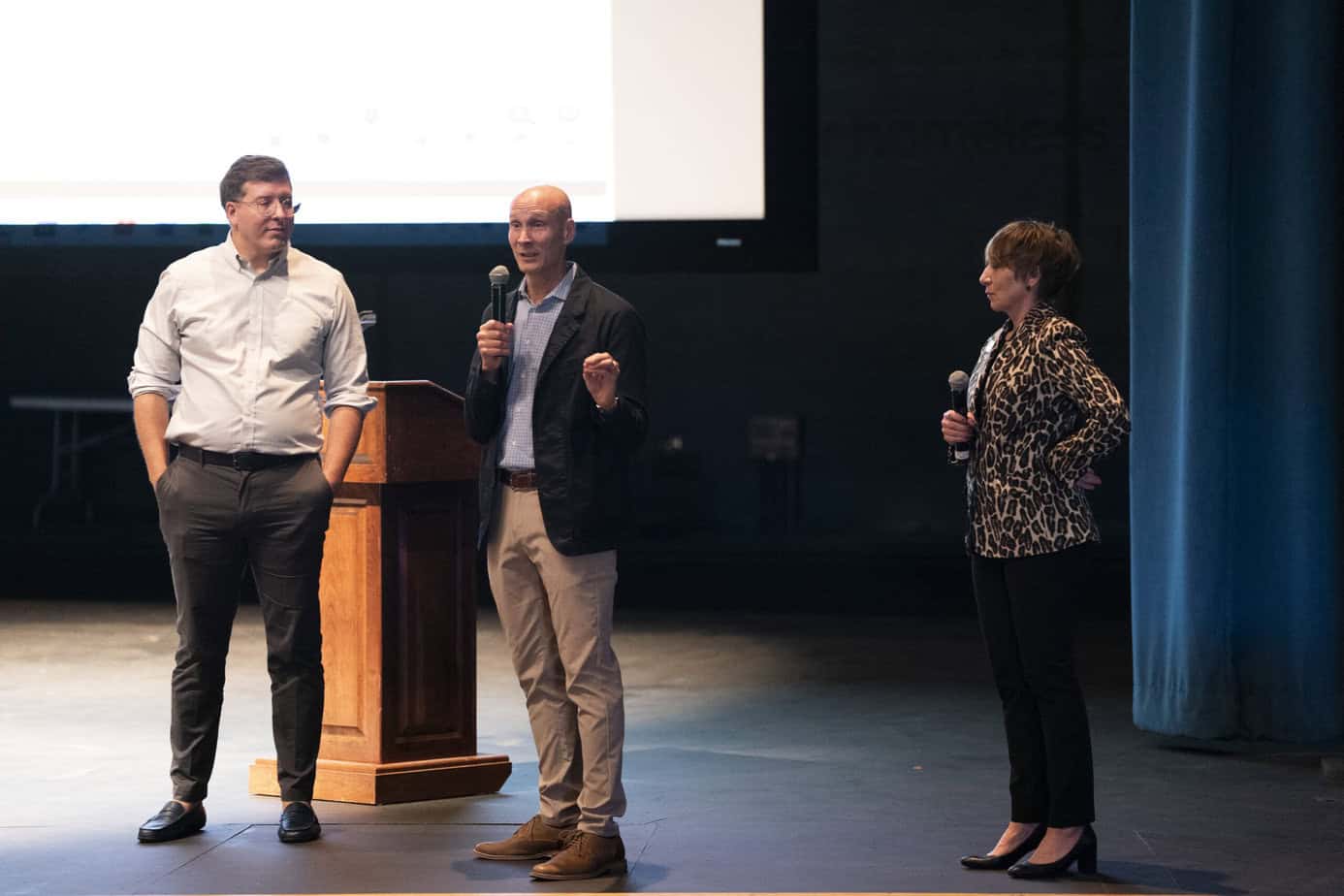
The Sedona City Council held a work session on Wednesday, Oct. 15, where Sedona Housing Manager Jeanne Blum, along with consultants Jonathan Danforth of Viam Advising and Matt White of Housing Innovations, presented the Homelessness Needs Assessment and Strategic Plan — a project the city funded at a cost of $116,719.
“The presentation needs to come to all of our communities and the county, because I think there’s a lot of questions,” said Clarkdale Mayor Robyn Prud’homme-Bauer, a common refrain from both sides of the stage during the meeting. “Can there be regional collaboration? Of course, there can be. The big question I have … [is] who manages this?”
That is a question the Sedona City Council seeks to answer through its direction to staff to start regional conversations with other municipalities, service providers like Catholic Charities Community Services and Yavapai County to set roles for a regional approach to homelessness.
“The assessment found that roughly 600 residents [across the Verde Valley] experience homelessness each year, and that the current system falls far short of meeting their needs,” the executive summary reads. “System modeling identified requirements for 260 crisis housing beds, 180 rapid rehousing units, 60 permanent supportive housing units, 360 households served annually through a Flex Fund, and 600 people connected to basic services.”
Viam proposed that the 600 breaks down into 60% of those experiencing transitional homelessness — a short-term crisis like eviction or job loss — 30% with episodic homelessness who have repeated bouts over a few years, and 10% who are chronically homeless, often compounded by mental or medical needs. The third group is the most visible that people see day-to-day.
The report stated that homelessness in the Verde Valley is “projected to rise 6% annually” over the next five years, based on historical trends in Yavapai County — a rate that would bring the total number of homeless individuals across the Verde Valley to 800.
The Verde Valley is already not meeting its current needs. There are 68 crisis housing beds out of the 260 needed, 180 rapid rehousing units are needed while currently there are none, and another 47 permanent supportive housing units are needed in addition to the 13 that exist. A fund for direct financial assistance would need to support 360 households annually to cover costs such as housing applications and to address barriers to housing. An outreach team is also needed, the report stated.
Viam presented a three-tier structure that the council discussed, ranging in annual costs from $175,000 to over $1.15 million — with the lower end focusing on the creation of a Flex Fund and crisis housing expansion, and the higher end expanding rapid rehousing with an investment of $750,000 plus a fully funded Flex Fund of $550,000.
Sedona City Councilman Brian Fultz expressed skepticism over the tiers, saying the city is already fulfilling recommendations to address homelessness with its discussions of housing at the Western Gateway, working with Yavapai County and nonprofit partners such as Hope House of Sedona — which provides temporary housing for families with school-age children — adding, “This is where we need Catholic Charities and the county to get involved.”
Fultz said his doubts about the immediate need for further action stem, in part, from recent steps the city has taken. He pointed to the creation of the Sedona Police Department’s first homeless community outreach officer — a position filled by Officer Michael Lucas and approved by council earlier this year at an initial cost of $200,000.
Fultz also said the council had discussed the appointment of Richard Speer as presiding magistrate judge during an executive session the day before.
“That will help with this topic,” Fultz said, “especially as we move forward with a community or specialty court, whatever we end up calling it. I want us to get started on that quickly with our new judge because it directly addresses chronic homelessness — those individuals will likely find their way into that court.”
“I feel like I’m being sold something right now and again, I think it’s for the same reasons that some of my colleagues are saying, ‘Hey, we need to understand this better still and understand what the level of cooperation is going to be with other members of the Verde Valley that we do want [a] partnership with,’” Fultz said.
Some ways the consultants suggested for a regional system include presenting the strategic plan to other municipalities, seeking participation through memorandums of understanding, developing a cost-sharing formula and creating a shared “by-name list” with weekly case conferences among municipalities.
Hope House of Sedona was a key partner emphasized during the work session and during a community engagement meeting led by Blum and the consultants earlier that day at the Sedona Performing Arts Center, which about 60 people attended.
“We are a non-emergency shelter at this juncture … [Hope] House of Sedona is a comprehensive housing program, and so we’re not just an overnight shelter,” Executive Director Turiya Weiss said. “We have specific qualifications for our residents. We, at this time, are only able to take families with children. … I absolutely plan on expanding and including all of the populations at some point. [But] we have to sustain funding first. We are funded over a third by private donors, and we have some first-year foundation grants that I’m hoping will continue. But at this point in time, it’s October, and I’m about three-quarters funded for the year, which is a little scary. And even more scary is that this is the first year that we have been this well-funded.”
Hope House’s 2025 budget totals $205,153, according to Weiss, who added that the organization’s property could accommodate an additional home but that construction has been delayed due to limited financial stability. Weiss said she hopes to begin planning for expansion in 2026 or 2027, depending on when funding becomes available.
One of the top-voted questions during the city’s community meeting was, “How many school-aged kids experience homelessness in Sedona?”
During the 2024–25 instructional year, the Sedona-Oak Creek School District reported 14 homeless students enrolled in the federally funded McKinney-Vento program, according to district liaison Stacy Smith. This marks a 50% decrease from the spring of 2023, when 30 students were identified as homeless under the program, the last time the Red Rock News reported on the issue. Smith said, however, these figures are not comprehensive.
“[Homeless students] come and go regularly, moving around quite a bit from school to school,” Smith wrote. “I never kept a record by semester. I would add to the list if new ones came and delete the ones that left. It’s confidential information that doesn’t get reported, except to the state of Arizona.”