










Piquant Peach performs poetry per perfect western parlance
Whether it’s drunken poker players, a clever bank heist or a shifty sheriff, the Southwest has a unique history with cowboys, animals, wranglers, guns, glory, mishaps — and poetry.
Michael Coyote Peach particularly loves the quirky stories.
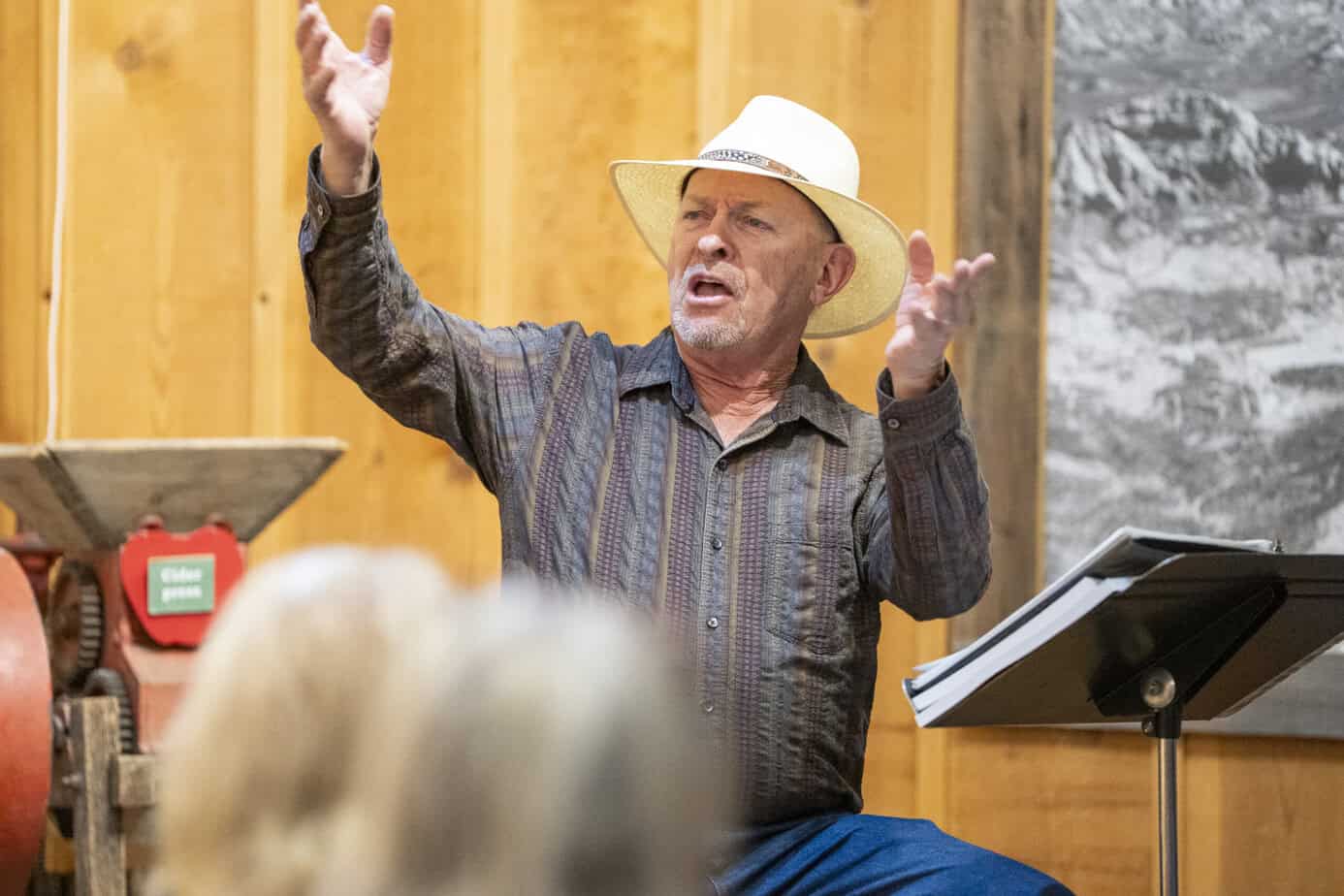
His performance on Saturday, Oct. 4, was accompanied by voices, volume changes and hand gestures that prompted audience laughter throughout the hour-long set.
He performed a story about a bank robbery involving a man with small feet — that’s important. Littlefoot, the character, was a clever fellow. As the story followed him plotting the robbery, Peach stroked his beard and did his best bankrobber voice.
Before the story, however, he prefaced it with its possible inaccuracy.
“I came across the idea for this story in a compilation book by the Western Writers of America Association,” Peach said. “It was a book called ‘Legends and Tales of the Old West,’ and there was a chapter in it that they called ‘Queer Catches,’ where they were talking about different ways that outlaws had been known to try to hide the loot from their crimes.”
Peach gave background to every poem before he read it to the about 10-person audience.
While he tried to keep the accuracy of his performances as close as possible, he made an exception for this story because it was plausible and quirky. In his time performing history and poetry, Peach has read quite a few textbooks, many of which with references to stories like this.
While he doesn’t read quite as many textbooks anymore, Peach still finds ways to learn and get more story ideas.
Peach is a lead guide and interpreter for Pink Jeep Tours, working for them since 1985 and loves the chance to tell stories of Sedona.
He has to wash his Jeep at the end of every day, so he’s gotten in the habit of putting in his earbuds and pressing play on his Audible audiobooks while he’s still busy. Every now and then, he’ll come across a line while he’s listening and pause for a moment to jot it down and do more research later.
Peach will have enough information for new poems to update his performance every couple of months, but he always has work in progress. He said he’ll work sometimes for “a couple years” before a poem is ready for performance.
Peach recently published two compilations of some of his work: “Blasphemies and Catastrophies: Haunted History from the Southwest,” on Aug. 11, and “Deceptions, Lies, & Alibis” on Sept. 29. Both are available on Amazon, or he usually has some copies available at his performances.
His next performance is Saturday, Dec. 6 at 1:30 p.m. in the Sedona Heritage Museum’s apple sorting barn.
Born in Phoenix and a long-time resident of the Verde Valley, Peach has always been fascinated in the history of the Southwest.
About 2000, a woman working for Northern Arizona University coordinating the programs for Elderhostel, renamed Road Scholar in 2010, was looking to expand programs focused on local history.
“She approached me and she said, ‘listen, I need to have a program created for my people about the history of the Verde Valley, and I think you’re the guy to do it,’” Peach said. “So I started diving into diaries and old newspapers and interviewed a couple of the members of some of the old families that were still around, and put together the first of those that I called the Voices of the Verde.”
The presentation, often held at the Sedona Heritage Museum, included local history, civil war statistics, who’d lived in the area, what had happened to the American Indians in the Verde Valley and that sort of thing.
Peach said he loves history and will still write about serious topics, but even when he changed up the stories and the Voices of the Verde program every couple of years, “it was a downer,” he said.
Now he performs western poetry at the Heritage Museum from time to time, in his series “Oops!” Telling only “slightly embellished” stories about the westernmost American Civil War battle — the Battle of Picacho Pass north of Tucson — the smelly circumstances surrounding the battle’s end and true stories about a bobcat walking into a bar, Peach knows quite a few quirky local stories.
“I have a background in acting,” Peach said. He earned his bachelor’s degree from NAU in philosophy with a minor in acting, later receiving a master’s in theatre from California Institute of the Arts.
Peach said he often doesn’t fit into what a lot of people would call a “cowboy poet.”
While having many of the same themes, he doesn’t have a connection to a ranch or a life herding cattle, which a lot of cowboy poets see as a requirement.
The Western Folklife Center, which runs the annual National Cowboy Poetry Gathering, lists its cowboy poets describing what qualifies as cowboy poetry.
“It stands to follow that cowboy poetry is a poem written by a person who knows the actual work and has extensive experience doing it well,” Virginia Bennet wrote.
“To me, what constitutes a cowboy poem is this: It should be recited from memory [preferably] by either a working cowboy or cowgirl, or at least a ranch-raised person, that way we keep it true to form, by description, content in general, and accuracy,” Dick Gibford wrote.
Bennet and Gibford reflect the majority opinion among the six poets asked this question in their 2022 blog.
So Peach prefers the term “western poet” because that describes him best; he writes as often as he can and nearly exclusively about the Southwest and its history.