















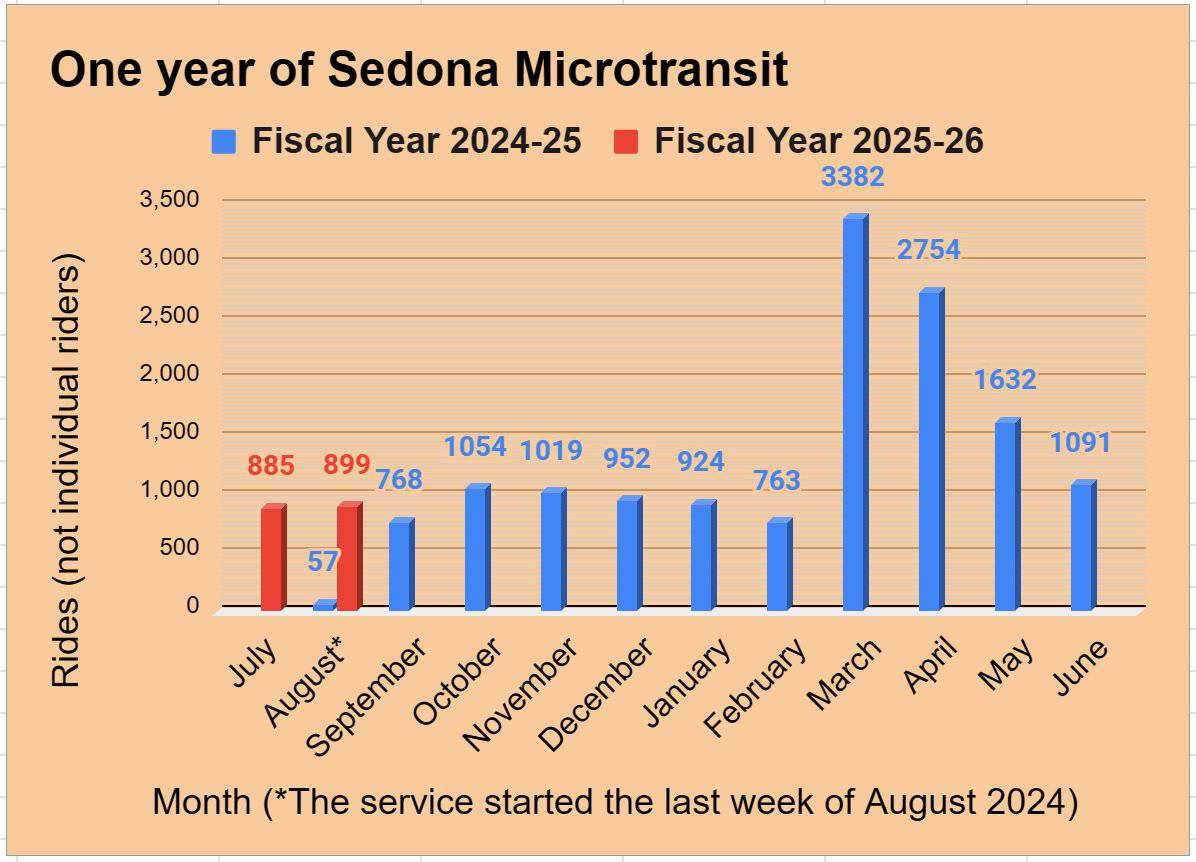
The Sedona Shuttle Connect microtransit, on-demand bus service run by the city of Sedona, turned one year old in the last week of August.
While it is much smaller, the service has seen similar trends as the larger trailhead shuttle service, both peaking in March.
In its first 12 months, the microtransit service counted 16,180 rides, including the 57 rides in its first week, which was the last week of August 2024. The service’s first full month was September 2024, which had 768 rides. It saw 3,382 rides in March. The lowest full month of ridership was February with 763 rides.
“This trend isn’t unique to Connect,” Transit Administrator Amber Wagner said in an email after a Sept. 23 presentation to the Sedona City Council on transit business. “Since the trailhead shuttle service launched in March 2022, we’ve consistently seen March and April lead the year in ridership. Sharing that data has helped illustrate how closely transit demand aligns with seasonal visitation and trail use.”
March and April are also some of the busiest months for tourism in the city. Spring breaks and weather conditions mean more visitors and residents using these services.
“While early this [fiscal year], our previous year’s comparisons are high in the early months because we were launching from a very low base last year, we anticipate the true year-over-year trend will stabilize,” Wagner wrote. “Based on those patterns, we’re projecting a 15% — 20% increase in ridership moving forward in FY26.”
October and November 2024 were the peak for the fall and winter, seeing about 1,054 and 1,019 rides respectively.
“We saw a decline due to seasonality this summer,” Wagner said in a presentation to City Council during its Sept. 23 meeting. “But I have to say, these last, past two weekends we are back up to our peak levels of transporting about 150 passengers per day on the weekend, which is really promising because that’s back up to our March and April numbers.”
At the meeting, she said the service reduced about 6,472 individual vehicle trips in Fiscal Year 2025.
“One of the most interesting things we’ve learned is how closely ridership aligns with visitor activity and lodging patterns, which allows us to tailor service and add capacity around peak demand and times,” she subsequently said.
In a slideshow, Wagner showed that locals made up 7% to 9% of rides and made up 25% to 30% of total trips. Usually, these rides are multiple times a week, to essential services like grocery stores, clinics and pharmacies.
Infrequent riders made up the rest of the riders and trips, 91% to 93% and 70% to 75% respectively. Often, these rides were to hotels, parks, Uptown and shuttle connection points.
The slides also listed the top 10 busiest pickup and dropoff sites as: North SR 179 Park and Ride, Uptown Sedona Shuttle Stop on Jordan Road, Sedona Chamber of Commerce Visitor Center and Uptown area, SR 89A Park and Ride and Courtyard Sedona, Bashas’ Plaza and Sedona Village Shopping Center, Posse Grounds Park, Shadowbrook Apartments, Safeway Shopping Center and Shops of Sedona, Tlaquepaque and Los Abrigados and Whole Foods Shopping Center.
The service held a summer ride campaign beginning in June, which distributed coupons for free rides in hotels and local businesses. Throughout June and July, the service brought in 290 rides.
The average ride for the last fiscal year was about five miles per trip. “We will be doing a Chapel neighborhood expansion pilot test,” Wagner announced to council. “We’re working with the Chapel [of the Holy Cross] and Mystic Hills’ committees — they have a volunteer committee — on a pilot project which we will launch in November.”
Another upcoming pilot for the service will be north of Sanborn Drive in the spring.
“In the Chapel area, the neighbors had some concerns, so we’re trying to address them based on performance metrics and questions they have once the service goes online,” Wagner said. “So I believe that during that test phase we’re going to be constantly monitoring … what we’re seeing in that particular service area, that’s why we’re not doing both of them at the same time, we can really focus on that area, make sure it’s not impacting on-time performance in the whole network and then we can go back and make adjustments as needed with those neighbors.”
Adjustments made to already existing routes include allowing the service to continue to 8:30 p.m.
Trailhead Service
The trailhead routes, often used mostly by visitors, saw similar peaks and valleys. It saw about 65,000 boardings in March. July was its smallest boarding month, which saw only about 10,000 rides. FY 2026 overall saw nearly 360,000 boardings, a 2.7% increase from the previous year. Wagner said its total number of reduced vehicle trips for the year was 89,703.
The trailhead service began in March 2022. Since then, it’s had 1.13 million boardings, with a total of 282,500 reduced vehicle trips.
The biggest change seen in the past year is more popularity for the faster bus routes, particularly in the summer heat.
“On Route 11, which is our Dry Creek/ Mescal route, out of the West Sedona lot, we shortened our service in the afternoons during the peak heat,” Wagner said. “That service was reinstated after Labor Day on Sept. 4. And we also paused our Route 12, which was our Dry Creek/Mescal route out of our Posse Grounds park-and-ride lot. Due to lower demand, folks have just started to use our Route 11 out of the West Sedona lot, more so because it has a better frequency of 30 minutes versus 50 minutes.”
She said in the fall, the bus services will pilot a 30-minute route there.