

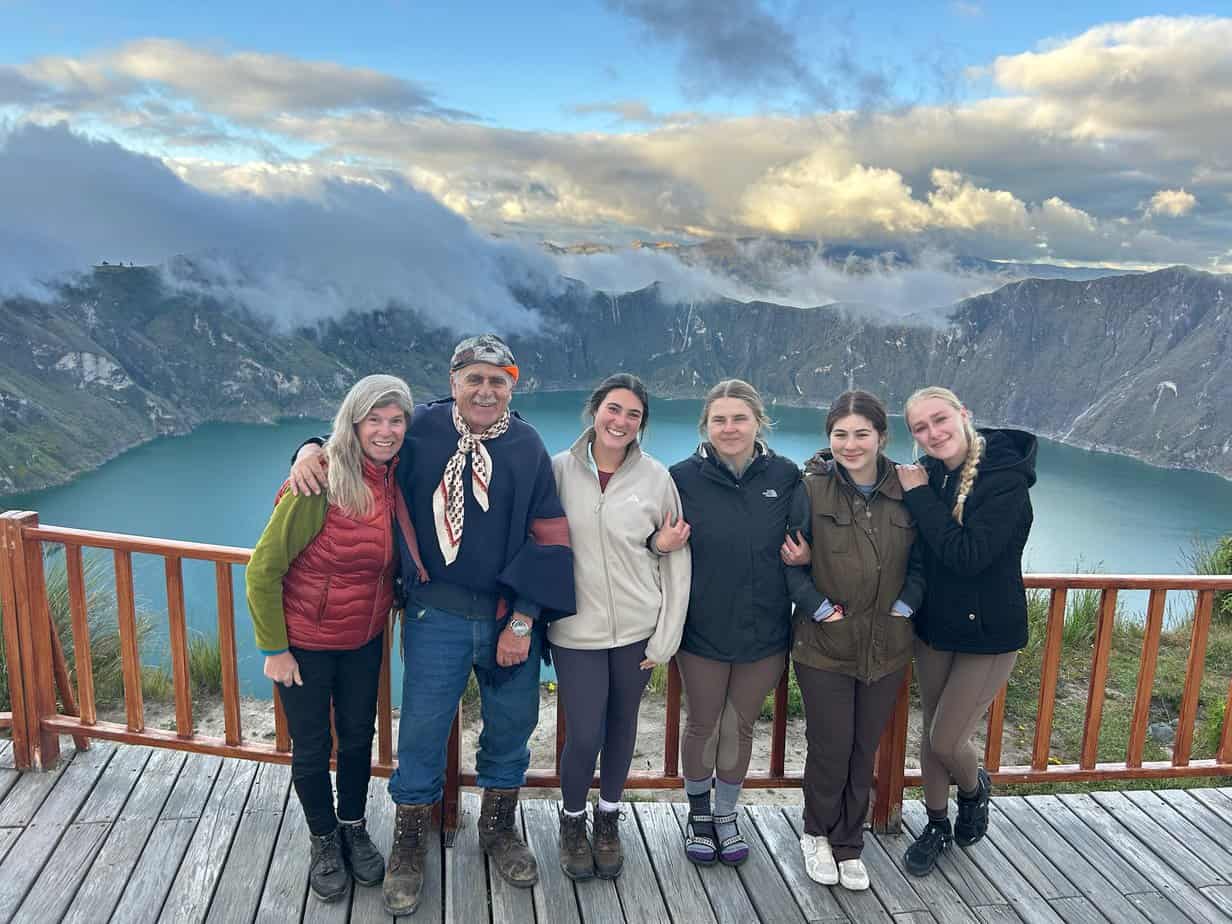
In 2020, when the COVID-19 pandemic was building momentum worldwide and governments were imposing shelter-in-place orders, for many, this meant lots of time spent indoors, with no idea of when it would be safe to resume normal activities.
At the time, Verde Valley School, an International Baccalaureate boarding and day high school in the Village of Oak Creek, restructured classes to be online only and many out-of-state and international students returned home to be with their families. However, a handful of day school students and teachers stayed connected throughout the remainder of the school year despite closed classrooms, as the school’s curriculum includes outdoor electives such as mountain biking, rock climbing, cross country and horseback riding.
Though it was a tough time, the students and teachers made the most of their experience, especially for a group of horseback riders, who ended up forming friendships that would ultimately outlast their time together at VVS and take them on the adventure of a lifetime.
Bonding on Horseback
For VVS Equestrian Program instructor and coach Natalie Rockwell and her then-students, the pandemic was a time that transformed ordinary classes into a deeper level of bonding and adventure.
The coronavirus had reached Arizona right around spring break, Rockwell recalled.
“The students could not come back to campus,” she said. “We didn’t know what the virus was; there were no vaccines. It was all about ‘What do we do?’ and that’s when all the Plexiglass dividers went up and sinks were installed for more vigorous handwashing … but one thing we could do was ride.”
For Rockwell and her “four best English riding students at the time” — Kanita Olsen, Karly Shanahan, Serena Allen and Natalie Montgomery — the pandemic became the backdrop for long rides through VOC’s red rock wilderness, where they would practice their riding skills and discuss their long-term plans for a post-pandemic future.
A Teacher’s Dedication
Rockwell spent most of her life around horses and holds the high honor of being an “A” rated member of the U.S. Pony Club, the largest equine educational organization in North America. She also has a master’s degree in nursing and is a licensed psychiatric and mental health nurse practitioner. She combines these experiences in her work as a Professional Association of Therapeutic Horsemanship-certified therapeutic riding instructor as well as her role as instructor and coach at VVS, where she teaches students the value of human and animal relationships in addition to the essentials of riding.
“I have moved away from emphasis on performance and competition to relationship-based horsemanship,” she said. “We recognize the horse as a sentient creature with an emotional and physical sensitivity that we need to honor and protect.”
“Before that spring break we had been prepping for English shows and gymkhanas,” Montgomery explained.
After realizing student competition would not be an option that year, Rockwell was determined to give her “show ready” students a comparable experience that would allow them to build their skills.
“Nat took us riding every weekend and whenever we had free time,” Shanahan said. “She built a cross-country course and we all got super into that. We were able to be outside with each other and with our horses when most people were stuck inside with masks on.”
“In many ways, it felt like we were in our own world,” Allen said. “This unique experience brought us all closer.”
International Citizenship
After spending months riding across miles of the Sedona area’s landscape, the students got the idea to meet up again one day, post-pandemic, and continue their adventure in another country and another landscape.
That idea, Rockwell said, falls very much in line with VVS’ Five-Fold Mission statement of intercultural understanding and world citizenship among other values like intellectual curiosity and creative expression.
“[The students] said to me, ‘we need to do an international ride someday,’” Rockwell recalled. “I said, ‘great, absolutely, let’s do it.’”
Rockwell admitted, though, she thought it was “probably never going to happen” as the students all had plans to attend college the following year.
Much to her surprise however, nearly five years later, Rockwell found herself planning a trip with her former students.
“They chased me down,” she laughed.

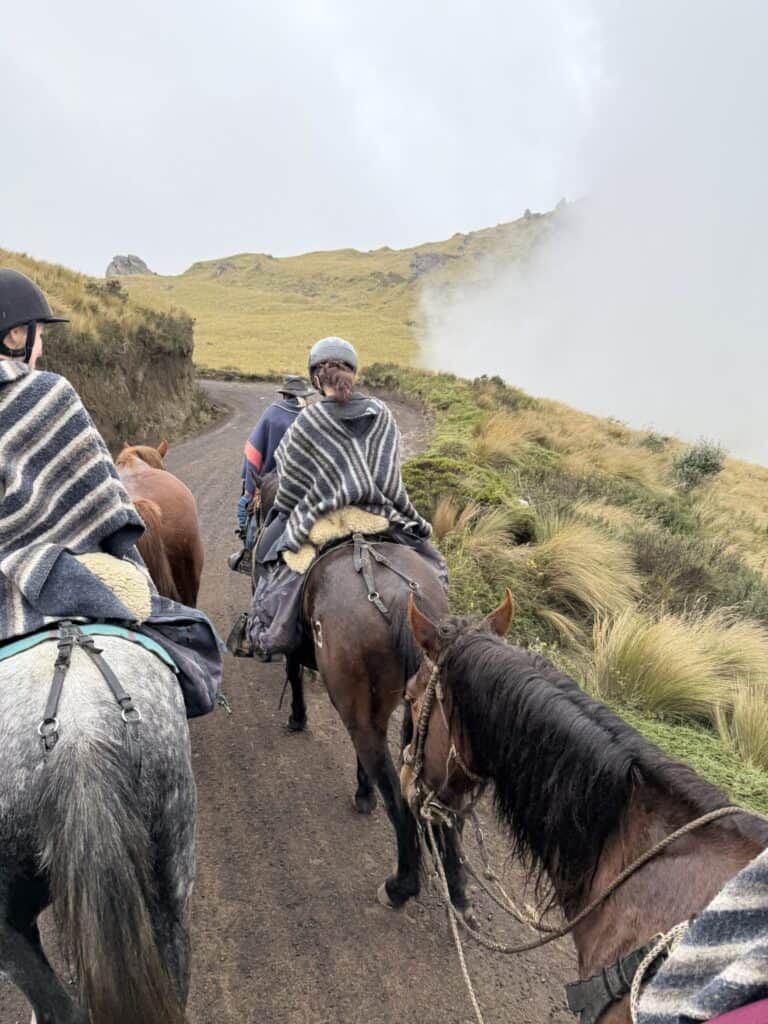
traverse a misty mountainside on horseback In the
Ecuadorian Andes.
Photo courtesy of Natalie Rockwell
Deciding on a Destination
Reiterating the students are “global citizens,” Rockwell said, “the intention was always to take an international trip.”
With that in mind, Rockwell said the five each researched a country while also looking into international equestrian travel tour outfits.
“We elected Far and Ride, which is a London-based equestrian tour company,” she said. “We looked at Iceland, Mongolia, Croatia, Italy, Portugal … we decided that Africa was too far. We looked at everything: Trip duration, travel time, the best horses, the best itinerary … and food — all about the food.”
Ultimately, the group decided a particular 10-day tour in Ecuador was the most appealing, especially since it would provide an opportunity for the students to speak Spanish.
“[VVS has] a lot of foreign students, so the main language taught, other than English, is Spanish,” Rockwell explained, while noting she’d also learned some Spanish from living in Barcelona, Spain, for a year as a child. “We all had that linguistic resonation; we all had some Spanish under out belt, so it just made sense.”
Hacienda La Alegria to Cotopaxi
In early June, Rockwell and the students found themselves arriving in Quito, Ecuador’s capital, where the lush greenery was a welcome change.
“It was very nice to have that change since I’m so used to the desert,” Montgomery said, noting it was also very rainy and humid, which was a nice break from the 110° heat she’d been experiencing living in Tucson.
The group then traveled to the Hacienda La Alegria, a family home, horse farm and ecotourism destination in Aloag, where hosts Gabriel and Paty Espinosa greeted them with warmth and a full spread of farm-to-table foods which were served thrice daily, even when the group were out riding.
Rockwell noted she could “talk all day and night” about the food, which she described as “elegant, three-course meals, very nourishing, with all organic ingredients.”
To many Americans, that might sound luxurious and expensive, however, Rockwell and the students noticed the types of food they enjoyed at the Espinosa’s were abundant throughout the region, where it is common to lead a “slower” lifestyle, farming one’s own food and living in a more rural, community-based environment.
“At a local farmers market, you could buy an entire bag filled with a variety of fresh fruits for just $2,” Allen said. “Back in the U.S., something similar would easily cost between $12 and $15.”
For Rockwell, one of her most enjoyable meals was at the second-highest summit in Ecuador, the Cotopaxi stratovolcano in the Andes Mountains, where Gabriel Espinosa had dismounted his horse, a “Percheron-cross,” donned a pair of gloves, and made sandwiches for the group in what she described as a “gorgeous picnic spread.”
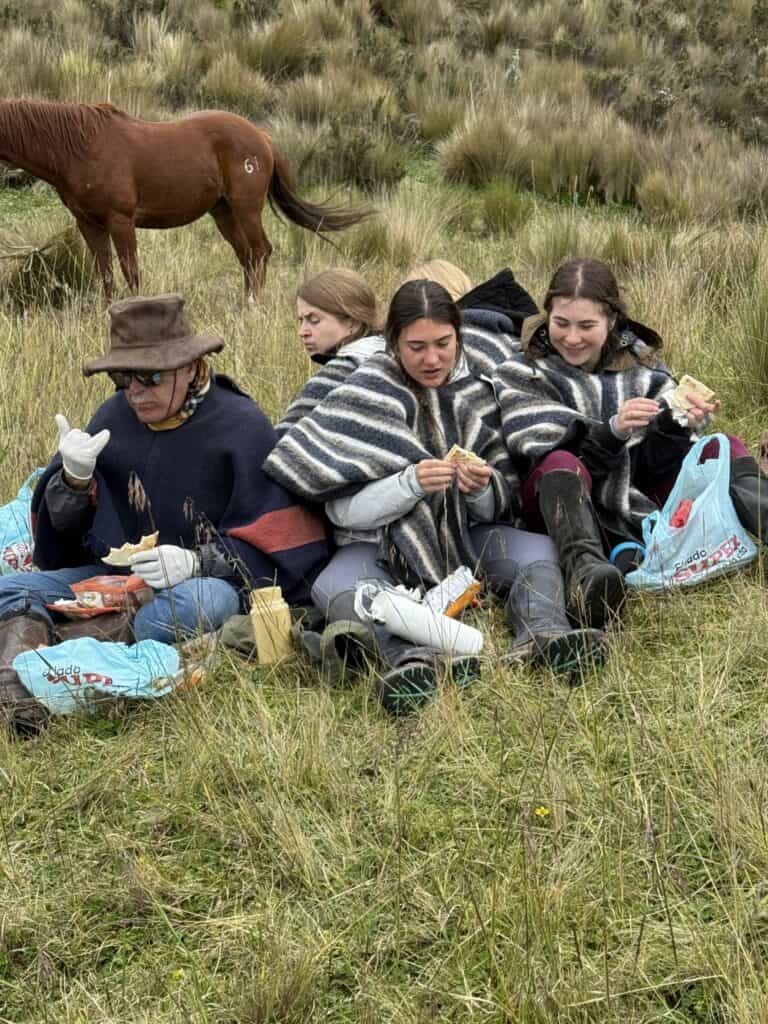
joins VVS graduates Natalie Montgomery, Kanita Olsen and Karly
Shanahan for a lunch of freshly made sandwiches.
Photo by Natalie Rockwell.
In addition to Cotopaxi, the group rode to Quilotoa Lake, a 3-kilometer-wide caldera formed about 800 years ago.
“Quilotoa is a major tourist attraction,” Rockwell said. “It is a gorgeous, full caldera with a lagoon in the middle. The water is green, like startling green, and it’s sulfurous — you can’t drink it or swim in it, but people kayak on it. We trailered the horses there and rode for several days in that area. Getting up to the rim of the caldera and riding around it, was indescribable.”
Conditioning for the high-altitude rides took a little bit of time, beginning with shorter rides at lower elevations before taking on the more epic ones. However, Rockwell said no one in the group ever developed altitude sickness, though she’d brought medications just in case.
“To their credit, Gabriel and Far and Ride catered the trip intentionally to prevent [altitude sickness],” she said. “They started us off low and slow and then gradually going up.”

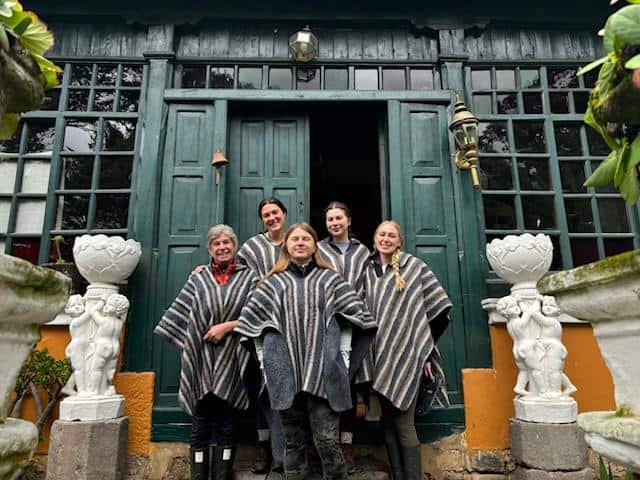
Natalie Montgomery, Karly Shanahan and Serena
Allen in front of the Hacienda La Alegria.
Photo courtesy of Kanita Olsen.
Inca Road
While much of the group’s adventures centered around must-see landmarks, their host also showed them around local neighborhoods, markets, churches and the historic Qhapaq Ñan, better known as the Inca Road.
Rockwell noted the pre-Columbian road bisects Ecuador from north to south, similar to Route 66 in the way that it parallels the main modern highways. Additionally, the similarities extend to an excess of overgrown areas, although Rockwell said plenty of the cobbled road is still visible.
Rockwell’s host regaled her with a story about how he’d personally discovered a pukara, or Inca fortress, along the road, whereupon he prevailed upon his entire family to come and excavate the 20- to 30-foot deep cylindrical ruin.
“It was actually terrifying,” Rockwell said of the site’s depth, which her host nearly-convincingly told her “that’s where they used to store the gold, or throw the prisoners.”
Although she regrets that a fallen tree had prevented her from seeing the pukara in person, Rockwell said “that’s one of many reasons to go back.”
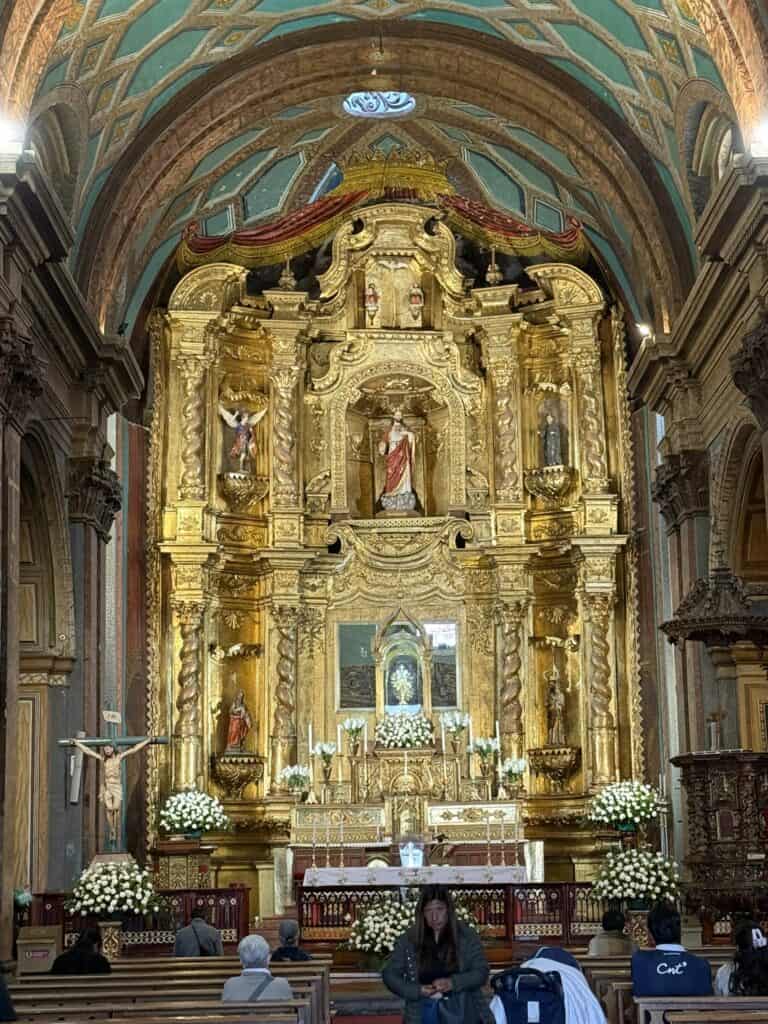
Church of the Sanctuary), a Renaissance Catholic
church in the city of Quito, Ecuador.
Photo by Natalie Rockwell.
Shanahan said her greatest takeaway from the trip was the importance of meaningful relationships in life.
“It was so inspiring to see how our trip leader Gabriel treated everyone like family and was so welcoming,” she said. “He had amazing relationships with so many people we met throughout the trip. I also learned the value of powerful female friendships. I am constantly inspired by Nat, Natalie, Kanita and Serena and it was very impactful to spend 10 days with these strong women.”
“The overall energy in Ecuador was just magical and peaceful,” Montgomery said. “All of the horses were so impressive. We were riding 5- and 6-year-olds who were so well behaved and sweet. They made the insane hills and terrain look easy. We rode between 5 to 8 hours a day and these horses handled it so well.”
Allen said beyond horses, the group was constantly surrounded by animals both wild and domestic: Cats, dogs, pigs, cows and alpacas.
“Entire families of animals roamed, appearing all along our journey as we traveled up and down the country’s stunning mountain roads,” she said.
“It was a great, great expedition,” Rockwell said.
“Our adventure immediately brought me back to my time riding horses at VVS with Nat,” Shanahan said. “It was so powerful to experience that bond again but in a different country.”
“My biggest takeaway was to push yourself and never stop adventuring,” Montgomery said. “I think that the situations you learn the most in are the ones that are outside your comfort zone. It’s always beautiful to learn about another culture and experience it firsthand.”
“I’m not just happy. I’m content,” Olsen said. “Something that I think is so much greater. To be happy is a feeling that you are continuously chasing. A feeling you don’t want to stop feeling so you find vices and fixes to keep you in that state. Contentness is knowing true peace. It’s being exactly where you are and not wanting or needing more. It’s something that no longer requires a chase. Being on a horse brings me to this state. A state of freedom and release that’s so hard to find in your mundane life.”
Allen also couldn’t help but wax poetic, writing “We galloped together beneath beautiful trees, our rain ponchos flowing like capes behind us. I felt like a princess escaping her castle for a day of adventure.”
“Community truly is the foundation of a meaningful life,” Allen said. “We’re not meant to go through it alone, and in many ways, Ecuador seems to understand that better than we do.”


