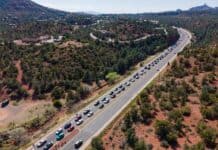













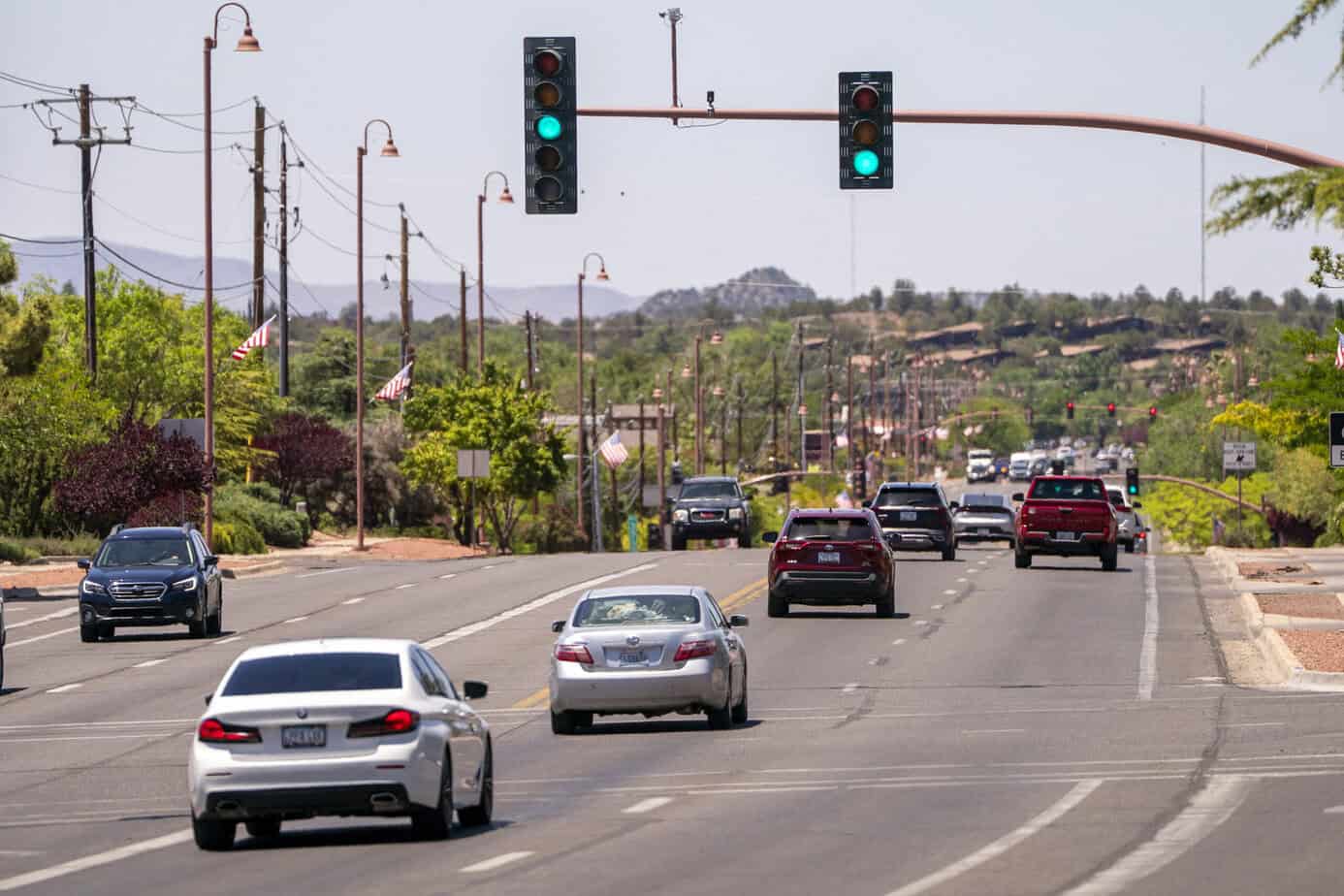
When it comes to discussions of traffic in Sedona, the “Y” roundabout and the Tlaquepaque crosswalk get all the attention, but the traffic lights in West Sedona also play a role in causing or relieving blockages in traffic flow. Understanding how Sedona’s traffic patterns work can help residents navigate around town more effectively, decide on alternate routes and make spur-of-the-moment decisions that will reduce traffic delays.
Arizona Department of Transportation spokesman Doug Nintzel explained that Sedona’s traffic lights are managed so as to prioritize steady flow of traffic along State Route 89A.
“As you may have noticed, the signals for traffic on SR 89A will ‘rest in green’ — remain green — until a vehicle is detected for another movement,” Nintzel said. “That could be a vehicle in an SR 89A intersection’s left turn lane or a vehicle arriving from a side street. That activates the timer process. Once that ‘conflicting’ movement is serviced, the signals are set to revert to green for SR 89A traffic.”
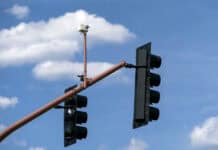
The SR 89A signals operate using video cameras mounted on the signals to detect vehicles in traffic lanes.
“The camera’s detection of a vehicle pulling up to an intersection from the side street triggers what we refer to as a ‘call’ sent to the system to start the timer, or countdown,” Nintzel said. “The system then calls for the traffic signals facing the main street, in this case SR 89A, to turn yellow and then red. Within that timing process, the system allows for the changing of the signal to happen when either a favorable gap in traffic flow is happening or when a predetermined maximum green light time for SR 89A is met. The programming is done by ADOT’s team of signal technicians.”
The timing of the intervals is calculated based upon federal formulas and the “professional judgment” of ADOT’s engineers.
“In addition to the general video detection controlling the sequencing of signal changes, all of the intersections through Sedona have protected left turn green arrow signals,” Nintzel added. “If there is no vehicle in a turning lane, our traffic signals are designed to skip the protected turn arrow for that lane. Movements, including left-turn movements, only run when the system, using video detection, ‘sees’ a vehicle.”
The timing intervals for each intersection are not equal, however, but differ based on local geometry and traffic volumes.
“The SR 89A intersection configurations at Mountain Shadows Drive and Dry Creek Road are more conventional in the positioning of the side streets and the main thoroughfare. The configuration allows pedestrian and vehicle movements to occur simultaneously. This reduces the total interval time needed before SR 89A traffic has a green light again,” Nintzel elaborated. “Meanwhile, because of geometric restrictions, the side street signal movements at Coffee Pot Drive and Shelby Drive run sequentially. An intersection configuration like this requires more time before the lights are green again for SR 89A. That’s especially true when pedestrians have called for the ‘walk’ signal.”
The time for which each signal is activated is determined by a computer based on traffic volumes. Nintzel did not provide the interval times for the traffic lights at each intersection in Sedona, stating that he did not have that information. However, Sedona Red Rock News observations and timing of the lights produced the following durations for total times from green to red lights at cross streets and along SR 89A for Sedona’s intersections with lighted signals from morning and evening samples on a Tuesday and Thursday:
- Dry Creek Road and Arroyo Pinon Drive: The most responsive signal in Sedona, with considerably shorter intervals than all other lights. Green light durations for the side streets ranged from seven to 18 seconds, with an average of 11 seconds, while green light durations for SR 89A ranged from 30 to 44 seconds with an average of 35 seconds.
- Andante Drive: Green light durations for Andante varied between 12 and 32 seconds, with an average of 22 seconds, while green light durations for SR 89A ranged from one minute 30 seconds to one minute 46 seconds, with an average of one minute 35 seconds.
- Rodeo Drive and Shelby Drive: One of the two sequential lights. Green light durations for traffic moving south from Rodeo to Shelby ranged from nine to 37 seconds, with an average of 20 seconds, in a morning sample. Green light durations for traffic moving north from Shelby to Rodeo ranged from 13 to 23 seconds, with an average of 18 seconds. Green light durations on SR 89A at the intersection varied from one minute 30 seconds to two minutes 10 seconds, with an average of one minute 53 seconds. This light is programmed to change more rapidly in the evening, with Rodeo to Shelby green times between 11 and 18 seconds, averaging 13 seconds, or 39 seconds with a pedestrian signal; Shelby to Rodeo green times between nine and 16 seconds; and SR 89A green durations between 29 and 58 seconds, averaging 35 seconds. The green signal allowing traffic from Shelby onto Rodeo is triggered less often than the signal in the opposite direction.
- Coffee Pot Drive and Sunset Drive: The other sequential light. Green duration for traffic moving from Coffee Pot to Shelby averaged about 20 seconds in a morning sample, while green duration for traffic moving from Shelby to Coffee Pot ranged from 15 to 35 seconds with an average of 23 seconds. Green light durations for SR 89A ranged from one minute 25 seconds to two minutes, averaging one minute 48 seconds. Like the light at Rodeo and Shelby, this signal operates faster in the evening, with cross-street green light times of 12 to 13 seconds in both directions and SR 89A green light times averaging 32 seconds.
- Mountain Shadows Drive and Northview Road: Green light durations for the side streets ranged from 15 to 31 seconds, with an average of 21 seconds, in the morning sample, while green light durations on SR 89A routinely exceeded one minute 25 seconds. In the evening sample, cross-street green times ranged from nine to 13 seconds, or 31 seconds including a pedestrian crossing, while SR 89A green durations ranged from 23 to 58 seconds. The south, or inbound, lanes of SR 89A receive a greater amount of green light time than the north outbound lanes.
- Soldier Pass Road: Green light durations in the morning ranged from 10 to 16 seconds, with an average of 13 seconds, while SR 89A green durations averaged one minute 25 seconds. In the evening sample, green lights on Soldier Pass were consistently 13 seconds long, or 29 seconds with a pedestrian crossing, while SR 89A green durations ranged from 29 seconds to 3 minutes 13 seconds, the light being far more responsive to traffic at this time of day.
- Airport Road: Green light durations are consistently 10 to 12 seconds. In the morning sample, green durations on SR 89A always exceeded one minute 50 seconds. In the evening sample, green light durations ranged from 32 seconds to one minute 27 seconds, with an outlier of more than three minutes.
- Forest Road: Green light durations ranged from five to 12 seconds, with an average of nine seconds. This green light is only used to allow left turns onto northbound SR 89A. The signal at this intersection gives more frequent red lights on SR 89A than are required for Forest Road turning movements in order to permit pedestrian crossings of SR 89A. Pedestrians crossing are also prioritized over traffic turning left, increasing its time to turn. SR 89A green durations ranged from one minute 25 seconds to three minutes 52 seconds with an average of two minutes six seconds.
- Uptown midblock pedestrian signal: Remains green unless a pedestrian crossing is requested, which halts the flow of traffic through Uptown for about 20 seconds.
The above times do not include additional time for cross-traffic protected left turns on green arrows, which can add six to 12 seconds to a red light duration, or pedestrian crossings, which add between 10 and 25 seconds to red lights.
Ultimately, knowledgeable and intelligent driving can help alleviate some of the time spent sitting in Sedona’s traffic.