















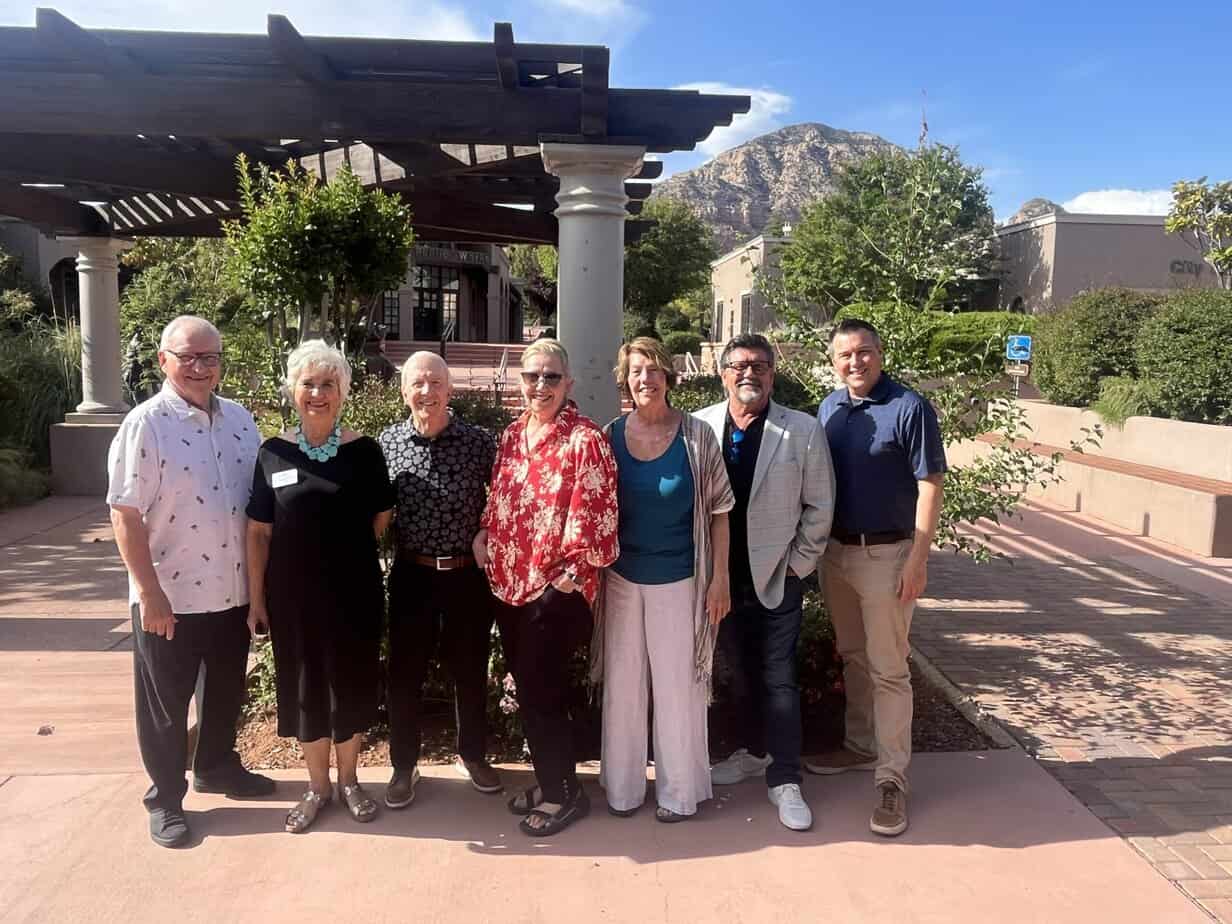
Sedona and Canmore, Alberta, Canada, will officially become sister cities on Saturday, June 28, at 3:30 p.m., after the Sedona City Council approved a friendship agreement with Canmore on May 27 as a consent item, which was followed by the discussion and unanimous approval of the agreement by the Canmore Town Council on June 3.
The formal signing of the agreement will take place in Canmore with Canmore Mayor Sean Krausert and a 10-member delegation from the Sedona Sister Cities Association in attendance, as well as Sedona Mayor Scott Jablow. Sedona residents can watch the ceremony virtually at the Community Library Sedona.
“It is one more step and a very crucial one for us and we’re all delighted,” SSCA President Chuck Marr said. “It’s been four years of effort, but our goal was to find a good sister city that would match our beautiful city, and we found one that’s Canmore.”
Sedona City Council previously approved a two-year friendship agreement on April 23, 2024.
“This official designation will affirm the strong partnership already established and provide a foundation for ongoing cultural, educational, and community collaborations between our two cities,” the agenda bill accompanying the agreement stated.
Marr said that once signed, the sister cities agreement will not require authorization since an end of the relationship “rarely happens.” Canmore previously established a sister city relationship with Higashikawa, Japan, but no notable events in that partnership have occurred in over a decade.
During the Canmore council meeting, Krausert called the agreement “a good news story in a time when good news is needed.” The meeting, during which the importance of cross-border friendships was discussed, was attended by SSCA members Janet and Dale Webber, along with Rob Seeley, chairman of the Canmore-Sedona Friendship Committee, and committee members Martin Buckley, Heather Walter, Janet Krausert and Lynda Damen.
“The mission of … Sister Cities is clear and compelling: ‘Bringing the world together one friendship at a time,’” Seeley told the Canmore council. “This vision traces back to 1956, when President Eisenhower founded Sister Cities International — a global initiative to foster peace and mutual understanding through grassroots, people-to-people relationships. That mission feels more relevant today than ever before.”
Seeley descrbed how in 1884, Canadian Pacific Railway surveyors had named a peak located in Canada’s Banff National Park that overlooks Canmore Castle Mountain. That peak was renamed Mount Eisenhower in 1946 to honor the future U.S. president, but its original name was restored in 1979 and a smaller pinnacle on the mountain’s east side was redesignated Eisenhower Tower.
“This story, rooted in our region’s landscape, reflects how even remote mountain communities can be shaped by global events,” Seeley said. “It offers a meaningful backdrop as we take this next step in international friendship.”
“The silver lining of [the] tariff debate is that relationships between municipalities [in] the United States and Canada, have never been stronger,” Krausert said. “We recognize that we have a lot of common interests … and that the tariffs, while there may be opposition to tariffs and there may be opposition to [the] approach by the current administration, it’s not about disliking or not liking those on the north or south side of the border, our longest undefended border in the world … We need to keep moving forward with those things that bind us together, as well as those things that make us stronger as a country.”
Marr said that SSCA had been concerned that the Trump administration’s tariff policies could slow down the development of a sister city relationship, “but as we talked to the team up there, they made the point that Sister Cities is about relationships between people, not governments, and that the leaders may change, but the friendships that you build over time are the key point.”
“The elephant in the room on this one is the current administration of the U.S. and and the current state of international politics between Canada and United States,” Canmore Councillor Wade Graham said. “Many of us, myself included, I didn’t travel to the U.S. during the first Trump administration. I have no plans to go for the second Trump administration. And I wonder if within these exchanges, what will those look like at this point in time? [Has] there been discussions around those?”
“Is this the time? It’s exactly the right time for this,” Seeley responded. “What we’re proposing isn’t a political relationship. It’s not about governments or administrations. It’s about people-to-people relationships. One based on friendship, critical understanding and a desire to build something positive together.”
“Through this Sister City relationship, we aim to enhance the cultural, educational, economic and social vitality of both Sedona and Canmore — now and for future generations,” a draft of the proposed sister cities agreement stated. “Let this agreement stand as a testament to our shared dedication to peace, partnership, and the promise of international collaboration.”
SSCA plans to present a separate two-year friendship agreement with the city of Jasło, Poland, to the Sedona City Council on Tuesday, July 8, as part of ongoing efforts to establish Jasło as Sedona’s second sister city. Marr said that pending approval by both city’s governments, he anticipated that agreement would be signed in late August, when SSCA will be in Jaslo for the city’s 18th annual Days of Wine Festival, drawing attendees from across Europe.
Sept. 17-20 will be Sister Cities Week in Sedona, including a free concert at the Sedona Performing Arts Center on Sept. 17, the Mayors’ International Dinner on Sept. 18 and a Polish Picnic at Posse Grounds Park on Sept. 20.
For more information about the Sedona Sister Cities Association, visit sedonasistercities.org.