









Three Ekin Patrol mobile license plate reader cameras pulled off consent agenda and unanimously denied
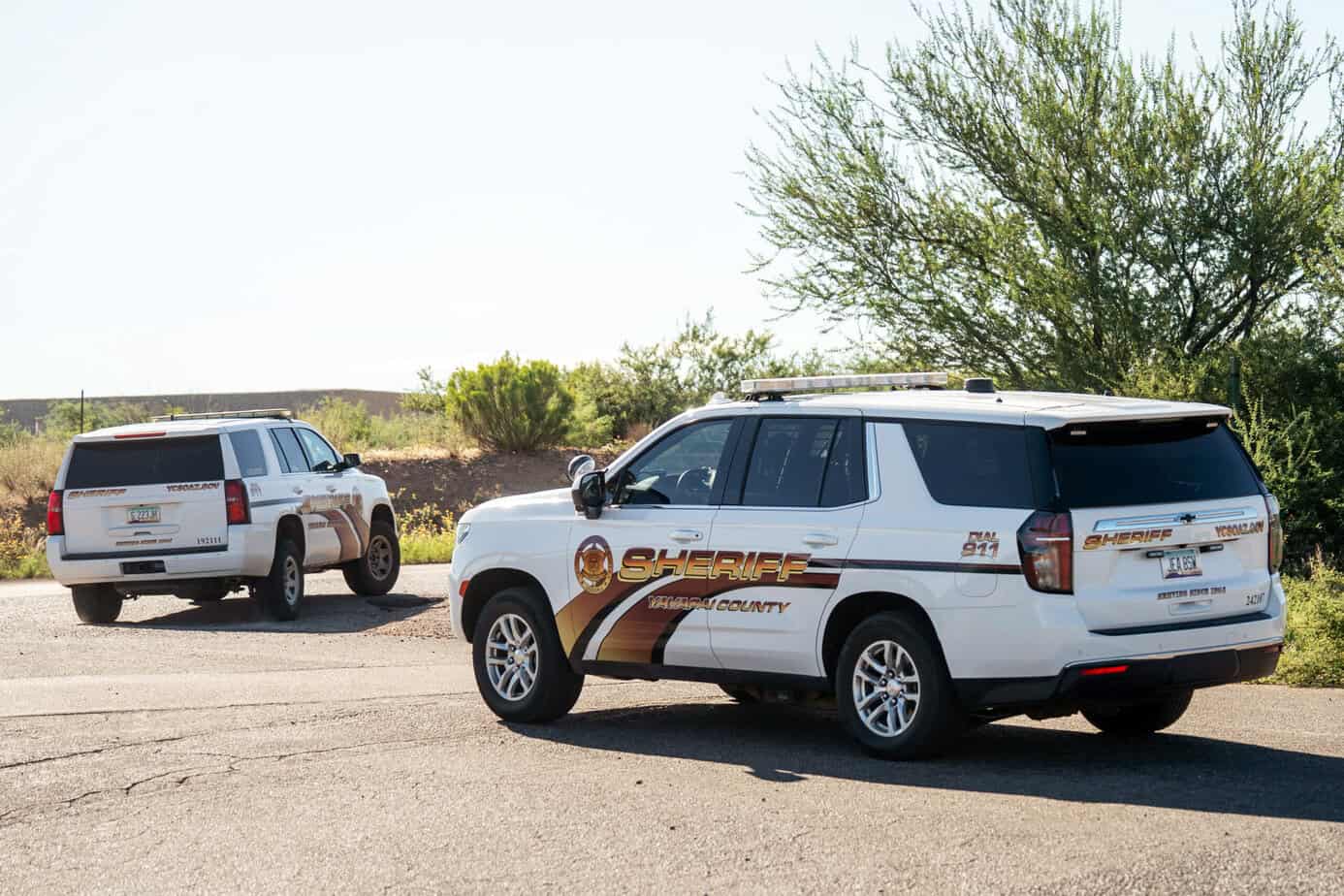
The Yavapai County Board of Supervisors unanimously rejected contracts for three Ekin Patrol automated license plate readers for the Yavapai County Sheriff’s Office at its Aug. 19 meeting.
The ALPRs were pulled off the consent agenda by Chairman Brooks Compton [R-District 1] and Vice Chairwoman Nikki Check [D-District 3] in the days preceding the meeting before they were unanimously denied without discussion at the beginning of the meeting.
YCSO was seeking approval of $39,348 for three Ekin Patrol G2 mobile ALPR units for an initial one-year term with a possible three-year extension, along with a $13,847 contract with LeadsOnline LLC for a NightHawk Subscription Services Agreement.
The board had approved $74,620 on June 7, 2023, for mobile plate readers for YCSO, with the plates for “reducing criminal activities associated with human smuggling and border-related crimes,” according to the agenda packet.
Seven residents spoke against the readers during the public comment period at the end of the meeting, saying the technology violates the Fourth Amendment to the Constitution and questioning why the contracts appeared on the consent agenda rather than as discussion items.
Intelligence Center
Yavapai County Sheriff David Rhodes [R] and the Board of Supervisors still see a role for APLRs in YCSO’s Criminal Information Intelligence Analysis Coordination Center despite the board’s unanimous denial.
“I read the contracts, and what was lacking in my mind is sort of the definitions that were in the contracts … such as who are our authorized users or partners that could also utilize the technology or the data, and what internal policies do we have in place?” Check said. “How do we actually utilize the technology, and what stopgaps are there to make sure that there’s no abuse?”
“People have a lot of questions about it, and so I think that you know the idea that you’re going to have these stationary license plate readers all over the county, and that nobody can drive by without having their images taken, is one thing that community members are very concerned about, and I understand,” Rhodes told Larson Newspapers following the vote. “But I was not asking for that. We were attempting to increase the number of cars from six to nine that had ALPR on them.”
“Entering into this agreement benefits the county by providing the Criminal Investigations Bureau with a platform that fuses multiple data sources — including call records, GPS data, social media, and license plate recognition hits — to build actionable investigative leads,” the agenda reads. “NightHawk supports large-scale investigations by enabling detectives to visualize subject interactions, generate search warrants and collaborate across agencies. This capability directly supports YCSO’s public safety mission and its efforts to combat drug and human trafficking.”
The ALPRs would have been funded by YCSO’s budget.
Senate Bill 1735, Section 118-30, would have funded the NightHawk through a $2 million appropriation from the state, championed by Arizona State Sen. Mark Finchem [R-District 1] for YCSO’s intelligence center. The board unanimously accepted the seed monies during its Nov. 5 meeting.
“We worked together on that when we saw the community reaction, and so that was not a surprise to me,” Rhodes said. “I talked to the board before the meeting.
“But I did not want the board to attempt to pass that yesterday morning after we saw some of the community reaction because ultimately the community needs to have a voice, and we need to listen to it.”
When asked if the ALPRs had him reconsidering YCSO’s intelligence center, Compton said, “Not whether to do it or not, but to more closely scrutinize what would be going into the building. How would it be [used], what is the plan?”
“I really do believe that this technology can be used in a responsible and productive manner,” Check said. “I just think that it’s so important that our policies make sure that people’s privacy isn’t overtly impacted.”
Rhodes said that he supports the use of ALPR in YCSO’s future intelligence center “but with guardrails.”
While YCSO does not currently have stationary Flock Safety ALPR cameras, it does make requests of other agencies, as shown in a Larson Newspapers review of 3.2 million searches of the Coconino County Sheriff’s Office Flock cameras. Year-to-date YCSO ran 106 searches of CCSO’s network. Another 173 searches were run by other agencies citing YCSO.
“I don’t personally know every time” YCSO staff use an outside agency’s Flock Network, Rhodes said. “But I do authorize them” to do so.
“Our internal policy” to use an outside agency’s Flock network “is to call and give a reason for the request and give a case number if they have one,” Rhodes said. “Some of them are actually made by dispatchers when they get a 911 call about a road rage [incident] or something like that.”
Rhodes cited operational reasons as to why YCSO does not currently use stationary Flock cameras.
“As I saw the agencies that were purchasing the Flock cameras, and I saw where they were being located and how they were being used, I felt like that was plenty for this area, and it really is one network, and I didn’t see a need for any more,” Rhodes said.
Other Board Actions
Among the YCSO items that the board did approve were: A $200,000 contract with Hundred Public Safety Inc., aka Performance Protocol, for staff recruitment and retention of $80,000 for digital advertising with the Arizona Media Association through the end of 2026 from the county’s anti-human trafficking program.
It also included $30,000 for Cole Pro Media, Corp, a media consulting firm for transparency engagement advising services.
ALPR Data
Larson Newspapers received a copy of Prescott Police Department’s network audit logs of its Flock cameras on Aug. 19, and the records are currently being reviewed.
Cottonwood Police Department did not turn over its Flock network audit logs to Larson Newspapers by deadline by Aug. 21, after a public records request was filed on July 17.
The Prescott Valley Police Department has not provided its data since the records were requested on July 30.