


Saturday, July 4, is the semiquincentennial of the signing of the Declaration of Independence on July 4, 1776.
The Second Continental Congress voted two days earlier, on July 2, 1776, to pursue independence with the Lee Resolution, which read: “Resolved, That these United Colonies are, and of right ought to be, free and independent States, that they are absolved from all allegiance to the British Crown, and that all political connection between them and the State of Great Britain is, and ought to be, totally dissolved.”
Twelve of the 13 colonies voted for the resolution — the New York delegation abstained because they had not received direct instructions from their legislature to pursue independence. The Second Continental Congress directed Massachusetts representative John Adams, Virginia’s Thomas Jefferson, Pennsylvania’s Benjamin Franklin, Connecticut’s Roger Sherman and New York’s Robert Livingston to draft what became the Declaration of Independence, approved on July 4, 1776.
The declaration is an essay in four parts: The preamble, the Declaration of Natural Rights, the List of Grievances and the Resolution of Independence. It was not written as a proclamation to the American people, who largely were bitterly aggrieved for years or decades. Most American colonists already wanted self-rule, be it as an independent alliance of free states or as autonomous states under British suzerainty, i.e., free to go it alone protected by the Royal Navy from European encroachment by the other great powers.

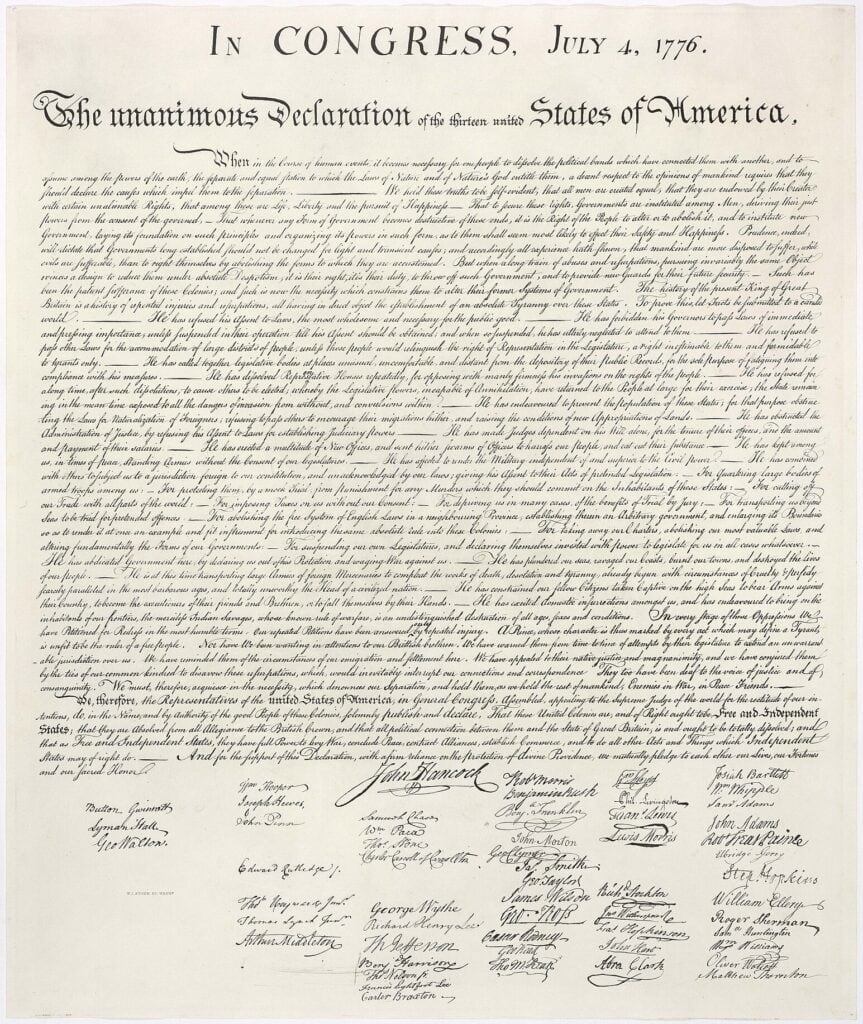
The declaration was an appeal from American colonists to their British cousins, telling them about the offenses to the 13 colonies by King George III, rhetorically argued so that no Briton would accept such mistreatment. The declaration of natural rights begins “We hold these truths to be self-evident, that all men are created equal …” be they American colonists overseas or Britons from Dunnet Head, Caithness, to Lizard Point, Cornwall.
The 1776 appeal by the people against a bad monarch was not new to the English, who had ousted King Charles I in 1642 and King James II in 1688.
The Declaration did not, however, establish the United States as we know it. Each of the 13 colonies were independent from each other, united in a political confederation of choice, but with a unified military to battle the British. Had King George III let the colonies go freely, the colonies may have gone their own way like the confederated states of the Holy Roman Empire, a peer nation at the time, lasting until 1806 when Napoleon Bonaparte remade the map of Europe. But the ineffectiveness of the Articles of Confederation led to a desire to remake the colonies into something more unified. The allied Continental Army left Americans with the idea that a unitary state might be better than the loose, often optional hodgepodge. The 1787 drafting of the U.S. Constitution was shaped by the Declaration’s espoused values into creating a more perfect union.
We still have more in common as a unified people than as separate ones: We want good schools, safe communities, a local sense of community, free speech instead of censorship, lean bureaucracies that spend our tax dollars wisely, a military that acts defensively and only when necessary, support for our international allies who share our values, regulations that make sense and are not overly burdensome, a stable and healthy economy, care for our young, old and poor, fewer homeless on the street, robust institutions that can rebuff bad actors destabilizing the social order, the freedom to live as we please, to read and speak what we want, to be exposed to diverse and constructive ideas and have fair and equal treatment under the law, regardless of wealth, class, race, national origin or language we speak at home. We want a government that helps us with the vast resources of our collective when needed, but largely stays out our lives on the day to day.
What unites us is not homogenous uniformity — that’s the Old World, with its 10,000 years of war and strife based on sharing the same skin or blood or gods. It is our wondrous variety and diverse ideas based on how we interpret the same words on parchment to make a better country that makes America.
Be it immigrants getting naturalized this morning or our family ancestors who arrived long after 1776, they all came to be part of this grand experiment dreaming of what our documents claim we are:
The land of the free.
The land of opportunity.
A shining city on a hill.
The melting pot.
The Mother of Exiles.
Our chief export is hope.
That’s what we celebrate on the Fourth of July: A nation we believe we can become, a nation that 250-year-old words hope we are.


