

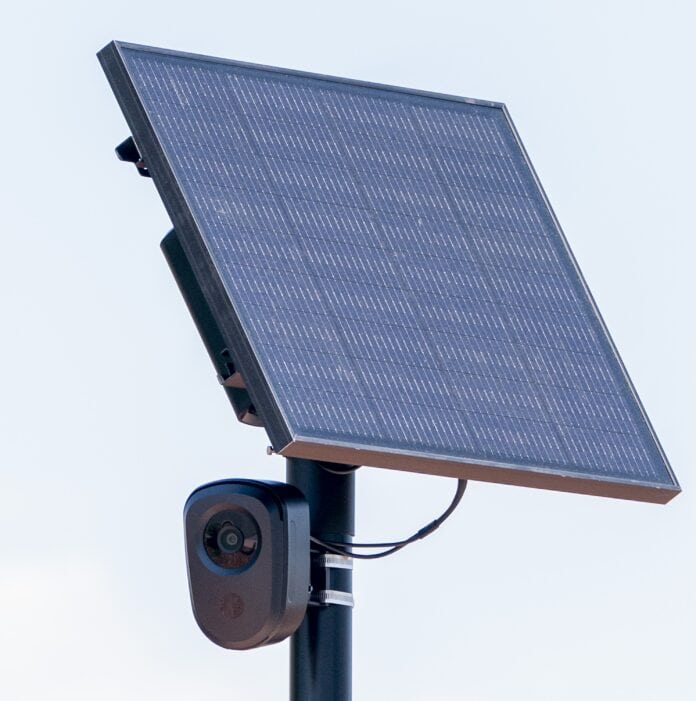
Sedona removed cameras in Sept. 2025; other Arizona cities and Pinal County removing cameras after pushback
There were 3,259,997 searches of Coconino County Sheriff’s Office network of 20 Flock Safety automated license plate readers by 3,815 law enforcement agencies from the start of 2026 through July 22, according to CCSO’s network audit logs obtained by Larson Newspapers.
The Yavapai County Sheriff’s Office ran 106 searches and the Cottonwood Police Department 649, while another 173 searches were run by other agencies citing YCSO or a YCSO case. The Camp Verde Marshal’s Office, which does not use Flock, ran 24 search. CCSO had data-sharing agreements with 94 law enforcement agencies when it rolled the program out, including CPD, YCSO and the Prescott and Prescott Valley police departments.
ALPR cameras photograph every vehicle passing by, capturing the plate number and other features — that data is sent to cloud servers and used to generate searchable profiles. CCSO’s policy is to retain the license plate data collected for 30 days. Nearly 16,000 times a day, the rural county of Coconino is searched — overwhelmingly by agencies outside of Arizona.
The Dallas Police Department conducted the most searches of CCSO’s network with 313,404, ahead of the California Highway Patrol’s 299,216. The Texas Department of Public Safety was third at 75,432, followed by the Houston Police Department with 72,184. Together, the top 10 agencies accounted for 957,176 searches — 29.4% of the total.
Sedona is listed in six searches of CCSO’s network logs in 2026: Jan. 1, by DPS for a hit and run/car accident, four searches on April 11 and 12 by CPD for a Sedona Police Department assault suspect. And a July 16, search by the Williams Police Department to “locate [a] missing person and stolen vehicle of Firefighter, last seen Sedona on Pocket Fire,” the log reads.
Yavapai County Sheriff’s Office
While YCSO does not operate Flock cameras, it accepted $71,381 for four vehicle-mounted Vigilant Solutions ALPRs in July 2023 for drug and human trafficking interdiction. YCSO ran 106 searches of CCSO’s network — another 173 searches were run by other agencies that named YCSO or a YCSO case in the stated reason, 93 of which explicitly identified YCSO as the requesting or assisted agency. About 50% of the Flock activity connected to YCSO took place on another department’s account.
The Prescott Police Department ran 132 of those searches, including 65 requests explicitly stating YCSO and attached a case number to every one. CPD ran 18, including 13 explicit requests, and attached a case number to four.
The 106 YCSO searches were concentrated in property and financial crime: Burglary at 28, embezzlement or fraud at 21, missing persons at 15, stolen property at 14 and narcotics at 11, along with six stalking searches, two arson and one homicide.
Across all 279 searches, burglary was the most frequently cited offense at 38 searches, followed by motor vehicle theft at 30, missing or endangered persons at 26, welfare checks at 24 and financial crimes such as embezzlement and fraud at 21. Stolen property and domestic assault accounted for 14 each, narcotics 11, and outstanding warrants and disorderly conduct nine each. Stalking was cited six times, threats or harassment five, vandalism five, larceny with four, sex offenses, hit and run, kidnapping and DUI at three each, and arson, traffic infractions and trespass at two each.
Forty three searches, all of them run by outside agencies, were filed under the category “Other” and none of the total 279 YCSO connected searches was logged as a human trafficking investigation.
Homeland Security Investigations, the investigative arm of U.S. Immigration and Customs Enforcement, ran no searches of CCSO’s network and holds no account on it. HSI is cited in the stated reason for 404 searches run by 38 other agencies, among them five in Arizona: Mesa police with 45, DPS with 27, Tolleson police with 14, CCSO with nine and YCSO with one. The searches were logged under narcotics 136 times, human trafficking 88, weapons 51 and financial crime 23. None referenced immigration status, deportation or removal. Searches assisting HSI without a written note leave no record of it.
The lone YCSO search citing HSI was run Jan. 7 and logged under drugs/narcotics with the written reason “drug investigation -PV HSI.” It reached 5,730 networks and had no case number.
Larson Newspapers requested the Prescott Valley and Prescott police departments provide their network audit logs.
CCSO installed its Flock network in the summer of 2025, which includes two in Oak Creek Canyon along SR 89A.
“An ALPR system may be used in conjunction with any patrol operation or criminal Office investigation,” CCSO’s ALPR policy manual reads. “Reasonable suspicion or probable cause is not necessary before using an ALPR.”
However, CCSO’s policy requires an event number, a departmental report number or, when assisting another agency, that agency’s name and report number. Absent those, officers must enter their badge number and a detailed reason.
Of the 3,259,997 searches of CCSO’s network, 775,167 recorded only a drop-down offense category, with no case number and no written explanations. Another 306,304 carried a written explanation of three characters or fewer, entries such as “inv” or “atl,” and 1,754,605 searches, or 53.8% of the total, recorded no case number.
Across CCSO’s network, 12,163 searches — 0.37% of the 3,259,997 — cite human trafficking as a stated reason, which includes 9,526 searches where it’s the sole category and 2,637 where it’s one of several selected.
In the Verde Valley, no agency logged a human trafficking search, including YCSO, while the Prescott Police Department logged four.
Governments Remove Cameras
The Sedona City Council made the unanimous decision on Sept. 9, 2025 to remove its ALPRs, after they had been installed in June. City leaders later learned the Flock system had been unilaterally pushed through city staff by then-Mayor Scott Jablow, despite direction from the previous city manager, Karen Osburn, to not proceed without public discussion by the rest of council.
After Osburn retired, Jablow pushed the process through new City Manager Anette Spickard, who later alleged in a letter to council that she had been “manipulated” into believe the cameras had previously been approved before her hiring. Jablow was later publicly censured by council and resigned as mayor.
The Flagstaff City Council ended its Flock contract on Dec. 16, 2025, removing 36 cameras in the city.
Pinal County Sheriff’s Office announced on Aug. 5 that it will not renew its Flock contract.
“I have serious Fourth Amendment concerns with some of the technology that is contained in [ALPR] cameras, whether we have access to it or not,” Pinal County Sheriff Ross Teeple [R] said in a social media video.
The city of Chandler canceled its contract and disabled all 40 of its Flock Safety automated license plate reader cameras in August, after an internal audit found a police officer, who later resigned, illegally used the system to track an elderly family member.
For more information visit the Arizona Daily Sun’s story follow-up on this story at this link.


