



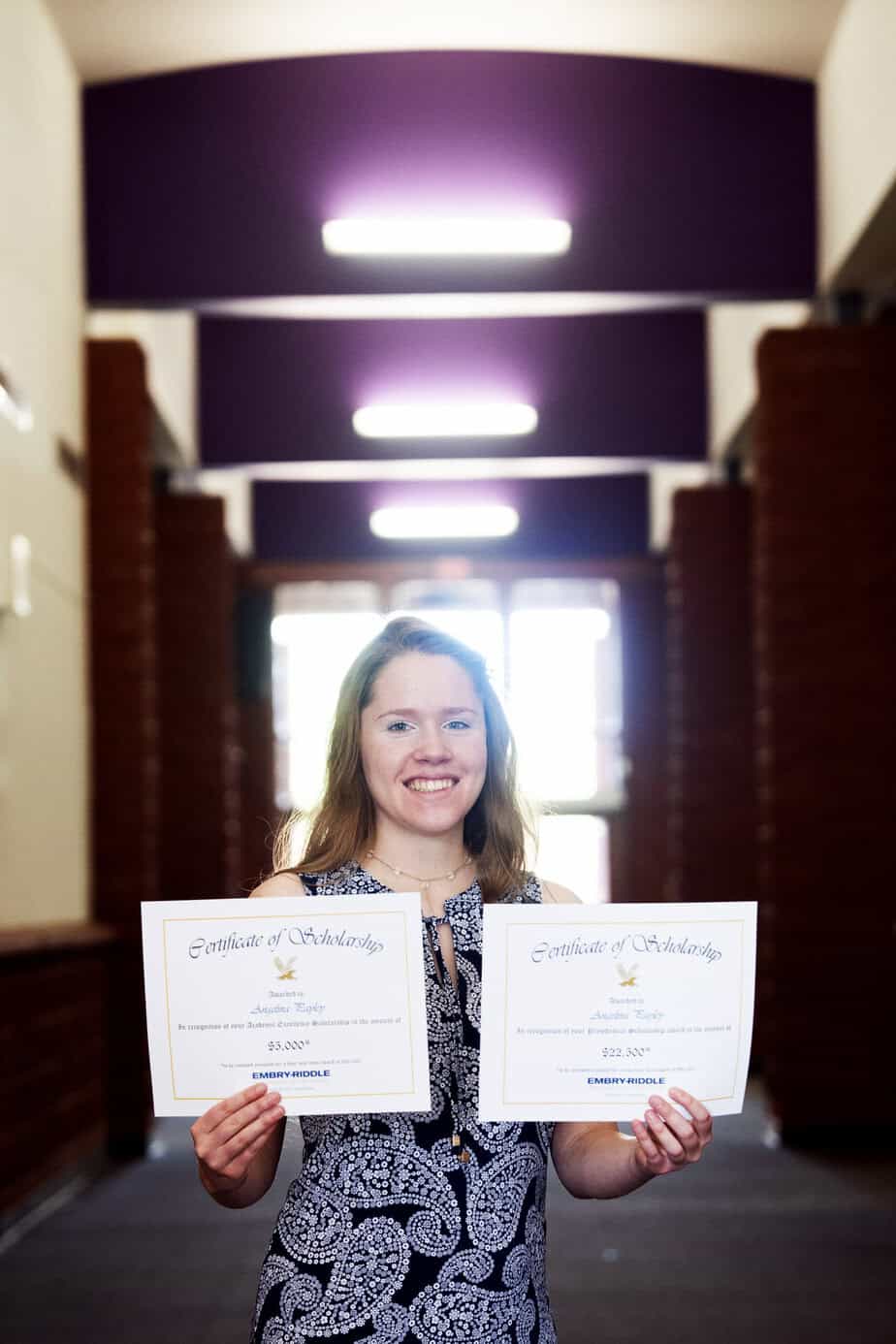
Sedona Red Rock High School recent graduate receives $27.5K yearly scholarship to Embry-Riddle
Whether it’s drawing dragons or earning a pilot’s license, anything that flies catches Sedona Red Rock High School Class of 2026 graduate Angelina Paley’s attention.
“I see a butterfly flying past, I just have to stare at it,” she said.
Paley — who received $27,500 in scholarships to Embry-Riddle Aeronautical University with the potential to renew each year up to a total of $110,000 — likes to write short stories and draw mythological creatures in her free time, especially about things moving through the air.
“They [dragons] have a serpentine body shape that flows,” she said. “Except the wings and talons are kind of hard to draw.”
She practices drawing airplanes, too, which has helped her improve. Some of her favorite classes she’s taken at SRRHS have been on more creative topics, like art classes, history and English classes.
“I’ve also done creative writing sophomore year, which was really fun, probably one of the best classes I’ve ever done,” Paley said. “I had Miss Swan [Jill Swaninger]. She was a great teacher, very encouraging.”
“Angelina’s bright smile and overall enthusiasm for learning made my job as her teacher a breeze,” Swaninger wrote in a recent email.
Toward the end of Paley’s time in her class, they’d had Sedona author and teacher Nathan Hansen present to the class on the “Nesting Novella.” The goal was to create a group-layered narrative.
“Angelina worked diligently during class and at home contributing to her group’s story, ‘Facing Reflections,’” Swaninger wrote. “Each day, I looked forward to her updates on how she integrated her imagination into the collaborative writing process. Angelina was so excited with how the story was unfolding, which is a teacher’s dream to see that kind of spark in a student.”
Flight Training
Paley has been taking flight lessons at Untethered Aviation out of the Sedona Airport since August, she said.
She’s planning to solo in the next two or three weeks, her instructor, Mike Wolford, said on May 20.
Paley hopes to officially earn her private pilot’s license before classes begin in the fall.
“I was just searching for a job I’d like to do one day,” she said. “I still didn’t know [what it would be] at the time, and I decided that I wanted to try flying. So I told my parents, and at first they thought I was crazy, but when they got in touch with my flight instructor, he told them something that blew their minds; it’s that you don’t have to be good at math or physics to fly, you just need to have no fear.”
Mike Wolford, her instructor, said it’s not about being without fear, it’s about learning to use it.
He was a wingsuit pilot for over a decade, he said, and it’s one of the scariest things he’s ever done.
“You can’t make it go away,” he said. “You can only develop a relationship with it that allows you to … control it.”
Once you get over the fear, it becomes an accomplishment to be proud of and to find peace in knowing you’ve done it.
“It’s therapeutic,” Wolford said.
Paley said she likes flying largely because of that peaceful feeling she gets while she’s up in the air.
“I get into this workflow state where nothing else matters, it’s just me in the plane, and when it happens, it just kind of feels so surreal,” she said.
The biggest flight she’s been on so far was to the Grand Canyon.
“We were also the highest I’ve ever been in my train airplane, which was 14,000 feet,” Paley said.
Wolford said he’s proud of Paley’s achievements, especially because so few women go on to become pilots. Only 7% of professional pilots are women, he said.
According to Flying Magazine, women student pilots are still a minority at about 16%.
Embry-Riddle
Paley plans to study aeronautical science while attending Embry-Riddle and eventually fly as a profession. She said she hasn’t decided between flying corporate or commercial, yet.
Commercial pilots typically fly for airlines, whereas corporate pilots will generally fly for special corporate needs. Embry-Riddle students can earn different licenses and certifications, like instrument flying and a multi-engine rating, depending on the classes they take.
Wolford said Paley will have a huge leg up in her studies by having her private pilot’s license first.
“I’m excited for the possibility that I’ll learn how an airplane’s inner workings work better, and the possibility that I’ll make new friends,” Paley said.
She’s already learned a little bit, especially how the engine works.
“In ground school now, I’m learning about all the flight instruments, how they’re controlled,” Paley said.
“Interestingly enough, I learned a little bit about flying in physics,” she said. “I learned that an airplane can fly because of Bernoulli’s principle, and then an airplane’s wing is streamlined because the air current would fly over the top of the wing, which is more curved, [creating] less density, less resistance, and then the underside of the wing is more flat, which will also create lift.”