












McCasland refused to agendize election; 3-1 vote ends meeting
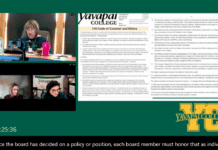
The Yavapai College District Governing Board’s April 21 meeting was adjourned after less than 10 minutes of discussion on the adoption of its agenda.
During the March 31 meeting, the board voted 3-1 to hold an election for the board chair and secretary positions, currently held by Deb McCasland [District 2] and Steve Bracety [District 5], respectively.
With identical votes to the March 31 chair and secretary election decision, the board voted 3-1 to not approve the agenda. Board member Patrick Kuykendall [District 4] was absent.
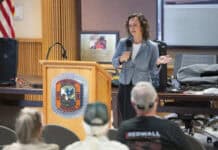
McCasland, the one who sets every meeting agenda and was the sole “no” vote during the March 31 meeting and Tuesday’s agenda non-agenda approval vote, refused to put the election on the agenda.
She prepared a statement on her decision, after hearing from Arizona Community College Coordinating Council Executive Director David Borofsky, Ed.D.
“During that discussion, a potential open meeting law violation related to the meeting was identified,” she said. “Specifically, the potential issue relates to revisions to Board Policy 304.”
McCasland said she filed a formal notice for an investigation with the Arizona Attorney General’s Office requesting a review of any potential open meeting law violations from the March 31 meeting.
“Under Arizona’s open meeting law[s], board action taken during a meeting that violates the law, may be considered null and void,” she said. “This may include votes or decisions made without proper notice, actions taken in improper executive sessions or decisions made through unlawful serial meetings.”
Because the open meeting law requires the agenda to be posted no less than 24 hoursin advance, she claimed it wasn’t possible to add anything new to the agenda once the meeting was called to order, including the election.
“Out of an abundance of caution and consistent with the chair’s discretion, the district Governing Board will table any items currently under investigation,” McCasland said.
She claim her action was important because if the board isn’t functional and open meeting law was violated, it could affect the college’s accreditation with the Higher Learning Commission, which may affect students’ access to federal financial aid.
The Chicago-based nonprofit HLC does not investigate Arizona open meeting law violations has no such stipulations about Arizona open meeting law requirements.
“The complaint filed [to] the attorney general was actually filed by the board chair,” board member William Kiel [District 1] said. “So if anyone is putting our accreditation at risk, it’s the administration or the board [chair]. … There have been no specific allegations leveled, just broad statements,” and all his statements reflect only his opinion as a singular board member, and are not the opinions of the board.
Kiel said he was reluctant to vote to not have a meeting, because of upcoming deadlines to approve the budget, but he plans on doing the same thing until the election is placed on the agenda.
Board member Toby Payne [District 3] told McCasland that she was advised to add it to the agenda by the board’s attorney.
McCasland said the legal advice was confidential information.
The board’s attorney was not present at the Tuesday meeting. Two attorneys have been present at previous meetings, Sarah Lawson and Lynne Adams, of Osburn Maledon Attorneys at Law. Neither were available for comment before the Wednesday, April 22, morning print deadline.
Kiel said the vote during the last meeting did not violate the HLC policies or open meeting law. He said he believes McCasland has been violating Policy 304 since he took office by refusing to put items on the agenda for discussion or vote.