














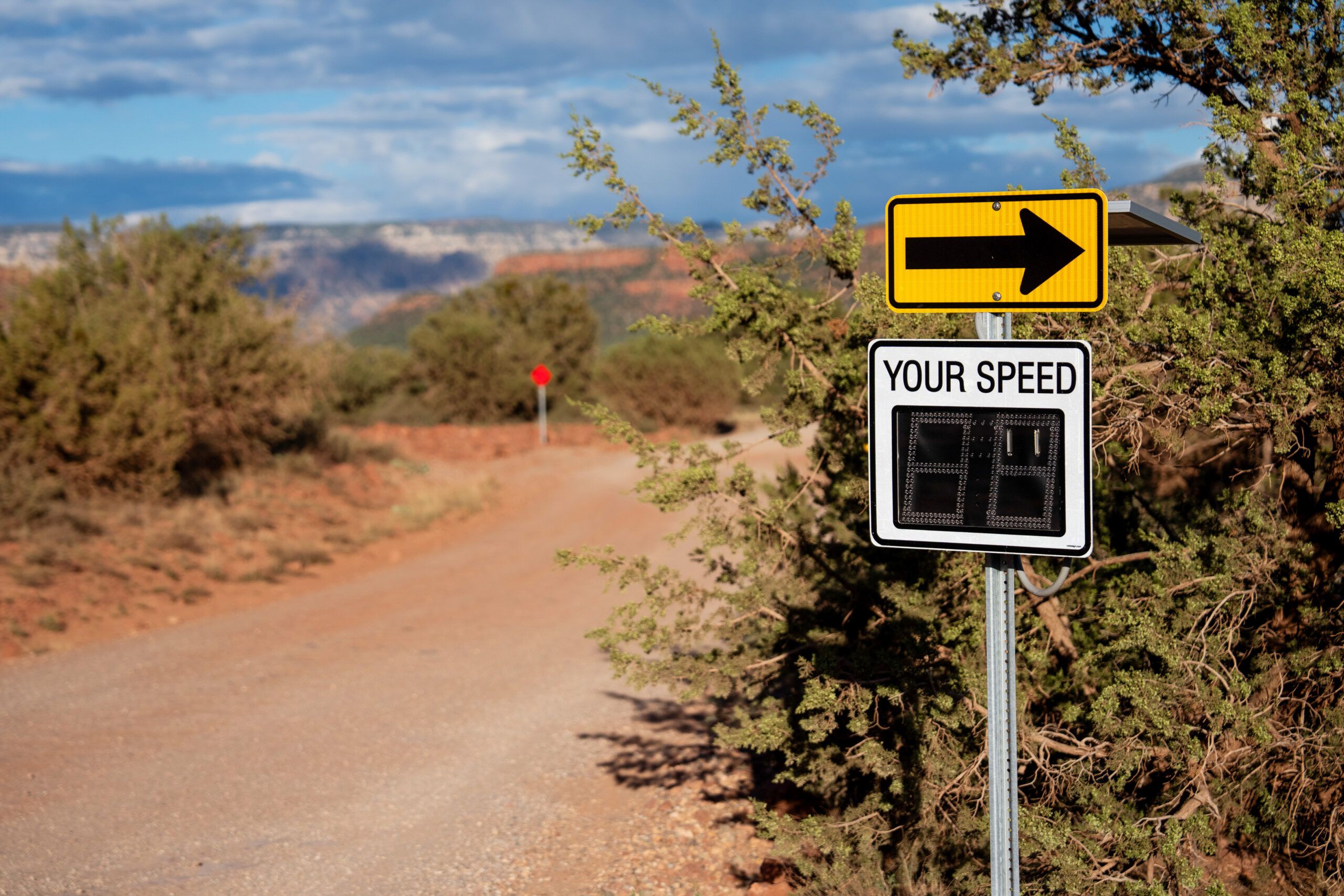
Within the next three months, the Coconino National Forest plans to impose a speed limit of 15 miles per hour for all vehicles for 1.1 miles of Forest Service Road 152C from the intersection of Bear Mountain Road to the intersection of Forest Service Road 525.
“The U.S. Forest Service has the authority to restrict speeds under 36 CFR 261.12,” District Ranger Alex Schlueter wrote. “An engineering assessment was completed in 2021. There were no critical safety items identified in the assessment, so it did not result in a recommendation for a speed limit at that time. Though a speed limit may have positive safety results, the primary purpose of this speed limit pilot is to reduce social impacts of dust and noise.”
Currently there is no posted speed limit along that stretch of dirt road.
The $20,000 grant for the Sedona Forest Road Speed Pilot Project was provided by the Polaris Fund for Outdoor Recreation, granted to the National Forest Foundation for OHV road improvements in National Forests and awarded over the summer. Polaris Inc. is a Minnesota-based manufacturer of OHVs, and watersport and motorsport vehicles.
“We’re measuring it with speed monitors, so they’re a radar that will basically mark the speed of every vehicle that goes by,” Schlueter said. “It can’t tell what kind of vehicle it is. It doesn’t take any photos or anything like that. But it will allow us to know how many vehicles go by it. We already have a counter out there that tells us that. But in addition, it’ll tell us the speed of every one of those vehicles, and we’ll have them facing both directions to test that out.”
A baseline number of vehicles passing through will be taken before and after the new signage gets installed, Schlueter said, adding that he does not anticipate the new speed limit leading to other speed changes on other OHV routes around Sedona nor other new rule changes on the Red Rock Ranger District.
“That’s not the intention,” Schlueter said. “Think of this as a specific area that has a pretty darn high number of vehicles on that road in close proximity to a neighborhood on a road that has a soil type that’s conducive to putting up dust. There’s a number of factors that all go together that make it a fairly unique situation on our district and on our forest.”
The speed limit was recommended by the Greater Sedona Recreation Collaborative, an ad hoc group of government agencies and residents that advises on OHV management on local public lands.
For the speed limit, Schlueter cited the “social impacts of OHV use along that stretch of road being a concern of residents, such as dust kicked up by OHVs and engine noise,” as the reason for the new speed limit, as opposed to environmental concerns such as the possibility of dust being kicked up by OHVs leading to mortality to junipers.
“When it comes to social impacts, they are valid impacts, just like natural resource impacts,” Schlueter said. “As a land manager, I need to consider both of them.
“From my perspective, the mortality of junipers, it’s not a big concern simply because we have a higher number of junipers on the landscape than we have historically, and so we have lots of projects where we’re actively trying to clear juniper,” he said.
GSRC will be working with the University of Arizona to do multiple surveys of both OHV users and residents, to see if the USFS’ management actions have had an effect, but he did not have a timeline.
Schlueter said that he does not anticipate that riders will notice any additional changes along Forest Road 152C outside of the new speed limit and vehicle counters.
“We rerouted part of Forest Road 152C [and] reopened earlier this year,” he said. But “in the next year or two, we will be considering rerouting part of the Diamondback Gulch OHV route to a different entrance location to get a little bit further away from some range infrastructure as well as the residential area there.”
USFS officials have not yet decided if the new speed limit will be permanent. Schlueter said that will be determined if the USFS gets fewer reports of noise and dust along that stretch of road.
“Most of our off-highway vehicle routes that people use, speed is not as much of an issue, because they’re technical routes that you simply can’t go very fast because of the terrain,” Schlueter said. “It doesn’t help to have a 15-mile-an-hour speed limit when you physically can’t go more than 12 miles an hour because of the rocks. So I don’t think it’s likely applicable to many other areas.”
Schlueter will also be part of the State of the Trails update to the Sedona City Council on Tuesday, Oct. 27 at 4:30 p.m. at City Hall.