








Uzumeckis shares the power of press from his father, captured and interred during the Battle of the Bulge
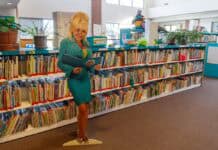
During the April 10 meeting of the Veterans History Project’s “Coffee with a Vet” at Sedona Community Library, Eduard M. Uzumeckis presented the story of his father, Edward A. Uzemack, who served with Company B, 110th Infantry, 28th Division in the U.S. Army during World War II. His father published a newspaper for his fellow prisoners of war at Stalag IX-B camp in Hesse, southwest of Berlin.
“In 1988, I decided I wanted to change my last name to the original family name that’s from Lithuania,” Uzumeckis said. “He and my mother both were first-generation, born in America. All my grandparents were born in Lithuania.”
“But my dad spent his first six years of his education in a Lithuanian parochial school,” Uzumeckis said. “So for the first six years his first language was Lithuanian, and then eventually it became English.”
Uzumeckis, a U.S. Army veteran in Vietnam in 1969 to 1970, said an eighth-grade English class first led him to learn more about his father’s World War II experience after he was assigned a book report and chose George Orwell’s “Animal Farm” because it seemed like a simple story.
“He seemed pleased with my selection. ‘I’ll be glad to help you,’ he said. ‘I worked as a rewrite man for the newspapers early in my career, and know all about writing,'” Uzumeckis said. “He would take up reporter stories, rewrite them so that they sounded better.
“Later, he told me he took classes at Northwestern University School of Journalism while working in the stockyards, and had actually become an investigative reporter and feature writer for the Chicago Daily Times. Just as his career as a newspaper man was gathering momentum, he enlisted in the army to fight World War II. In December of 1944, he was captured during the Battle of the Bulge and spent the next 106 days in a German prison camp.”
Uzumeckis got the ‘A’ and matriculated from eighth grade thanks to his father’s process of pulling out “the dreaded red pencil” to underline, pointing out where the misspellings were and where he needed to elaborate on points. “He would just tell me, you need to do something different here … so it was my own work.”
Edward A. Uzemack
Uzemack grew up on Chicago’s South Side in the Back of the Yards. His parents had immigrated from Lithuania around 1913. His father was killed in a hit-and-run truck accident when Edward was a young man, forcing him to help support the family while pursuing his journalism career at night.
He served in the 110th Infantry, 28th Division, known as the “Keystone Division.”
In early December 1944, following the brutal Battle of Hürtgen Forest from Sept. 19 to Dec. 16, 1944, Edward had been transferred near Clervaux. He was captured by the Germans on Dec. 17, 1944, on the second day of the Battle of the Bulge, and subsequently sent to Stalag IXB in Bad Orb, Germany.
There, he and fellow prisoners created a handwritten newspaper. Even being a prisoner of war didn’t stop the flow of news, as he and a couple of other prisoners, John Dunn and Dennis Murray, bribed their guards for their information, and used one sheet of their toilet paper and produced the “Daily News’ Bulletin” to keep the camp informed about the war.
The Bulletin was plastered with headlines such as: “Rhine Crossed by 7th,” in its March 16, 1945, issue, “Yanks in Koblenz,” on March 21, 1945. Uzemack was listed as the editor along with assistant editors Dennis Murray and John Dunn. A special edition on March 28, 1945, reads “Yanks Occupy Offenbach,” with the final edition published following the camp’s liberation with the headline: “No News Today!” on April 2, 1945, at 8 a.m.
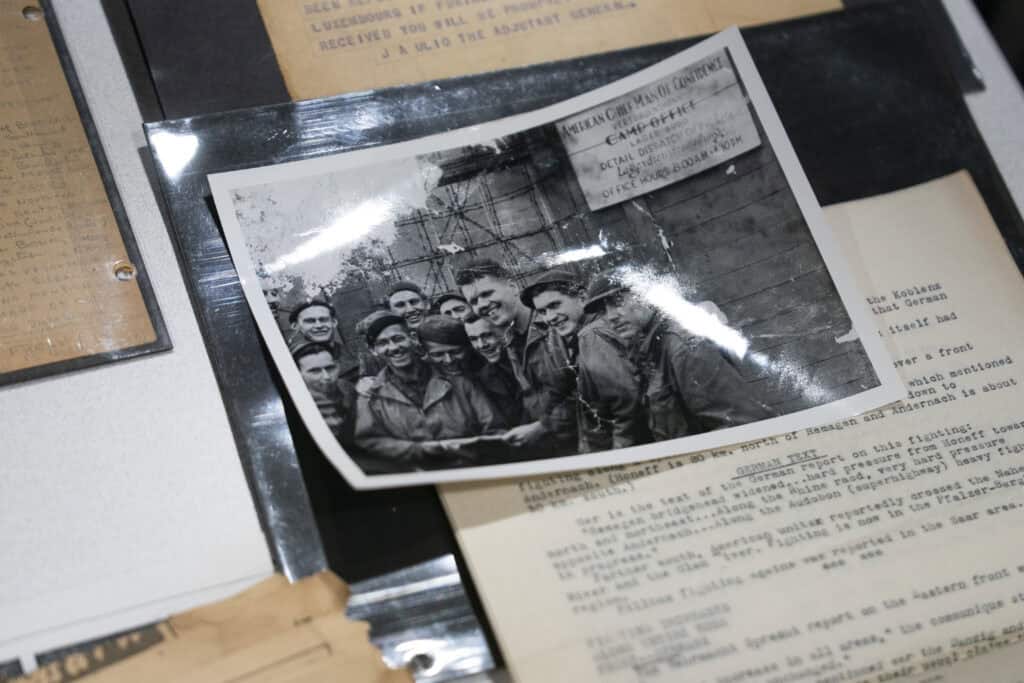
“The idea was to improve morale, because otherwise all they were being fed was Nazi propaganda,” Uzumeckis said. “By gathering daily reports from the German guards and other sources, they could keep the other POWs informed. At that point, the prisoners only knew they had been overrun and captured, and they had no idea what had happened to anyone else.”
Getting that information was risky because if the Germans had ever discovered how they were obtaining it, it could have meant the end for all of them.
“But they were determined to get the information out to their fellow prisoners,” Uzumeckis said. “They couldn’t let them be consumed by German propaganda, because it was destroying morale and without morale, those men simply weren’t going to survive.”
Uzemack documented much of his ordeal in writing, and the memories he carried home were as vivid.
“There are instances in his story in the Battle of the Bulge, in the Battle of Hürtgen Forest, in the POW camp, where he literally came close to dying,” Uzumeckis said. “My father had a scar on his arm, and it was kind of bluish.
“He didn’t tell me exactly what it was, but later I realized that that was his identification number for the POW camp, and he removed it himself, which is why it was so badly done. He didn’t want that memory. He didn’t want to be walking around with that on his arm.”
The next regular meeting of the Veterans History Project “Coffee With a Veteran” program takes place on Friday, May 8, at 10 a.m. at the Community Library Sedona’s Si Birch Community Room.