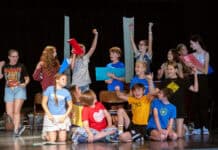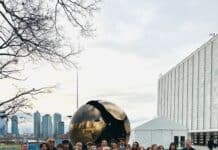





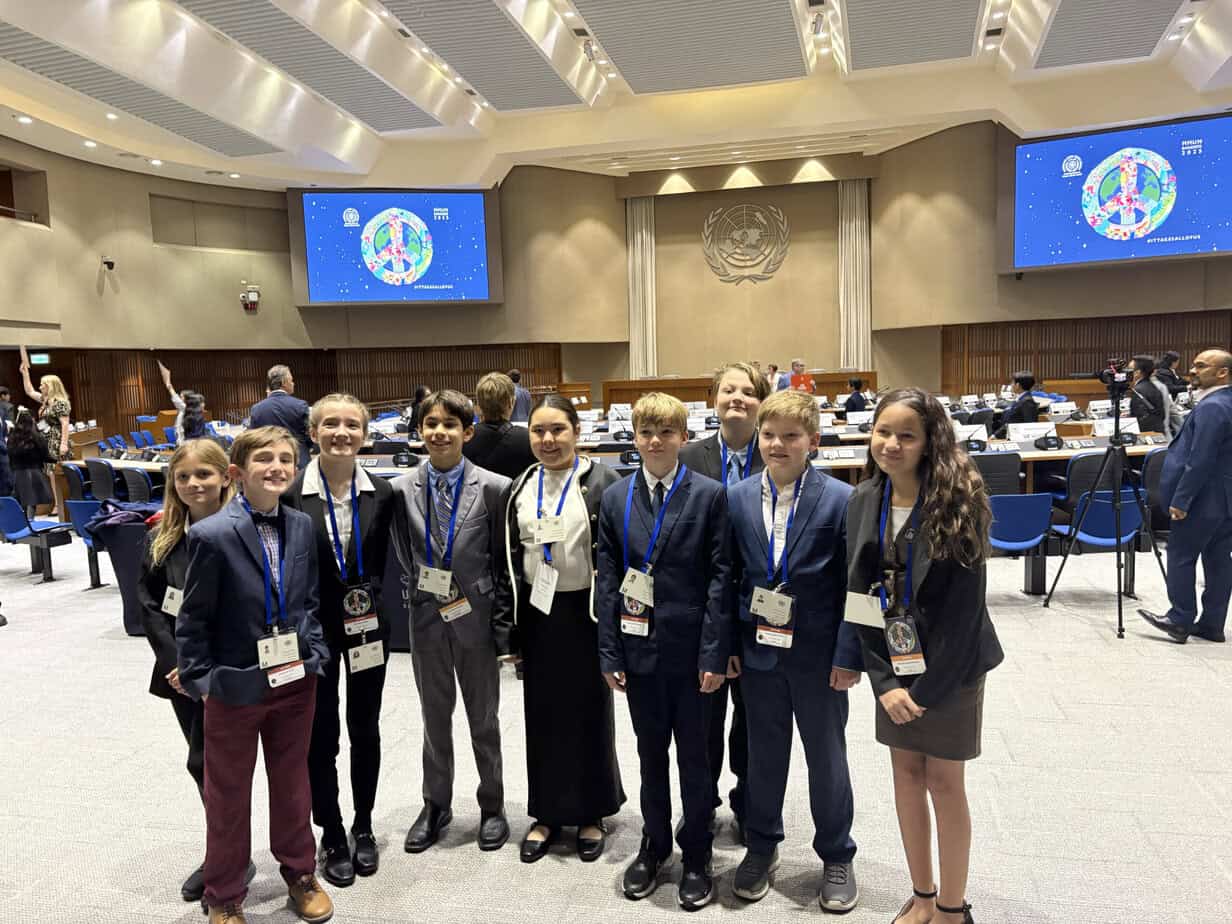
On a 10-day trip to Thailand for the Montessori Model United Nations conference in December, Sedona Charter School students said they had fun making new friends, discussing topics the UN often debates, presenting their thoughts and ideas and, of course, eating the food.
“I ate crickets, centipedes and scorpions,” 11-year-old Levi Kraut said.
Nine students gave a presentation at the school about their experiences in Thailand on Jan. 26, sitting in a row like a panel. They walked in carrying flags of Uruguay, China and Argentina, the countries they were assigned to represent.
Arantza Esquer, 11, went around after the meeting offering crickets she brought back from Thailand to anyone brave enough to try them.
The trip wasn’t all food, though. It took quite a bit of preparation for it.
“Children work in pairs and they step into the shoes of someone from a different country,” teacher Maija Alanen said. “Every child here represents a different country other than the United States. So, they had to look at their problem through the eyes of China, for instance.”
The different problems ranged from disarmament to universal health care.
On the first day they got to Thailand, fellow student Lucas Cordova, 12, said he was nervous.
“The first day was my speech day,” he said.
The papers and speeches were the product of many weeks of work, staying after school at least once a week through the fall and even occasionally working Saturdays.
“So we write how our problem impacts the world and different countries around the world and people,” Esquer said. “Then we write stuff that they have done before, like solutions that has made it a little bit better. … And then at the end of our position paper, we write our solution that we think could help it. After our position paper, we do our speeches, which is either a minute or under a minute long, about our solution in our country and our topic.”
Esquer said for the position paper, they needed to learn MLA format and include a bibliography.
“These papers are pretty high level,” Alanen said. “These are like middle school- slash high school- level papers, so their writing is quality work.”
Once the students got the Thailand, and were broken up into their committees with the other MMUN delegate — World Health Organization or Disarmament and International Security Committee — they discussed their position papers and gave their speeches and voted on someone to present their ideas to UN members, including the head of the UN peacekeeping operations and the creator of MMUN, Judith Cunningham.
Kraut was one of those chosen to present his group’s ideas.
“Our topic was universal health care,” he said. “Our four main points, social awareness on health care issues, focus on prevention, tools and infrastructure in health care and equal and quality health. This resolution addresses the need for health education, and the committee believes it will make a difference on this very important topic.”
In addition to the days at the UN, the students were also able to explore Thailand. The differences surprised them.
“What was cool was, all the signs here are in English, but in Thailand, they were in Thai, and it was kind of hard to read, and the [steering] wheels of the cars were on the opposite side,” Kraut said.
The group went to downtown Bangkok and saw temples and markets. There was a water market where all the kids got into a boat and paddled through to see all the vendors.
“The person on the back of the boat would have a very long staff and they would push on the bottom, and you could see houses that were built around the river,” Esquer said. “The people selling stuff in the markets would take a hook and pull your boat over so you’d buy stuff. Yeah, it was basically like you were fishing for people.”
“It was very pushy,” Cordova said, “but the food was heaven, even though it kind of looked like we were in a sewer.”
The students saw monkeys and native birds. They went to the Hua Hin Beach, the ancient capital of Thailand, Ayutthaya, and the Kui Buri National Park.
“My mother said, the first one to spot an elephant will get 50 Thai baht,” Kraut said before holding up a 50-baht note.
While they were at the monkey temple, Cordova said a baby monkey must have thought his leg was a tree.
“It just ran up and hugged it,” he said.
For most, including Cordova, the food and the five-star hotel, the Shangri La, were the favorite parts.
“The boat ride that we did, the MMUN committees and the floating and the trade market,” Esquer said were her favorites.
Kraut’s were “the Sharngri La, the monkeys and Albert Apestein, the smartest monkey.”
This is Alenen’s 10th year running MMUN, but first time going to Thailand. Next year, interested parents will have to vote on where and when to go, which could be New York City or Rome.
“In the fall, we’ll meet with those people who are interested and come up with a plan to start to talk about fundraising,” she said.
The trips are not cheap and require a lot of effort to ensure they are affordable to families. Student fundraisers this year ranged from lemonade stands to car washes to yard sales.
“Also, people in Arizona can donate their tax credits,” Alenen said, “which is $400 per couple.”