















Debate rages over the use of artificial intelligence, which has permeated everything online from social media to search platforms. An “AI Overview,” now appears at the top of most Google searches, attempting to summarize what people are searching for.
Often, these AI searches are beset with the same problems that a normal online search suffers from: inaccurate or outdated explanations, links to websites or web pages that were later amended or corrected and biased content that promotes a political, commercial or personal agenda and are pushed to the top of a search platform not because they’re the most accurate results but because they have the most hits in previous online searches. It’s great that AI overviews include links to material they source, but just like Wikipedia, which lists external links at the bottom of pages, most users accept the initial results at face value without going a step further to verify that information.
The use of AI in public discourse has exploded thanks to the plethora of large language models like Open AI’s ChatGPT, Anthropic’s Claude, Google’s Gemini, Meta’s LLaMA, the French Mistral AI SAS, United Arab Emirates-based Falcon, Cohere’s Command R, X’s (Twitter’s) Grok, Alibaba Cloud’s Qwen and the Chinese DeepSeek-R1. Large language models, or LLMs, are AI programs trained on vast amounts of text to understand and generate human-like language. They break down language into “tokens” — words, suffixes, prefixes, word parts and sometimes an individual letter — which are converted into numerical representations called “embeddings,” which LLMs study to determine relationships between them through “transformer models” that operate on the principle of “next-word prediction.”
In layman’s terms, when a user gives a LLM a text prompt, what is the most probable next word that will follow the previous one? The vastly complex computations — based on the texts the LLM was trained on — determine the probability of what embeddings will follow in sequence, and the LLM then coverts those numerical representations back into text. The LLMs also learn from their own results and interactions with every user, generating better and more accurate answers or text over time.
LLMs can generate and revise text with close to humanlevel performance, but because they’re based on probability, not the uniqueness of individual human minds, they have limitations in what they produce.
Even a complex language like English, which has 170,000 current words in use, 795,606 words in total and 1,578,939 definitions for them, there is an upper limit to how words can be coherently strung together. The most complex known system in the universe is the human brain, which has, on average, about 86 billion neurons forming 100 trillion connections, a portion of which allows us to generate language in innovative ways that modern AI cannot replicate, at least not yet, nor may be able to at the speed with which we can.
According to a recent study published in Science, “Delving into LLM-assisted writing in biomedical publications through excess vocabulary” found that many scientists use LLMs in their scholarly writing. The study looked at vocabulary changes in more than 15 million biomedical abstracts from 2010 to 2024, showing how LLMs led to an abrupt increase in the frequency of certain styles and words across disciplines, countries and journals, surpassing the effect of even major world outbreaks such as Ebola and COVID-19.
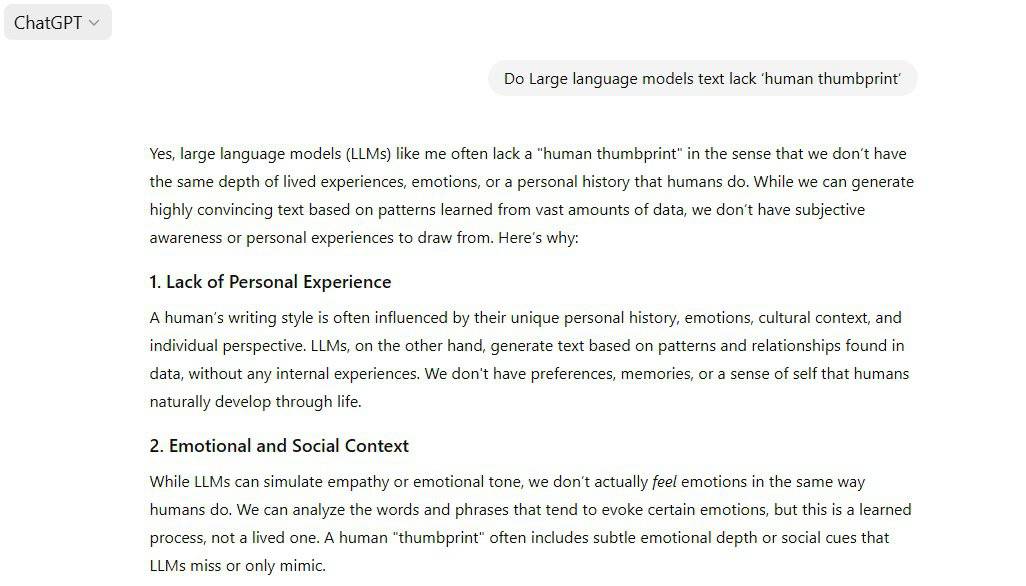
I was recently interviewed by two researchers from Arizona State University about the current and future impact of AI and LLMs on journalism. I told them that I could have my current and former journalists all attend the same meeting and write a news story about it and, from that, I could tell them which reporter wrote which story from just the first few paragraphs — human writing is like a thumbprint. And yes, when people send us content for publication written by LLMs, we can tell.
When we write or speak, even using a common language to convey meaning to each other, we do so in ways that a computer-based LLM cannot. LLMs can certainly come close and many LLM responses sound like a human could have written or produced them, but for many voracious readers, the text of an LLM “feels” artificial. While LLMs can provide answers and churn out text, they can turn the artistry of human language into bland linguistic paste that attentive readers can spot in just a few sentences.
Authors embed themselves and their thinking in their word choice, sentence structure and how they formulate a thought they want to convey. Following equations based on word probability, LLMs lack this agility and adaptability.
Certain AI tools are already useful and will certainly improve over time, making our jobs easier and more efficient, but generative AI like LLMs can’t replicate what humans can do. They will make communication between us all easier and convey ideas faster but will remain tools because they lack the human connection and that need to convey thoughts that made us begin communicating through language in the first place.