















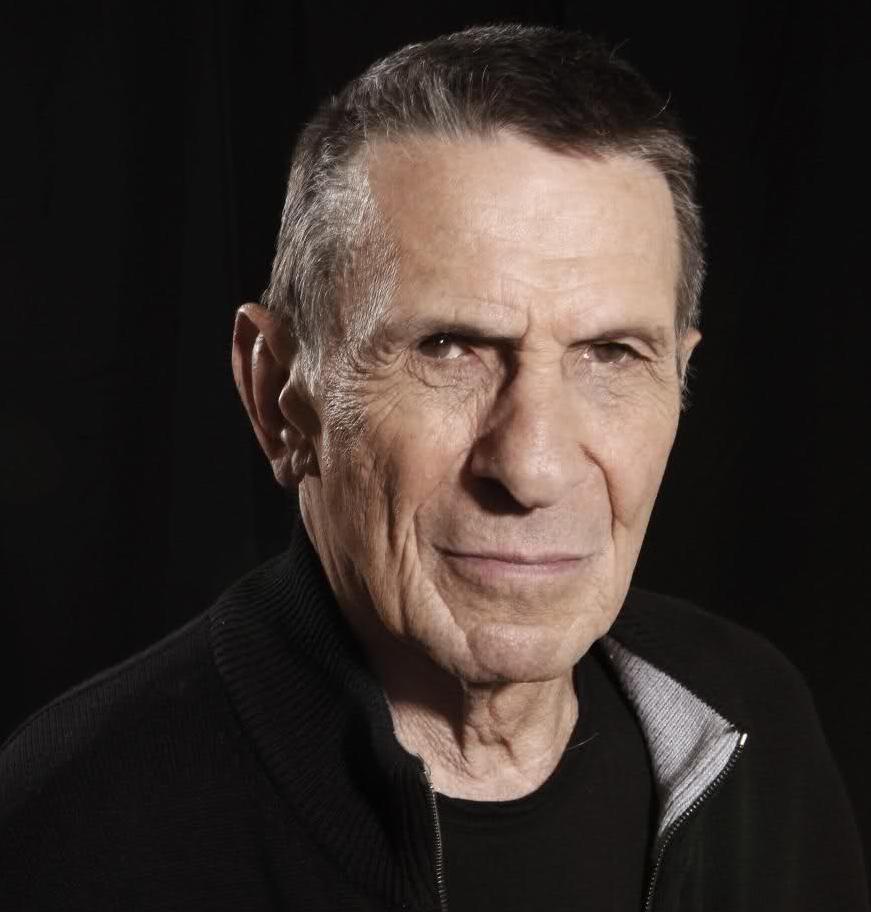
“The needs of the many outweigh the needs of the few, or the one,” is known as the Spock Principle.
Taught as the guiding principle in medical triage, it is also a thought experiment in philosophy and named after the character Mr. Spock, played by Leonard Nimoy, who died Friday, Feb. 27, provoking a mournful cry of “Khan!” by scientists and nerds worldwide.
 Nimoy played Spock for three seasons of the original series of “Star Trek” in the 1960s, in six movies in the 1980s and 1990s, and reappeared in two movies in the most recent reboot of the series.
Nimoy and his character Spock influenced a generation of kids to dream of exploring the stars. “Star Trek” appeared on television in 1964 near the start of the space race, before humans first set foot on the moon, but demonstrated our species was embarking on a great exploration beyond the surly bonds of Earth. We were shown a future when we would sail between the stars, colonize other planets beyond our solar system and possibly meet aliens, but still grapple with tough moral and ethical decisions. No matter the level of technological advancement, we would remain inextricably human.
A single character split into three parts, Nimoy’s Spock represented the mind, DeForest Kelley’s Dr. “Bones” McCoy represented the heart and William Shatner’s Capt. James T. Kirk represented the spirit, giving screenwriters the ability to explore this trinity of the human condition.
Nimoy’s character also inspired those same children to pursue science as a career. The handful of astronauts at NASA and tens of thousands scientists who send them into space made Spock a mascot and named an asteroid after the character in 1971. The love of real science instilled through a science fiction television program has profoundly changed our world through our understanding of the skies above.
 Spock was half-human and half-Vulcan, a race of near-human aliens with pointed ears, green blood and dedication to a quasi-religious belief system that demanded the dedication to pure logic and complete suppression of all emotion, which more than one ex-girlfriend has accused me of emulating. Nimoy played a character from two cultures for narrative purposes, but he himself has become an icon for mixed-race Americans and offered advice to those who wrote to him about their own suffering from racism. While Spock played the outsider aboard a human starship, Nimoy himself grew up in Boston as an outsider too, in an Orthodox Jewish household and speaking Yiddish as a first language.
Nimoy and the rest of the cast of the brief series lived long and prospered as a major cultural icon in syndication, creating five spinoff television series, 12 feature films, numerous parodies, 11 Emmy Awards and inspiring inventions like cellular phones, touch screens and video conferencing, technology which first appeared on the show 50 years ago.
Though Nimoy has left our world, Spock remains in our cultural memory. When Spock died in “Star Trek II: The Wrath of Khan,” he left us with final words best fitting Nimoy’s relationship to his fans and all the dreamers of our human species: “I have been and shall always be your friend.”
Christopher Fox Graham
Managing Editor