

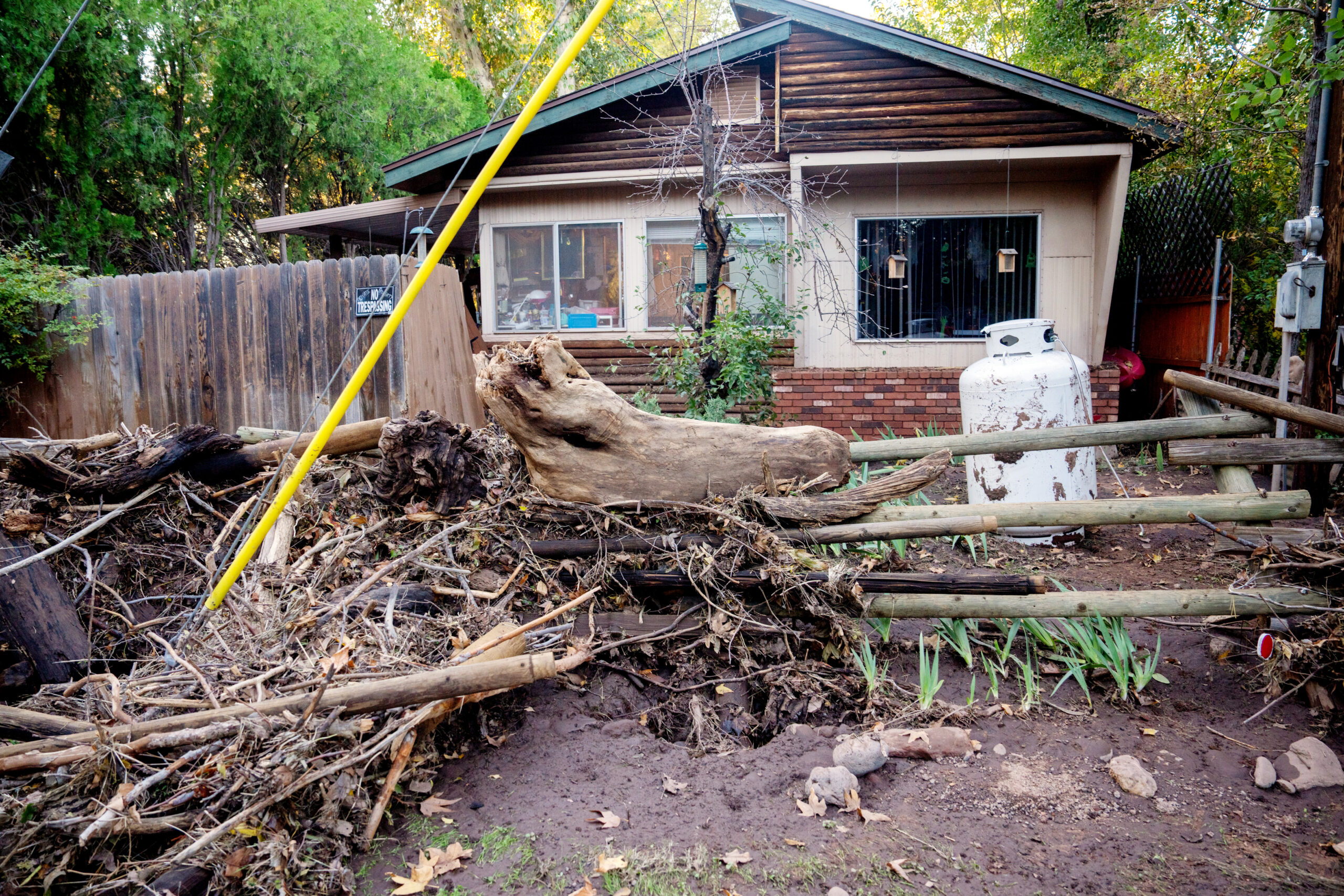
Historic rains and flooding damaged 88 structures; 45 rescued by airlift
During a work session on Thursday, Nov. 12, Sedona City Council reviewed the city’s emergency response and current recovery efforts following the Nov. 1 flooding along Oak Creek, which damaged dozens of structures and prompted 28 air rescues with 45 residents hoisted out across Sedona.
At 22,600 cubic feet per second, the flood ranked second since 1983 behind 1993’s 23,200 cfs, and the National Weather Service called it “unprecedented” as most local floods have historically been “rain-on-snow events.”
Sedona Police Department Emergency Management Coordinator Chance Wnuck said the Nov. 1 flooding is unique for being “strictly a rain of full saturation.”
Although climate change is measured over 30-year increments, the flooding might have forced the city to rewrite part of its emergency action playbook.
“As one thing we can consider,” Wnuck said, when asked by Mayor Brian Fultz what the city learned from the flooding. “I think taking in the totality of this summer, and you know, looking at what it might be over the winter, I think we start looking at setting up maybe our emergency operations center sooner. Just knowing that we have 600% rainfall over the last month, and not just taking the forecast as what it’s forecasted, but starting to develop additional measures. Maybe earlier management action points.
“Now that we know that an event like this can occur, not associated with a rain-on-snow event.”
Rain began around 7 p.m. Saturday, Oct. 31, and rapidly rising creek levels prompted officials to activate the Emergency Operations Center before dawn Sunday Nov. 1. Under the statewide “Ready, Set, Go” evacuation warning system, the city issued a “SET” Nixle alert for Evacuation Zones 9 and 10 at 7:18 a.m., which escalated to a “GO” evacuation order for Zones 8, 9 and 10 at 7:44 a.m. Three minutes later, the Brewer Road siren sounded, and first responders conducted door-to-door evacuation notifications in the affected areas from 7:55 to 8:45 a.m.
This marked the second time the city’s siren system has been activated in an emergency, following its initial use on Oct. 22 as a tornado warning.
As of Nov. 12, Council’s presentation materials noted about 88 structures within Sedona city limits that straddles Coconino and Yavapai counties were damaged by the flooding. Meanwhile, Yavapai County Emergency Manager Ashley Ahlquist said during a county town hall in Cottonwood on Nov. 10 that out of 527 resident reports, the state has verified 22 homes as destroyed, 83 with major damage, 65 with minor damage and 87 as affected.
Sedona Fire District Fire Marshal Kirk Riddell said that he did not have tracking details for the specific locations and times of those who were short-haul airlifted when asked by the NEWS.
Sedona Vice Mayor Holli Ploog asked if federal elected officials had reached out to the city regarding recovery assistance, noting that the offices of U.S. Sens. Mark Kelly [D] and Ruben Gallego [D] had been in contact.
U.S. Rep. Eli Crane [R-District 2] toured the damage in Camp Verde on Friday, Nov. 13, according to his office.
The Bear Wallow Neighborhood, off of Schnebly Hill Road, was among the hardest hit areas in the city with 11 damaged structures. Several residents were among those to speak during the public comment portion of the meeting.
“I’m here on behalf of several people from Bear Wallow because we are all still digging our homes out,” resident Lauren Thompson said. Thompson said that a neighboring married couple did not receive a door-to-door evacuation warning.
“[The husband] almost lost his life going to save his wife,” Thompson said. “No one was able to evacuate her, and the only reason that she lived is she walked [to] my house through three feet of water, telling herself that she felt she was going to die. She was in my house until 2 p.m., until a neighbor hiked down the cliff to go help get her out.
During discussion, Councilman Derek Pfaff said that he would like to hear from city staff what the city can do to speed up recovery with regards to financial charges to homeowners such as development impact fees and learn what “we can do to empower the mayor to waive some or all of those costs during circumstances such as this.”
Pfaff’s proposal was supported by council to be added for discussion at a future meeting.
Interim City Manager Kevin Phelps said that flood control and mitigation projects will likely be on the agenda for the council’s December priority retreat for 2027, and that the city could establish placeholder funds in its 10-year Capital Improvement Plan to designate potential future flood control measures.
A formal after-action report detailing the city’s response and areas for improvement likely will not be finalized for another six to eight months, Phelps said to the NEWS following the meeting.
Fultz announced that the Airbnb Foundation has committed 500 room nights for temporary housing for that affected by the flood, which will be administered by the Greater Sedona Chamber of Commerce.
Shondra Jepperson is organizing the Sedona Verde Valley UPLIFT! Flood Recovery Fundraiser at Community Library Sedona on Saturday, Nov. 21, from 10 a.m. to 5 p.m., including a silent disco and live music. For more information about the fundraiser call 928-300-6960.
For more information about the flood visit sedonaaz.gov/floodrecovery or sedonachamber.com/businesses-resources-flooding.


