











Red Rock Ranger District outlines policy changes, office moves, possible shift in fire staff to Dept. of Interior
Delayed by the outbreak of the Pocket Fire in June and July, the Red Rock Ranger District gave its annual update to an at-capacity, standing room-only Sedona City Council Chambers of residents and council members, along with area non-governmental partners, for a “State of the Trails” report on U.S. Forest Service and local partner projects on Oct. 27.
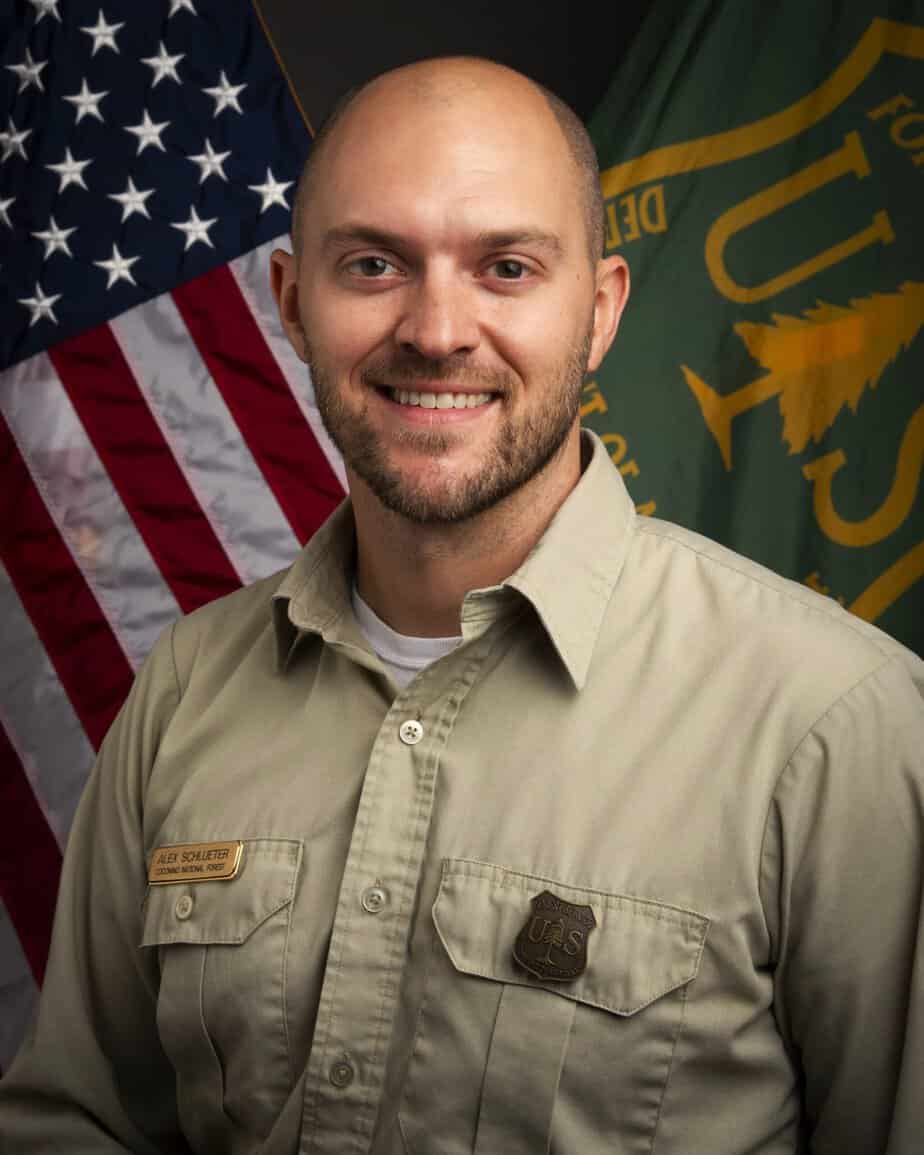
“Our current staffing has changed a lot in the last couple of years,” RRRD District Ranger Alex Schlueter said. “So our fire program has stayed the same in the last couple years, we’ve continued to fill behind firefighters as they get promoted, they move. We share a program with the Verde Ranger District in a zone program where they respond anywhere in the Verde Valley to any wildland fire and assist other agencies as necessary.”
The Coconino National Forest is split into the Red Rock, Flagstaff and Mogollon Rim ranger districts. The Prescott National Forest is comprised of the Verde, Bradshaw and Chino Valley ranger districts.
The Red Rock Ranger District currently has 34 permanent employees, with 13 focused on fire and 21 in non-fire-related positions along with about 15 seasonal employees and five partner employees. The last permanent employee hired outside of the USFS fire program was in November 2024. RRRD staffing levels peaked in 2024 with 35 permanent non-fire employees, while fire staffing levels have remained steady.
There is potential agencywide for massive shifts in fire staffing with the Sept. 15, 2025, announcement by the U.S. Department of the Interior to establish the U.S. Wildland Fire Service.
“There was an executive order that asked the agencies to look at and potentially move all wildland firefighting resources under one organization within the Department of Interior,” Schlueter said. “They already have moved from the Fish and Wildlife Service, Park Service, Bureau of Land Management to a new national wildland firefighting service. Within the USFS, we haven’t done that. We’ve done some consolidating a bit internally. There’s a study that was recently contracted, I believe the results will be out early next year, looking at, ‘does it make sense to move the USFS firefighting force into the Department of Interior under that new Wildland Firefighting Agency?’”
A refrain throughout the evening was that the RRRD has one full-time permanent employee for the approximately 400 miles of trails in its boundaries, and that the 40% decrease in RRRD non-fire employees “makes it really challenging right now,” Schlueter said about accomplishing public land projects. “It’s knowing that there’s only so many things, no matter what our partners come to the table with, so many things that we have to do that are inherently governmental functions that we can’t pass off and can’t ask a partner to do.”
Agencywide, the USFS has “decreased about [by about] 6,000 to 7,000 employees in the last couple of years,” Schlueter said. Federal data shows that the Forest Service has lost about 6,000 employees, or about 15% of its workforce, during President Donald Trump’s second term as part of the administration’s cuts to agencies that oversee the nation’s natural resources, the Associated Press reported on Sept. 3.
Other changes to the USFS highlighted by Schlueter are the reorganization of the agency and policy changes.
“We’re moving the headquarters of the Forest Service from Washington, D.C., to Salt Lake City,” he said. “The regional offices, the format that the Forest Service has operated under since its inception for over 100 years, are going away.”
The relocation to Salt Lake City was announced on March 31 for the stated reason of “Streamlining how the USFS is organized will position the Chief and operation leaders closer to the landscapes we manage,” U.S. Secretary of Agriculture Brooke L. Rollins wrote. “This includes supporting our timber growers across the country, including those in the Southeast, by prioritizing a regional office and promoting policies that boost timber production, lowering costs for consumers.”
The Grazing Action Plan to put more cattle on public lands to boost the supply of American beef was also signed on March 31 by the Departments of Agriculture and the Interior.
“While this doesn’t necessarily affect Sedona that closely, there’s one range allotment in West Sedona, the Windmill West allotment that runs basically from Cottonwood all the way up almost to Flagstaff, a huge allotment,” Schlueter said. The Grazing Action Plan “does take a lot of our—potentially a lot of our capacity to do this.”
“We’re changing to a state-based system, we will have an Arizona state director that oversees the entirety of all of the national forests in Arizona. Some of those state directors nationwide have already been named; Arizona has not.”
The Coconino National Forest Supervisor’s Office is located in Flagstaff, while the USFS Southwestern Region is located in Albuquerque, New Mexico.
Schlueter also addressed the Trump administration’s proposal to rescind the 2001 Roadless Area Conservation Rule, which restricts road construction and timber harvesting in designated backcountry areas and applies to about 44.7 million acres of USFS land nationally and 1,174,000 acres in Arizona; a final national ruling is expected in 2027.
Locally, at least, Schlueter said, “I don’t anticipate locally that to have a major effect” if it was rescinded, since within the RRRD there are four areas that it applies to and “they’re all east of Camp Verde.” Across the Coconino National Forest that includes the RRRD, the inventoried roadless areas are Barbershop Canyon, Boulder Canyon, Cimarron Hills, East Clear Creek, Hackberry, Jacks Canyon, Lower Jacks Canyon, Padre Canyon and Walker Mountain, according to the 2018 Coconino National Forest Management Plan.
A larger change for his district, Schlueter said, is the administration’s proposal to change the Travel Management Policy, which requires significant public engagement for the rules that govern trails, to move e-bikes from their classification as motorized vehicles to treat them essentially as equal to non-motorized mountain bikes, which would open them to all non-motorized trails, unless explicitly restricted.