










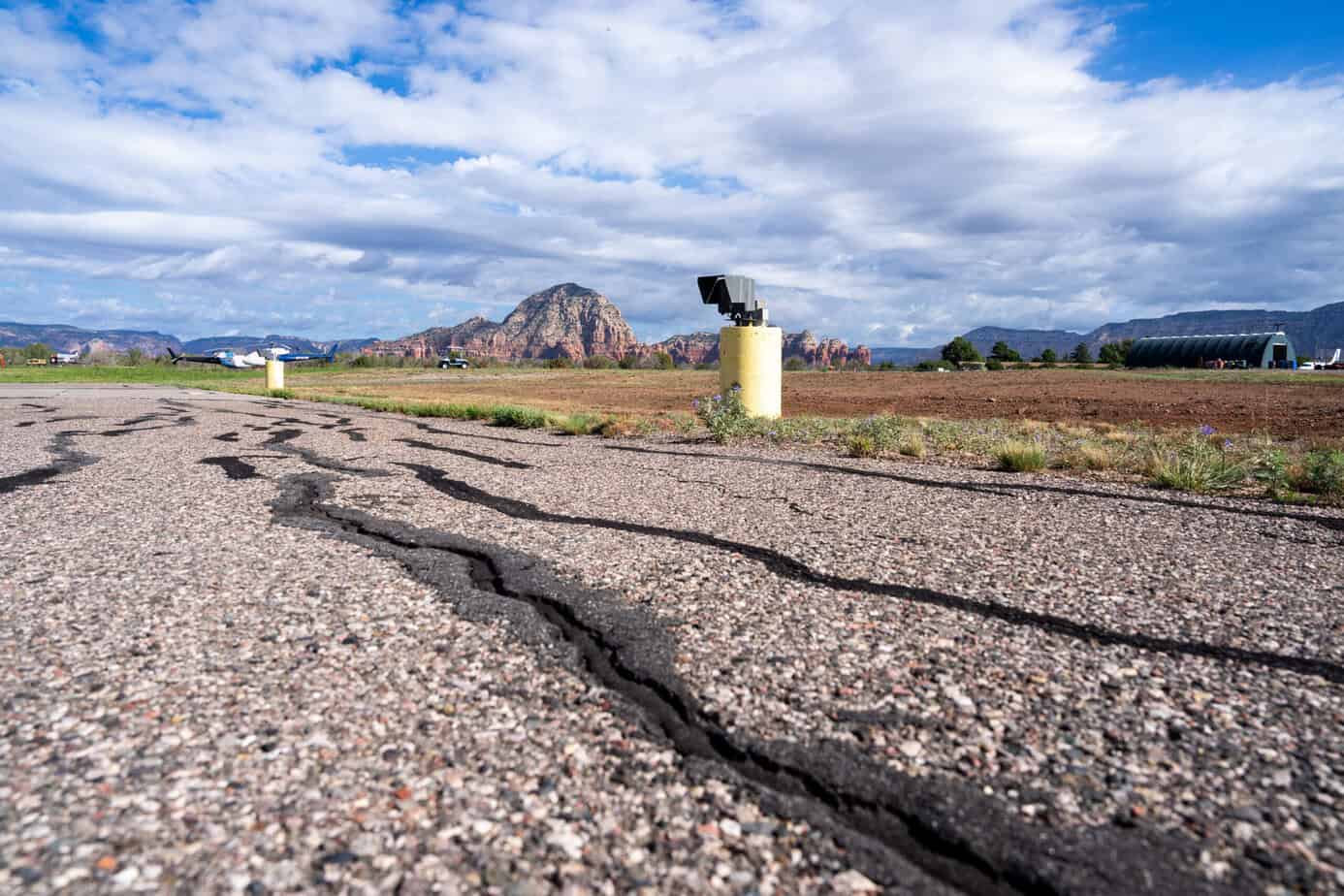
The Sedona Airport is set to receive $2,869,848 in repairs to its infield and $598,715 in repairs to the 4,400-square-yard Helicopter Six-Pack Parking Apron.
The Yavapai County Board of Supervisors unanimous approved funding — mainly from the Federal Aviation Administration — during the Aug. 19 meeting and was set to approve J. Banicki Construction and Dibble Engineering as two contractors for the infield during the Wednesday, Sept. 2, meeting, after print deadline.
The board accepted the $2,726,356 Infrastructure Investment and Jobs Act Airport Infrastructure Grant from the FAA, and $568,779 from that grant for the helicopter-six pack — both allotments that will cover 95% of the costs of their respective projects.
“No. 1, it improves the safety of the Sedona Airport, and when safety is improved, then the users tend not to be scared off,” Airport General Manager Ed Rose said. “So we’ll have more visitors to pay attention to businesses in town.”
Rose said that he is hopeful both projects will get started before the end of the year, “if not then there’ll be a spring startup,” and that he did not have an estimated start and end date of construction for the projects.
“The rehabilitation of the six-pack will close the six positions on the helicopter six-pack, but we’ll have what we refer to as our ‘heavy-heli’ still available and, of course most of our west ramp will be available if needed for rotor activity,” Rose said. “The same contractor is working on the infield drainage, so there’s some efficiency with that. The infield drainage will require some runway closures … 6 p.m. to 6 a.m. until the project is complete, so as to provide minimal disruption to our traffic.”
Helicopter tour operators occasionally park on the six-pack and they will be deposited to the southwest end of the airport’s west ramp.
The heavy-hellipad will be saved for medical or firefighting crews.
Rose said that he also anticipates minimal disruptions to the neighborhoods below Airport Mesa because the construction is taking place at night.
“The infields at Sedona Airport are currently depressed, and drainage is conveyed through a series of culverts beneath each connector taxiway,” the board packet reads. “Over time, erosion has resulted in significant rutting, slope failures,and ponding. The existing infield conditions also no longer comply with FAA criteria for slopes and grading within the Runway Safety Area, creating significant safety concerns.”
The pavement on the six-pack has been held together for three years with mastic, a crack sealer containing a fibrous additive. The material has kept the surface intact, Rose said, but “it’s not self-healing,” and it continues to ravel.
Rose, the airport manager since 2020, said that repairing the infield drainage has remained a major priority for him.
“It’s a safety hazard, and somebody’s going to get seriously hurt, or there’s going to be a fatality there,” he said. “So I brought [the Arizona Department of Transportation] and FAA up here to get their eyeballs on it instead of just looking at a piece of paper with numbers, and got them to realize that this is an issue, that it’s within the runway safety area and it needs to be addressed, and they need to find a way to fund it. And they have. This is the third attempt. The first two times, the bids outstripped the dollars available, so we weren’t able to execute the project.”
Additional drainage improvements Rose said he anticipates will be tackled in the future on the southernmost infield island as part of the larger Runway Safety Area improvements that includes an extension of the taxiway, but “I don’t have any numbers yet, because that’s has just gone through preliminary community engagement,” Rose said.
“The process is to get the environmental assessment into our five-year capital program, and then start phasing some of the improvements that were spelled out in the focus planning study, like the taxiway extension, like modifications to our safety area, including an engineered material arresting system on that end of the runway,” Rose said.