

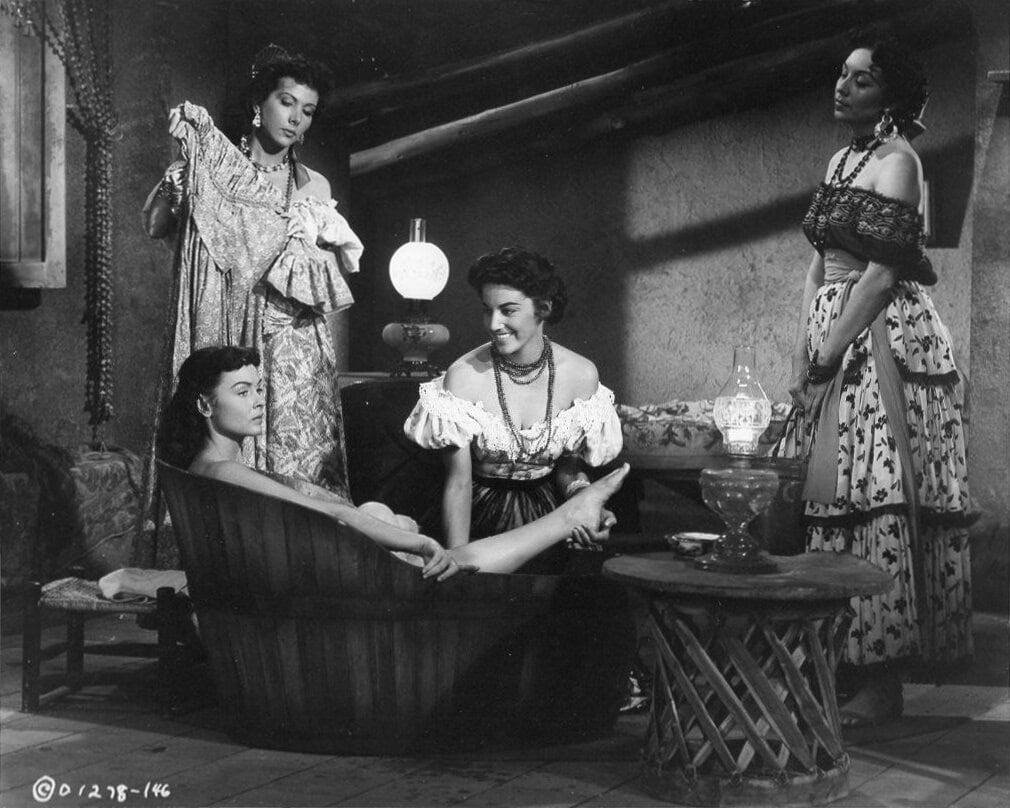
Howdy partner, saddle up and mosey on over to the Mary D. Fisher Theatre at 3 p.m. on Saturday, July 25. It’s time to pony up $20 to celebrate National Day of the Cowboy with the Sedona Heritage Museum’s screening of the 1953 western “Gun Fury,” complete with historians John Conway and Clancy Sage sharing stories about the Rock Hudson movie filmed in Sedona.
“The stunning natural settings and brisk pacing are major assets but the real draw here is the ensemble cast which includes two of the screen’s greatest heavies as sidekicks of the disreputable Slayton, Lee Marvin is Blinky and Neville Brand is Brazos,” Turner Classic Movie’s description reads. “Both actors make the most of their minor roles but Marvin has the edge, particularly in a sequence where he tries to put the moves on Slayton’s wildcat Mexican mistress Estella [Roberta Haynes] and she knocks him senseless. Nobody, however, matches Phil Carey for on-screen villainy in this film; he chews up the scenery with gusto as the wicked amoral Slayton. Yet, despite the over-the-top nature of the performances — particularly Rock Hudson’s pacifist turned bloodthirsty avenger — there is genuine tension generated throughout, particularly in regards to Donna Reed’s victimized heroine.”
“It’s fitting for our community, that had so many cowboys in the cattle industry that pastured their cattle in Grasshopper Flat, aka West Sedona, and Big Park, aka the Village of Oak Creek, and ran them up to the rim in the summer,” SHM Executive Director Nate Meyers said. “Then with all the westerns that were shot in Sedona, it just makes sense to celebrate it this way.”
In the early ’50s, movie studios were losing revenue to television because it was free at home versus paying for a ticket at a theater. According to research from the University of Dayton, weekly movie attendance plummeted from a peak of 90 million in 1946 to roughly 46 million by the mid-1950s.
One attempt to lasso audiences back into their seats was the craze of 3D movies in the 1950s, that “Gun Fury,” was apart of with several action shots, such as a rattlesnake lunging at the camera as well as Sedona’s scenery — although this screening will not be in 3D.
“‘Gun Fury’ was filmed in Technicolor with a huge and unwieldy dual-camera 3-D unit of Columbia’s own design, and it was the third stereoscopic western released by the studio in 1953,” Joe McNeill’s book “Arizona’s Little Hollywood” reads. “Raoul Walsh was hired to direct ‘Gun Fury’ and at first glance seems an odd choice for a stereoscopic movie, considering that he only had one eye, which made it impossible for him to see a 3D effect. De Toth, who directed ‘House of Wax’, also had just one eye; when Time magazine asked him to comment on his ability … to direct in the third dimension, De Toth testily replied, ‘Beethoven couldn’t hear music either, could he?'”
Filming started in Sedona on Monday, May 25, 1953, and most of the shooting was done over 19 days, with Hudson extensively journaling the production, which was shot locally from Grasshopper Flat, Oak Creek Canyon, Red Rock Crossing, Courthouse Butte, Bell Rock and more.
“You’ll learn something, you’ll enjoy a great film, you’ll enjoy the scenery of Sedona with all of the proceeds benefitting the Sedona Heritage Museum,” Meyers said.
Visit sedonafilmfestival.com for tickets, or call the Sedona International Film Festival at 928-282-1177. The office and theater are located at 2030 SR 89A in West Sedona.


