














Budget, spending and ‘home rule’ divide hopefuls
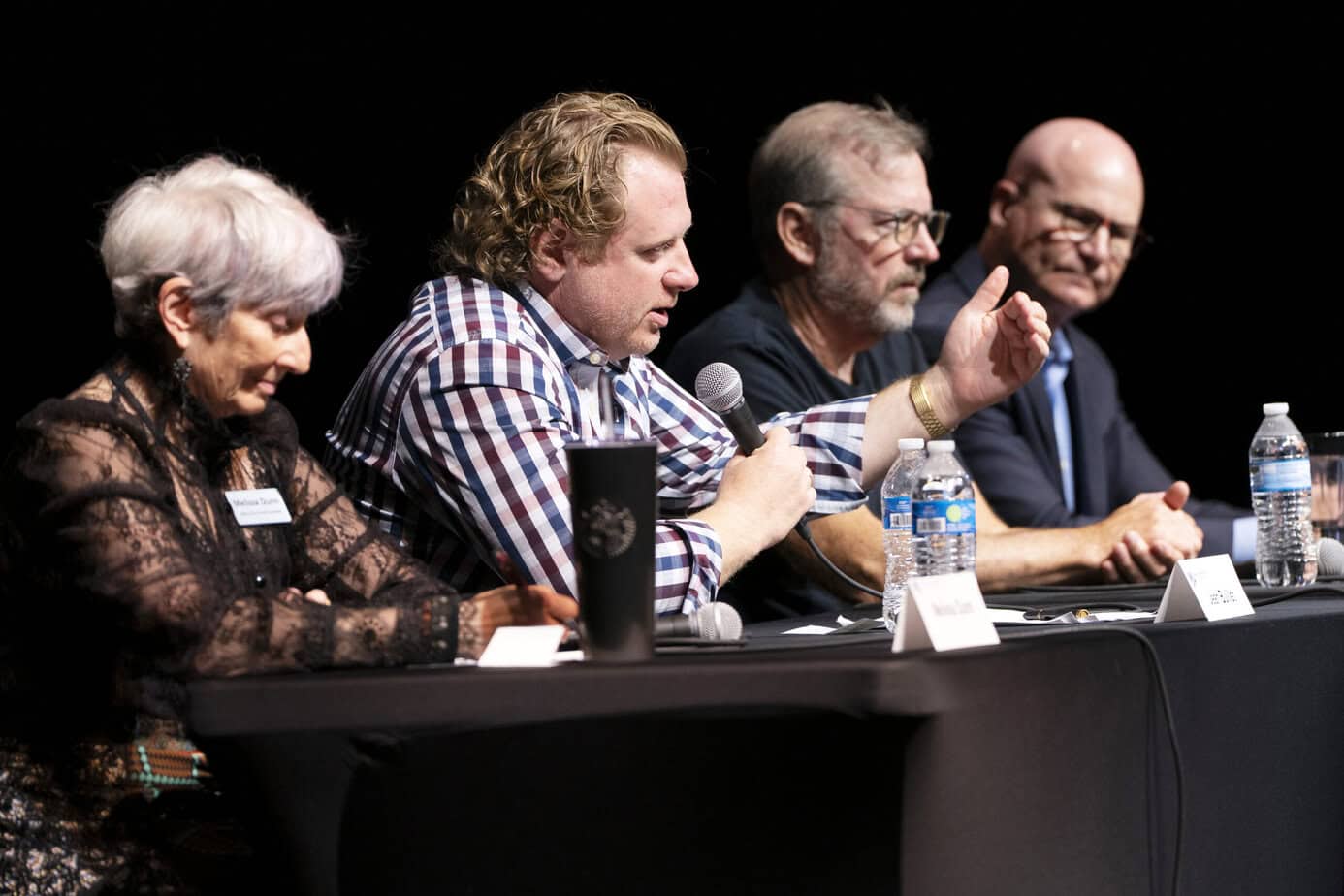
Newcomers Jean Christophe Buillet, Rich Gay and Tony Hauserman and incumbent City Councilwoman Melissa Dunn, made their pitch to voters at the League of Women Voter’s forum at the Sedona Performing Arts Center on June 11. Candidate Lita Loesch Boyd did not attend because of a family emergency.
The four fielded questions on “home rule,” city spending and traffic as they laid out why they should fill the three Sedona City Council seats that will be decided in the Tuesday, July 21, primary election.
“I acted on this stage,” said Buillet, a 1999 Sedona Red Rock High School graduate. “Today, I’m a dad raising my four kids in the same community.”
“For the past two years, I was in the city budget work group, and what I saw was very concerning,” Buillet said. “There were very poorly structured budget proposals, spending decisions that were driven a lot by ideology more than sound planning and the city government that lacks vision and project management discipline.”
“Over the past four years, we’ve made real progress,” said Dunn, who is seeking her second term. “We strengthened our quality of life, improved our community health, and managed the pressures of high tourism on a small town infrastructure.
“After four years, I understand how the city works and how state laws shape what we can and cannot do locally. That knowledge matters when the issues are complex and the stakes are high.”
“What motivated me to run is a simple belief that the people who live and work in this town every day deserve a stronger voice in the decisions that shape it,” Gay said. “I’ve watched too many important choices move forward with what feels like limited real input from residents.”
“My commitment to this community didn’t just start when I was deciding to run for this office,” said Hauserman, who is a police department volunteer, Rotarian, former PTA president at West Sedona School, served on the wastewater treatment and effluent committee, is a current member of the Uptown Parking Committee and is head coach of SRRHS football program. “My commitment to this community has been going on for 26 years, and I would be honored to take the next steps and represent you as a city councilor.”
‘Home Rule’
Like their mayoral counterparts, the council candidates are split in their positions on the Alternative Expenditure Limitation, commonly called “home rule,” a ballot measure voters will decide on to set the city’s spending limit. Dunn and Hauserman have voiced their unequivocal support for Proposition 400 while Gay and Buillet have deferred to the will of the voters on the July 21 primary election ballot measure.
“I’m absolutely positively in favor of voting ‘yes,'” Hauserman said. “Even if you don’t vote for me to put me in office, I still want you to vote ‘yes’ on the home rule. … It’s our money, it’s not fiscal responsibility to vote ‘no’ on home rule, it’s fiscal self-sabotage.”
However, if “home rule” failed, the city would continue to collect taxes but be unable to spend it. The city’s tentative budget for the new fiscal year is about $98 million. If home rule fails, the city could fall to the state-set limit, with a maximum budget of about $31.7 million. That number comes once debt payments, grants and passthrough funds are added back onto a lower limit of about $15.4 million.
Sedona voters historically pass the measure every four years.
Buillet argued that if home rule failed, the effect would be less severe than those numbers suggest. Because investment income is allowable over the spending limit, he said, reallocating city investments toward higher yields could bring the city to about $29 million, which he described as roughly 10% under “where we are now,” with cuts that “would not be that disastrous.”
One option Buillet put forth was moving some city reserves into an employee benefit and pension trust, which he said could earn higher returns and help fund pension liabilities “instead of just having to pull it always from revenues and general funds.”
“The city has already fully funded the Public Safety Personnel Retirement System,” Deputy City Manager Barbara Whitehorn wrote to the NEWS. “The funding status is over 100%, with a net pension asset of $1,609,332 as of June 30, 2025. Since the pension is already fully funded, there is nothing to be gained by allocating additional funds.”
Budget
Buillet cited his budget group experience as one of his major qualifications and where he sees a need for greater fiscal accountability.
“I’m an accountant,” he said. “When I was looking over the budget this year, I looked at the audit reports that came back, and there was $4 million missing between schedules and what was on the general ledger.”
However, council received a clean audit during its March 10 meeting with a presentation from Whitehorn, Clifton Larson Allen LLP signing director Jean Marie Dietrich and city accounting manager Renée Stanley.
“I don’t believe the city has misappropriated funds or that there’s any impropriety,” Buillet later said. “When you look at the schedules in the audit, the schedules that map out the master balance sheet don’t match,” he said.
“Finance staff and I have rereviewed the financial statements in their entirety and have not found any errors,” Deputy City Manager Barbara Whitehorn wrote to the NEWS. “I asked two people asserting that there is a $4M error to please show me the error or tell me which schedule contained an error, but neither did so.”
A campaign pledge of Gay, Buillet and mayoral candidate Henry Silbiger during the forum was to send capital projects over $5 million for voter approval.
“We’ve got to get control of this capital spending and stop doing many projects, slow it down and make sure that we really have citizen engagement,” Gay said.
Gay called for reviving Sedona’s citizen commissions, arguing residents need a structured way to weigh in before decisions are made.
“These commissions used to exist in Sedona, providing value input on everything, the planning, the transportation budget … and reestablishing that would give residents a structured, meaningful way to contribute,” he said. “The commissions would report to the council, not to city staff.”
Dunn has made transparency a centerpiece of her pitch, stating “trust is built through clarity,” and pointing to her own outreach with meet-and-greets at Community Library Sedona twice a week for two years, though “very few people ever came.”
However on wildfire evacuations, “we have a plan, we have an evacuation manager,” Dunn said, referring to Chance Wnuck, who became the city’s first emergency manager on Nov. 17. “He’s going to be presenting to council, probably next month, what his plans are. There are a lot of times we can’t actually show you plans because you don’t want bad actors to know what your evacuation plans are, either. So, sometimes the details that you might want, we’re not able to give you.”
“We’ve got to improve the evacuation communication, and frankly, I find it very difficult to understand … why do we think we can’t communicate to residents about an evacuation plan, because we need to keep it a secret,” Gay said. “That’s just kind of weird. We need to change that.”
Lita Loesch Boyd
Boyd did not attend because of a family emergency. Event moderator Mary Chicoine read a short biography and a statement from Boyd, a founder of the Verde Valley Regional Economic Organization and the Planning Consortium.
“When I moved here in 2003, I couldn’t find a home I could afford in town, so I bought in Cottonwood and commuted to Sedona for a decade to build my business from the ground up,” Boyd wrote. “Over the last four years, I’ve watched our small town character sidelined.
“I will audit our city budget to rein in waste spending … accelerate our wildfire safety initiatives and prioritize traffic strategies that actually provide relief and just not more roundabouts.”