














City considers median barrier, crossing signals for temporary closures
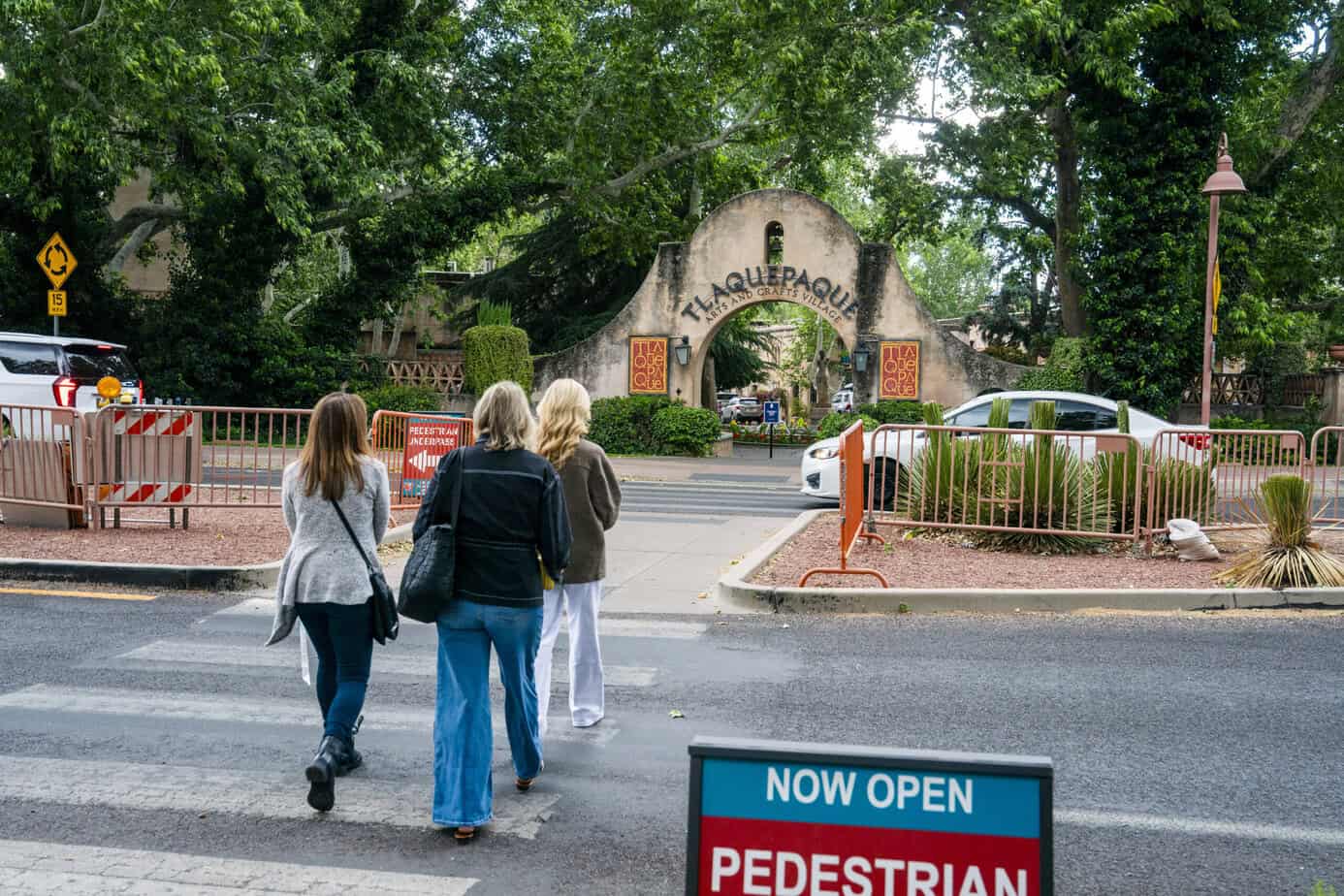
A draft warrant analysis submitted by the city of Sedona to the Arizona Department of Transportation last summer could determine the future of the pedestrian crosswalk into Tlaquepaque.
However, 18 months after the State Route 179 Pedestrian Crossing at Oak Creek opened, the city says it has no intention of closing the crossing permanently, even as it has been gating it off when vehicular traffic slows to a crawl.
“For the Tlaquepaque Crossing, the city does not envision a permanent closure of that crossing — in no way, shape or form — for a couple of reasons,” Sedona Engineering Supervisor Jon Ebers said. “One is because it’s unnecessary to keep it closed. There’s value in having it open, particularly when traffic is light; and two, if our only crossing there is at the underpass, if there is a flash flood or repairs to the underpass, we need another crossing option.”
Sedona Public Works Director Kurt Harris reiterated that point, adding the city’s position is that there are only a few times a week they feel it warrants closing the pedestrian crosswalk.
“The concern was … ‘why do you have an at-grade crossing, and now you have an underpass, you should close the at-grade crossing?’ Harris said. “Well, that’s not feasible, because there’s only a few times in the week that you actually need to close it because of traffic.”
The city’s current policy is that once the travel time hits 18 minutes on Google Maps from the Village of Oak Creek to the ‘Y’ roundabout where State Routes 179 and 89A merge, the city will intervene and close the crosswalk with moveable gates and redirect pedestrians to the underpass.
The ADOT permit, which the city received to build the pedestrian underpass, required that “the at-grade crosswalk located on SR 179 between Portal Lane and Schnebly Hill Road will remain until such time as a pedestrian crosswalk warrant analysis is performed by the city. … If ADOT determines that the crossing is not warranted, the city shall remove the at-grade crosswalk.”
If ADOT determines the crosswalk is required, the city would then be required to conduct a study on whether an electronic pedestrian signal should be added.
“We’re working on a permanent barrier in that area right now for the median, which will replace that temporary barrier,” Deputy City Manager Andy Dickey said at an April meeting. “But also with that, we need to do some analysis on what to do for more of a secure system for closing the crosswalk. What that means is it could be an automated system of some kind — could even include some level of traffic control signal system.”
Currently there is not a timeline for completing the consensus plan that will be the governing document for the crosswalk between the city, ADOT and Tlaquepaque.
“I’d love to be there in the next six months with some real, clear goals and milestones for” all three parties, Ebers said.